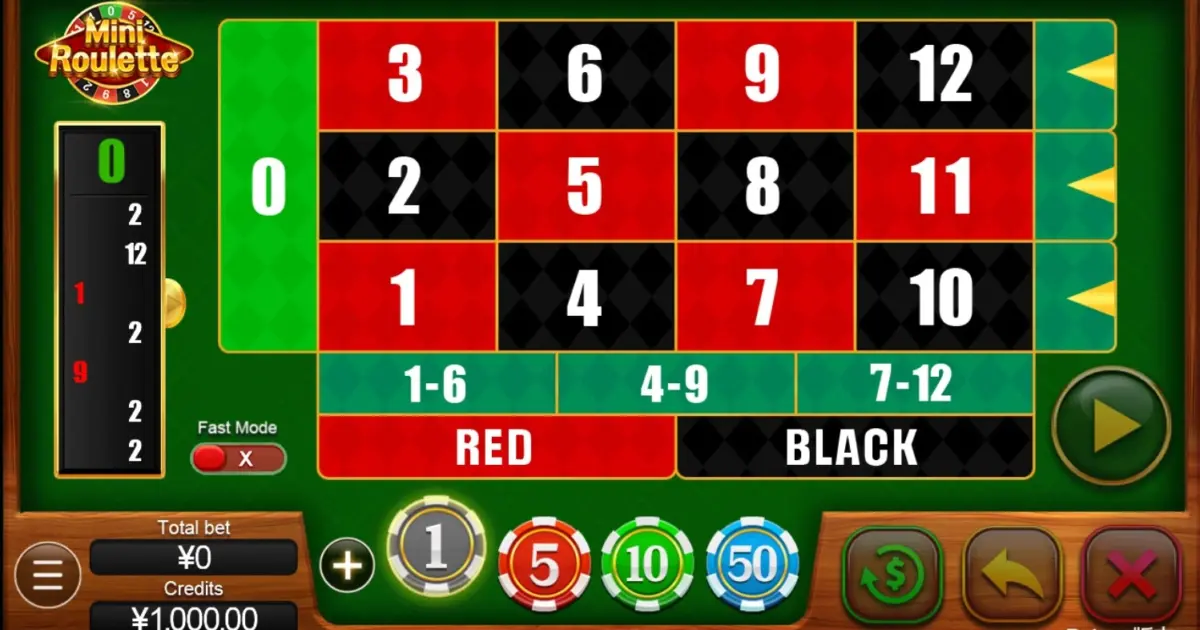
Mini Roulette (CQ9Gaming) is not your standard 37-pocket European wheel or 38-pocket American layout. It uses a shortened wheel — typically 13 pockets — which fundamentally alters the mathematics behind every bet. If you are deciding whether this compact format deserves your time, the short answer is that it depends on what you want: faster rounds and simpler bet selection, or the lowest possible house edge. This review breaks down what the smaller wheel actually costs you and where the free demo fits in.
Mini Roulette (CQ9Gaming) at a glance
CQ9 Gaming is the provider behind this title, and it sits in the roulette subcategory of their portfolio. The game is available as a free demo, so you can evaluate the interface, bet range, and pacing without committing real money. No download is required to access the demo version — it runs directly in your browser on most devices. The title ranks around the middle of the popularity range for roulette games on this site, which suggests it attracts a niche audience rather than mainstream traffic. If you enjoy compact table formats and want something that loads quickly with fewer decisions per round, Mini Roulette (CQ9Gaming) fits that profile. For comparison, standard European wheels from providers like European Roulette (Red Tiger) or French Roulette (NetEnt) carry a 97.3% RTP — numbers you can use as a benchmark when evaluating this game’s own paytable.
Which wheel is this, and what it costs you
The name “Mini” strongly points to a shortened wheel, typically containing 13 pockets rather than the 37 of a European single-zero or the 38 of an American double-zero table. A smaller pocket set changes the true odds on every bet type. On a standard single-zero wheel, a straight-up bet pays 35:1 against true odds of 36:1, and that one-pocket gap is the entire 2.70% house edge. On a 13-pocket wheel, the true odds of hitting a single number shift to 12:1, and whether the payout adjusts to maintain or widen the house edge depends entirely on the game’s own paytable.
Here is the critical point: the variant name alone does not tell you the house edge. Mini roulette formats vary — some pay 11:1 on a straight-up hit (matching true odds, which would eliminate the edge on that bet), while others pay less and build in a house advantage. You must open the rules screen inside Mini Roulette (CQ9Gaming) and check the payouts before placing any real-money wager. A standard single-zero wheel carries a house edge of 2.70% across all standard bets. American wheels cost you 5.26% on every bet except the five-number basket, which jumps to 7.89%. French rules with La Partage return half your even-money stake when zero lands, cutting that bet’s house edge to approximately 1.35%. Where Mini Roulette (CQ9Gaming) falls in that spectrum is something only the in-game paytable can confirm.
What a % RTP means per spin
The exact RTP figure for Mini Roulette (CQ9Gaming) is not listed in the data available for this review. RTP — return to player — represents the theoretical percentage of all wagered money a game pays back over an enormous number of spins. A 97% RTP means that for every $100 wagered across millions of rounds, the game returns $97 on average, keeping $3 as the house edge. This is not a promise for any individual session. Over 100 spins at $1 per bet, you are wagering $100 total. At a 97% RTP, the expected return is $97 — a $3 loss on average. But variance means your actual result could be a $50 profit or a $100 loss on that same sample. The fewer pockets a wheel has, the more each individual outcome can swing your session results. Check the game’s help or info screen for the published RTP before you play. If the figure is not displayed, that itself is a reason to treat the game cautiously — transparency about RTP is a baseline expectation from any reputable provider.
Inside versus outside bets
Inside bets target specific numbers or small groups, offering higher payouts at lower hit frequency. Outside bets cover broader categories — red/black, odd/even, high/low — with lower payouts but more frequent wins. The fundamental rule of roulette is that neither category offers better expected value: the house edge applies uniformly across standard bets. What changes is variance. A straight-up bet delivers wild swings; an even-money bet delivers a smoother ride with smaller peaks and troughs.
The table below shows the standard payouts and true odds for a 13-pocket mini roulette wheel. Confirm these against the actual paytable in Mini Roulette (CQ9Gaming), as the provider may adjust payouts from the theoretical figures.
| Bet Type | Payout | True Odds (13 pockets) | Notes |
|---|---|---|---|
| Straight up (1 number) | Varies — check paytable | 12:1 | Payout may differ from standard roulette |
| Split (2 numbers) | Varies — check paytable | 5.5:1 | Adjacent pair on the layout |
| Street (3 numbers) | Varies — check paytable | 3.33:1 | Row of three numbers |
| Corner (4 numbers) | Varies — check paytable | 2.25:1 | Square of four numbers |
| Six Line (6 numbers) | Varies — check paytable | 1.17:1 | Two adjacent rows |
| Red/Black, Odd/Even, High/Low | 1:1 | 12:13 | Even-money bets; zero typically loses |
| Dozen or Column (12 numbers) | 2:1 | 1:12 | Covers 12 of 13 pockets |
The gap between payout and true odds on each row is where the house edge lives. On a 13-pocket wheel, if a straight-up bet pays 12:1, the edge on that bet would be zero — which no casino offers. Expect the actual payout to be lower, creating the house advantage.
Why no betting system changes the maths
You will encounter Martingale, Fibonacci, D’Alembert, and dozens of other progression systems that claim to beat roulette. None of them work. Every spin on Mini Roulette (CQ9Gaming) is independent — the wheel has no memory of previous results. Martingale doubles your bet after each loss, aiming to recover everything on the next win. The problem is real and mathematical: a losing streak of seven or eight on even-money bets is not rare, and the required bet size quickly hits the table limit or exhausts your bankroll. The expected value per spin does not change regardless of how you sequence your bets.
Progression systems redistribute variance. They produce more small wins and fewer catastrophic losses — until the catastrophic loss arrives, and it wipes out every small win plus your original bankroll. D’Alembert increases bets by one unit after a loss and decreases by one after a win, which slows the bleeding but does not stop it. Fibonacci follows the famous number sequence, which only means your bets grow in a mathematically elegant way toward the same negative expected value. No system changes the fact that the house edge is baked into the payout structure. The only reliable strategy is to set a budget, decide your session length, and stop when either limit is reached.
Playing the Mini Roulette (CQ9Gaming) demo
The free demo of Mini Roulette (CQ9Gaming) is available without download, letting you explore the interface, test bet sizes, and get a feel for the wheel’s pace before risking real money. Demo play is genuinely useful for one purpose: understanding the game’s mechanics, payout table, and betting layout. It does not predict real-money results. An RNG-powered wheel produces independent outcomes every time, and a winning streak in demo mode carries zero statistical significance for your next session with real stakes.
If you choose to play with real money, set a firm budget before you start and treat every spin as entertainment, not income. Never chase losses, never borrow to play, and never wager more than you can afford to lose. Roulette is a game with a built-in mathematical advantage for the house — over time, the casino always wins. Play within your means, stick to your limits, and stop the moment it stops being fun. You must be 18 or older to play.
Verdict
Mini Roulette (CQ9Gaming) offers a stripped-down alternative to standard European or French tables. The smaller wheel changes the odds in ways that are not immediately obvious without checking the paytable — and that is exactly what you should do before betting real money. The game is worth trying in demo if you are curious about how a shortened wheel feels in practice, but it should not be your default choice if house edge is your primary concern. Standard single-zero wheels carry a 2.70% edge, and French roulette with La Partage drops even-money bets to roughly 1.35%. Unless Mini Roulette (CQ9Gaming)’s paytable reveals a competitive edge — which you can only confirm in-game — the classic formats remain the mathematically superior choice for long-term play. For a broader comparison, European Roulette Pro offers the familiar 37-pocket layout with a known 97.3% RTP, making it a reliable benchmark against which to measure any mini format.
Frequently Asked Questions
Can I play Mini Roulette (CQ9Gaming) for free without downloading anything?
Yes. The free demo of Mini Roulette (CQ9Gaming) is available directly in your browser with no download required. It lets you explore the betting layout, check the paytable, and understand the wheel's pace before committing real money.
What is the RTP of Mini Roulette (CQ9Gaming)?
The exact RTP figure is not listed in the available data for this game. RTP represents the theoretical percentage returned to players over millions of spins. You should check the game's help or info screen for the published RTP before wagering real money.
Is Mini Roulette (CQ9Gaming) better than European roulette?
That depends on the house edge, which you must confirm in the game's paytable. A standard European single-zero wheel carries a 2.70% house edge. Mini roulette uses a 13-pocket wheel that changes the true odds on every bet — whether the payouts adjust to give you a better or worse edge is specific to this game.
Can a betting system help me win at Mini Roulette (CQ9Gaming)?
No. No betting system — Martingale, Fibonacci, D'Alembert, or any other progression — changes the expected value of a spin. Spins are independent and the wheel has no memory. Progressions redistribute variance but accelerate the risk of hitting table limits or exhausting your bankroll.
How does Mini Roulette (CQ9Gaming) compare to French Roulette by NetEnt?
French Roulette by NetEnt uses a standard 37-pocket European wheel with a 97.3% RTP and La Partage rules that cut even-money bet house edges to roughly 1.35%. Mini Roulette (CQ9Gaming) uses a shortened wheel with different odds — compare the paytables to determine which offers better value for your play style.




