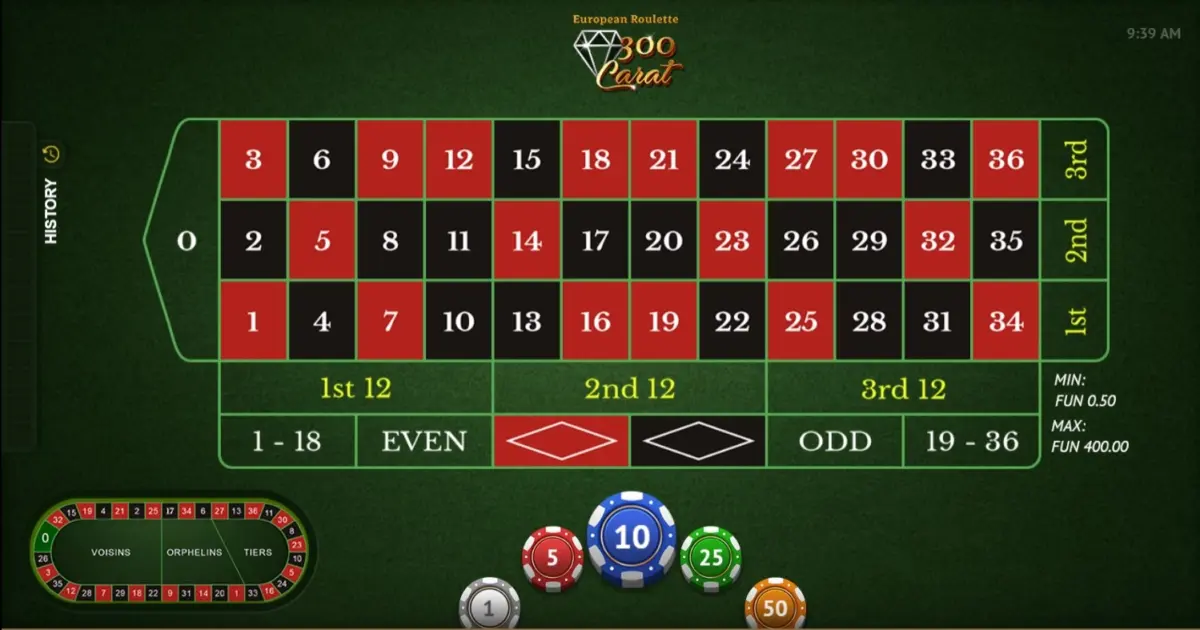
The one number worth starting with on 300 carat roulette is the published RTP: 97.3%. That is the same figure a standard single-zero wheel produces, and it sits slightly above the 96.97% average across the roulette tables in our database. A free demo is available, which is the sensible place to confirm the details the listing does not give you.
Those missing details matter more here than the headline number does. The FACTS for this table do not state the pocket count, whether French rules apply, what the table limits are, or whether a racetrack for call bets exists. Everything below separates what is confirmed from what you need to read off the game’s own rules screen.
What kind of roulette is 300 Carat Roulette?
Confirmed: it is a roulette title from Leap Gaming, categorised as roulette, with a demo mode and an RTP of 97.3%. There is no variant hint in the data — nothing in the name says European, American, French or Lightning. So the wheel type is genuinely unknown from the listing alone.
That is not a small gap. Wheel type is the single most important thing about any roulette table, because it fixes the house edge before you place a chip. A single-zero wheel has 37 pockets and a 2.70% house edge on every standard bet. A double-zero wheel has 38 pockets, a 5.26% edge on standard bets, and 7.89% on the five-number basket bet. Those two games look nearly identical on screen and cost roughly twice as much to play.
The 97.3% RTP is a strong indicator. 100% minus 2.70% is exactly 97.3%, which is the arithmetic signature of a single-zero wheel with no La Partage. A double-zero wheel would publish around 94.74%. But an RTP figure is not a rules statement, and the theme name gives no confirmation, so treat the single-zero read as very likely rather than settled. Count the pockets in the demo. It takes ten seconds and removes all doubt.
Return to player and house edge
The published return to player is 97.3%. Over a long enough run of spins the game returns 97.3 units for every 100 staked, and keeps 2.7. In roulette that figure is not a modelled estimate the way it is in slots — it falls directly out of the wheel’s geometry and the paytable, so it is unusually trustworthy as long as the wheel and paytable are what you think they are.
Against the corpus average of 96.97% for roulette tables in our database, 300 Carat Roulette sits 0.33 points ahead. That gap is real but modest. It means about 33p less expected cost per £100 staked than the average table on our list, which is worth having and is not worth travelling for.
The important comparison is the one the data cannot make for you. If this table runs French rules — La Partage or En Prison, where zero returns half your even-money stake — the even-money house edge would drop to roughly 1.35% and the effective return on red, black, odd, even, high and low would be near 98.65%. Nothing in the FACTS says French rules apply, and a headline RTP of 97.3% suggests they do not, since a La Partage table usually advertises the higher even-money figure. Check the rules screen. If half-back on zero is there, even-money bets become the best value on the table by a wide margin.
Reading the Leap Gaming paytable before you bet
Leap Gaming has one roulette title in our database, so there is no house style to generalise from. That makes reading the paytable directly more important, not less.
Three things to look for. First, the straight-up payout. Classic roulette pays 35:1 on a single number. If the game pays less than that — and multiplier formats routinely do, funding their big multipliers by trimming the base payout to 29:1 or similar — then the straight-up return is not the 97.3% headline and has to be read from the paytable itself. Nothing in the FACTS indicates any multiplier mechanic on this table, but nothing rules one out either.
Second, the zero rule on even-money bets: full loss, half back, or imprisoned. Third, the table limits, which are not listed here. Limits decide how long a session can run at a given stake and cap any progression long before it becomes safe.
If you want a table where these details are already well documented, European Roulette Pro publishes the same 97.3% and follows the standard single-zero layout, and French Roulette (NetEnt) is the one to look at if half-back on zero is what you actually want.
Bet coverage, variance and session length
Every standard bet on a single-zero wheel carries the same 2.70% edge. What changes is variance: how fast your balance moves and how long a fixed budget lasts. The table below assumes 37 pockets, which is the likely configuration given the RTP.
| Bet type | Pays | True odds (37 pockets) | Win chance |
|---|---|---|---|
| Straight up (1 number) | 35:1 | 36:1 | 2.70% |
| Split (2 numbers) | 17:1 | 17.5:1 | 5.41% |
| Corner (4 numbers) | 8:1 | 8.25:1 | 10.81% |
| Dozen / column (12) | 2:1 | 2.08:1 | 32.43% |
| Red / black / odd / even | 1:1 | 1.06:1 | 48.65% |
The straight-up row is the whole story of the house edge in one line: the wheel pays 35:1 against true odds of 36:1, and that one missing pocket is the 2.70%. Spreading chips across more numbers does not reduce it. Six chips on six numbers costs the same in expectation as six chips on one.
Practically: even-money bets win just under half the time and give the longest sessions per pound. Straight-up bets win about one spin in 37 and produce long dry runs punctuated by 36-unit returns. Pick based on how you want the session to feel, not on which bet you think is better value, because none of them is.
Patterns, hot numbers and the gambler’s fallacy
No betting system beats roulette. Martingale, Fibonacci, D’Alembert, waiting for five reds before backing black — every one of them has an expected value of exactly the house edge, because the edge is charged per spin and progressions only change how many chips ride on each spin.
The wheel has no memory. On an RNG table each spin is independent, so eight reds in a row tell you nothing about the ninth. Black is not owed. A number that has not landed in 200 spins is not due; its chance next spin is 1 in 37, the same as every other number. Displayed histories and hot-and-cold panels are decoration.
What progressions do change is risk shape. Martingale converts many small wins into an occasional catastrophic loss, and it fails against table limits: after seven straight losses at a £1 base you need £128 on the next spin, and most tables stop you before the sequence can complete. The maths does not break — you just run out of money or headroom first. If a system worked, roulette would not still be on the floor.
Trying the demo
The demo is available, and it is the right tool for a specific job: confirming the facts this listing leaves open. Load it and check the pocket count, the straight-up payout, the zero rule on even-money bets and the minimum and maximum stakes. Five minutes there tells you more than any review can.
What the demo cannot do is predict real-money outcomes. A demo run that goes well or badly is a short sample from a game with fixed maths, and 100 spins is nowhere near enough to reveal a 2.70% edge. Do not read a lucky demo session as a signal.
Roulette is entertainment, not income. Play only if you are 18 or over, set a budget in advance that you are comfortable losing entirely, and stop when you reach it rather than when you feel a run is about to turn. Expected loss on this table is roughly £2.70 per £100 staked, and staking is cumulative — a £1 bet repeated 300 times is £300 through the wheel.
Verdict on 300 Carat Roulette
A 97.3% RTP is a fair figure and 0.33 points better than the average roulette table in our database, which puts this one in reasonable company. The arithmetic points strongly to a 37-pocket wheel with a 2.70% edge, which is what most players want from a standard table.
The reservation is how much the listing leaves unstated: pocket count, zero rule, limits and whether call bets exist. None of those is likely to be a problem, but you should confirm them yourself rather than assume. If the rules screen shows 37 pockets and 35:1 straight up, this is a straightforward single-zero table at a competitive return. If you would rather start from a table whose rules are already documented, European Roulette (Red Tiger) offers the same 97.3% with no ambiguity about the wheel.
Frequently Asked Questions
Can I play 300 Carat Roulette free with no download?
Yes. A free demo is available for 300 Carat Roulette and runs in the browser, so no download is needed. The demo uses the same maths as the real-money version and is the fastest way to confirm the pocket count, straight-up payout and zero rule before you stake anything. Demo results do not predict real-money outcomes.
What is the 300 Carat Roulette RTP?
The published RTP is 97.3%, meaning the game returns 97.3 units per 100 staked over the long run and keeps 2.7. That sits 0.33 points above the 96.97% average across the roulette tables in our database. In roulette the RTP follows directly from the wheel and paytable rather than from modelling.
Which wheel does it use and what is the house edge?
The listing does not confirm the pocket count, so you should check the rules screen. The 97.3% RTP is exactly what a 37-pocket single-zero wheel produces at a 2.70% house edge, which makes that the likely setup. A 38-pocket double-zero wheel would publish about 94.74% and cost 5.26% instead.
Does any betting system work on this table?
No. Martingale, Fibonacci, D'Alembert and pattern-based approaches all carry the same expected value as flat betting, because the house edge is charged on every independent spin. Progressions only redistribute variance and run into table limits fast: seven losses at a £1 base already requires £128 on the next spin.
Who makes 300 Carat Roulette and how does it compare?
Leap Gaming, which has one roulette title in our database, so there is no wider provider pattern to judge it against. Its 97.3% RTP matches European Roulette Pro and European Roulette (Red Tiger) exactly. The difference is documentation: those tables state their wheel and rules clearly, while this listing leaves several details unconfirmed.




