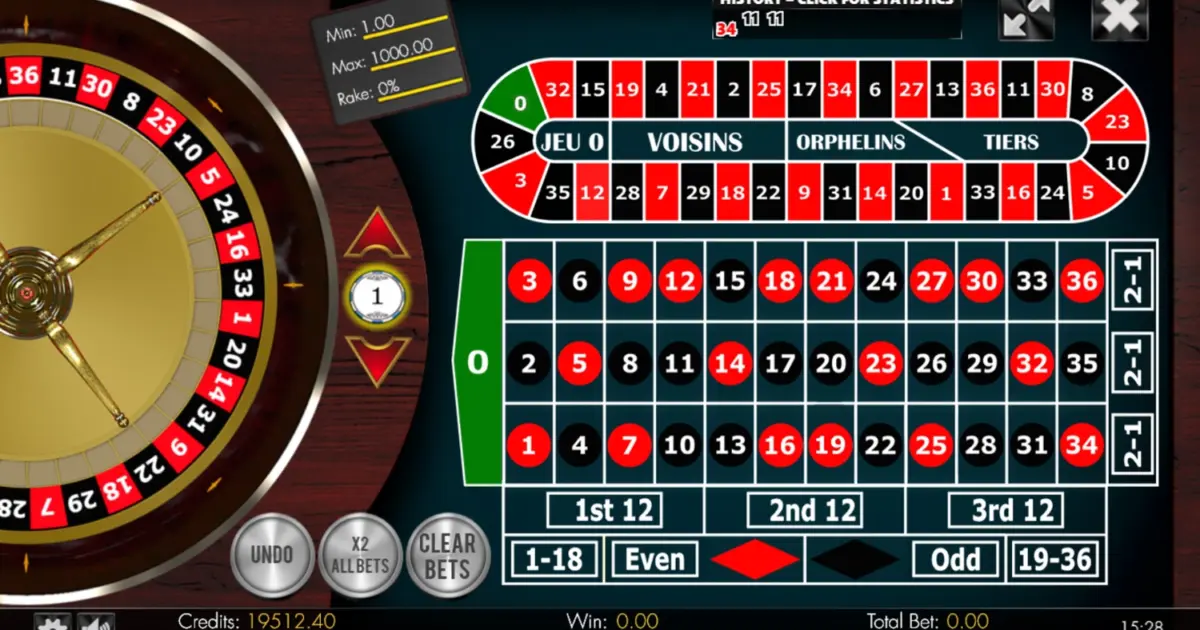
Is European Roulette 2D Advanced worth your time? On paper it points to the best standard roulette maths available — the single-zero European format with a 97.3% RTP — and it is available as a free demo with no download required for practice. The name is only a strong hint at the wheel type, so you should confirm the pocket count and rules on the game’s own help screen before playing for real money.
How European Roulette 2D Advanced plays
Casino Web Scripts lists European Roulette 2D Advanced as a roulette title with free demo available, which lets you spin without registering or risking funds. The FACTS block for this review does not include a detailed paytable, table limits, racetrack or call bets, chip denominations, or special features, so those specifics cannot be confirmed here and must be checked inside the game. What you can expect from any roulette table is the same core loop: you place chips on the layout covering numbers, colours and sections, the wheel spins, and payouts follow the paytable. Because this is presented as a 2D Advanced title, the interface is likely a top-down layout rather than a 3D wheel animation, but the visual presentation does not change the maths. Use demo mode to learn where inside and outside bets sit, how to clear and repeat bets, and how the history display behaves, since none of that is described in FACTS. If you want a near-identical alternative from the same provider, European Roulette 3D Advanced shares the same 97.3% RTP and European hint with a different presentation.
The pocket count is the whole story
In roulette the number of pockets decides the house edge, and the edge decides everything else. The title European Roulette 2D Advanced points to a European wheel, which normally means 37 pockets — numbers 1-36 plus a single zero — and a house edge of 2.70% on every standard bet. That must remain a strong hint rather than a confirmed fact, because FACTS does not explicitly state the pocket count, whether La Partage or En Prison applies, or the confirmed house edge for this table. If it is a standard European wheel, the maths is fixed: a straight-up pays 35:1 while true odds are 36:1, and that one-pocket gap is the house edge on every spin. For comparison, a double-zero American wheel has 38 pockets and a 5.26% edge on almost all bets, rising to 7.89% on the five-number basket, while French even-money rules that return half on zero cut the edge to about 1.35% on red/black, odd/even and high/low. No layout choice changes this. Confirm the zero count and any French rule in the game’s rules screen, because a single line there outweighs everything implied by the name.
| Bet type | Pays | True odds (European 37 pockets) | House edge if European |
|---|---|---|---|
| Straight-up (single number) | 35:1 | 36:1 | 2.70% |
| Split (2 numbers) | 17:1 | 17.5:1 | 2.70% |
| Street (3 numbers) | 11:1 | 11.33:1 | 2.70% |
| Corner (4 numbers) | 8:1 | 8.25:1 | 2.70% |
| Red / Black, Odd / Even, High / Low | 1:1 | 1.055:1 | 2.70% (1.35% with La Partage) |
| Dozens / Columns (12 numbers) | 2:1 | 2.08:1 | 2.70% |
Reading the 97.3% figure
The listed RTP for this table is 97.3%, which corresponds to a house edge of 2.70% if it applies to all standard bets on a single-zero wheel. That alignment is exactly what you would expect from a classic European game, and it sits slightly above the corpus average RTP of 96.97% and above the provider average of 96.45% for Casino Web Scripts across nine games. RTP is a long-run theoretical average over millions of spins, not a promise for a single session. In a short demo you can easily run above or below 97.3% because variance dominates. What RTP tells you is comparative value: on a confirmed 97.3% European table you lose on average 2.70 units per 100 wagered over time, while an American 94.74% table loses 5.26 per 100. Multiplier or Lightning-style formats fund their big multipliers by cutting the base straight-up payout to less than 35:1, so their effective straight-up RTP is lower and must be read from that game’s paytable. For this table no alternative payout or multiplier structure is listed in FACTS, so there is no reason to assume a reduced base payout, but you should still verify the paytable shows 35:1 for a straight-up before assuming classic returns.
Choosing bets for the session you want
Inside versus outside bets do not change expected value on a standard wheel — they reshape variance. A straight-up covering one number wins rarely at 35:1, so your bankroll swings hard and you need many losing spins to fund one hit. An even-money bet covering 18 numbers wins almost half the time at 1:1, so results hug the average more closely and sessions last longer on the same stake. Dozens and columns sit in the middle at 2:1. None of these is “better value” if the wheel is standard European; the house edge is the same 2.70% on each. Choose by goal. If you want time on the table and steady turnover for learning the layout, outside bets and small dozen bets smooth the ride. If you want a volatile hunt for a big hit and accept long dry spells, straight-ups and splits deliver it. Combining bets — for example covering a favourite number plus its neighbours and a broader outside bet — does not create a hedge that erases the edge; it just blends volatilities into a weighted average. Check the limits screen before mixing, because table minimums and maximums cap how much ground you can cover, and that information is not in FACTS for this table. A useful contrast from the same studio is French Roulette 3D Advanced, which lists 98.65% RTP and, where La Partage is active, offers about 1.35% edge on even-money bets.
Martingale and friends: the honest answer
No system changes the house edge, and that includes Martingale, Fibonacci, D’Alembert, Labouchere, and any “wait for five reds then bet black” pattern. Spins are independent; the wheel has no memory, so after four reds the chance of red on the next spin is the same as always. On a single-zero wheel that is 18 in 37 for red, not 50%, and the zero is why the payout of 1:1 is short of true odds. Martingale — doubling after a loss — feels logical until you price the risk: a run of six or seven losses turns a small starting stake into a bet many times larger, you hit the table maximum or your own bankroll ceiling, and you lock in a large loss that wipes out all prior small wins. Fibonacci and other progressions do the same thing more slowly; they redistribute when losses occur, they do not reduce how much you lose on average per unit wagered. Tracking history displays for “hot” or “cold” numbers has no predictive value on an RNG wheel. Past results are just variance already spent. If you enjoy a system for structure, use it at the lowest stakes in demo and track the worst drawdown, not just the wins, so you see the variance it creates.
Bankroll and table limits
Because FACTS does not list table minimums, maximums, or chip values for European Roulette 2D Advanced, the only honest bankroll advice is general and must be tied to the limits you see inside the game. Open the limits panel before you plan a session. Note the minimum and maximum for inside bets and for outside bets separately, since many tables cap them differently, and note whether the maximum is per spot or per layout. Size your base unit so you can survive ordinary variance: a common guideline is at least 50 to 100 units for even-money play and several hundred units if you play straight-ups, but those numbers are illustrations, not guarantees. A responsible session starts before the first spin. You must be 18+, set a budget in advance that you can afford to lose, and treat roulette as entertainment with a cost, not as a way to make money or recover losses. Use time limits, loss limits and win limits, and use deposit or reality-check tools if available. Demo play does not predict real-money results, but it is the safest place to test how quickly a progression hits a limit and how your balance behaves when variance turns against you.
Verdict on European Roulette 2D Advanced
If the in-game rules confirm a standard single-zero wheel paying 35:1 on straight-ups, European Roulette 2D Advanced is the mathematically strongest common roulette format you can choose, and the listed 97.3% RTP matches that expectation. It sits above the provider average and the corpus average, and the 2D presentation keeps the focus on the layout rather than animation. The uncertainty is not about maths — European maths is completely known — it is about confirmation: FACTS does not state pocket count, paytable, limits or French rules, so you need thirty seconds on the help screen to verify them. Where you have that confirmation, the choice is straightforward: play this wheel over any double-zero alternative, pick bet types by the volatility you enjoy rather than any illusion of better value, and avoid systems that promise to beat the edge. For players who want the same hinted maths with a different look, French Roulette 2D Advanced from Casino Web Scripts is worth opening in demo to compare its 98.65% figure and even-money handling.
Frequently Asked Questions
Can I try European Roulette 2D Advanced for free?
Yes. FACTS lists free demo as available, so you can play without registration or deposit on this site. Use demo to learn the layout, bet controls and any history display, and to confirm the paytable and limits before considering real money. Demo results do not predict real-money outcomes.
What is the RTP of European Roulette 2D Advanced?
The listed RTP is 97.3%, which implies a 2.70% house edge if the table uses standard single-zero payouts such as 35:1 for a straight-up. That is above the Casino Web Scripts average of 96.45% and the corpus average of 96.97%. RTP is a long-term theoretical average, not a short-session guarantee.
Is this a single-zero European wheel and what is the house edge?
FACTS does not explicitly confirm the pocket count, so this cannot be stated as fact. The name strongly hints at a European wheel, which normally has 37 pockets and a 2.70% edge on all standard bets. Confirm the zero count and whether La Partage applies on the game's rules screen, as French rules would cut the even-money edge to about 1.35% where active.
Do Martingale or pattern systems work on this table?
No. Spins are independent and the wheel has no memory, so past reds or blacks do not change the next result. Systems like Martingale or Fibonacci only redistribute variance and accelerate the risk of hitting the table limit or bankroll limit. They leave the expected value unchanged at the house edge implied by the paytable.
Which bet is best on European Roulette 2D Advanced for longer play?
For maximum time on the table, outside even-money bets such as red/black or odd/even offer the lowest variance and the most frequent wins, though the expected value remains the same 2.70% edge on a standard European wheel. For high variance and a chase at 35:1, straight-ups provide bigger swings and need a larger bankroll.




