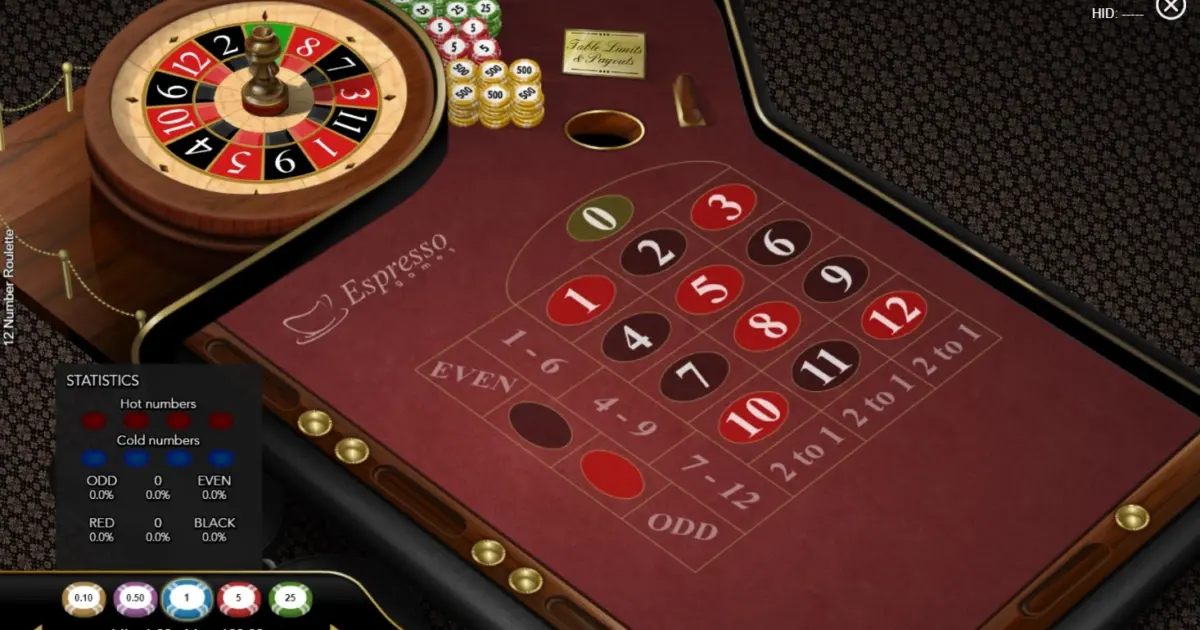
This is a 96.15% RTP roulette table from Espresso Games, playable as a free demo with no download. That figure sits about 0.8 percentage points below the 96.97% average across the roulette games listed here, and roughly 2.5 points below what a well-configured single-zero wheel returns. If you want the cheapest roulette maths available, this is not the table that delivers it — but the demo costs nothing, and the name alone tells you this is a layout worth understanding before you commit real money.
12 Number Roulette (Espresso) in one minute
Provider: Espresso Games, one of five roulette titles they have in this collection. Stated RTP: 96.15%. Free demo: yes. Popularity: 58.7th percentile, ranked 93rd here — mid-table interest rather than a headline release.
What FACTS does not tell us is the thing you most want to know: the pocket count and the bet layout. The title implies a twelve-number format rather than a conventional 37- or 38-pocket wheel, and that would mean a paytable unlike anything in classic roulette. Espresso Games also lists Global 12 Numbers (Espresso) at exactly the same 96.15%, which suggests a shared engine, but that is inference rather than confirmed fact.
Because the wheel configuration is unconfirmed, treat every payout assumption you carry over from European or American roulette as unverified here. Open the game’s own rules and paytable screen first. That screen is the authority for this table; nothing on this page can replace it. What we can say with confidence is the return figure: 96.15%, meaning an expected cost of 3.85 units per 100 staked over the long run.
| Provider | Espresso Games |
|---|---|
| RTP | 96.15% |
| Free demo | Yes |
The maths of a single spin
Roulette is the game where the arithmetic is fully public and fully fixed. On a standard single-zero wheel there are 37 pockets. A straight-up number has a 1-in-37 chance and pays 35:1, when fair odds would be 36:1. That one-pocket gap is the entire house edge: 2.70% on every standard bet on that wheel. A double-zero wheel adds a 38th pocket, pushes the edge to 5.26%, and prices its five-number basket bet at 7.89%.
Two consequences follow, and they hold for any wheel including this one. First, spins are independent. The wheel has no memory, an RNG has no memory, and no sequence of previous results changes the probability of the next one. Tracking results tells you about the past and nothing about the future.
Second, bet selection changes variance, not expected value. A straight-up number and a red/black bet on the same wheel cost the same percentage of your stake over time; one just delivers that cost in rare large swings and the other in frequent small ones. Choose based on how you want your session to feel, not on which bet you think is cheaper.
Where the 96.15% comes from
An RTP of 96.15% is the same statement as a house edge of 3.85%. It means that across a very large number of spins the game is modelled to return 96.15 units per 100 staked. It is a long-run average, not a session forecast, and short sessions will land well above or well below it in both directions.
What the figure does not tell you is how it is constructed. On a classic wheel, RTP is a direct consequence of pocket count and payout odds — 36/37 gives you 97.30%, 36/38 gives you 94.74%. 96.15% matches neither, which is consistent with a non-standard layout where the designer sets the payouts to reach a target return. But FACTS does not confirm the pocket count, the payout ladder, or whether the return is uniform across all available bets, and that last point matters most. On some tables every bet carries the same edge; on others, specific bets are markedly worse. Read the paytable and check each bet you intend to use rather than assuming the headline number applies evenly.
Even-money bets and the zero problem
On conventional roulette, the zero is where even-money bets lose their symmetry. Red/black, odd/even and high/low each cover 18 of 37 pockets on a single-zero wheel — just under half. When zero lands, all of them lose outright, and that is the whole 2.70%.
French rules soften this. Under La Partage, a zero returns half your even-money stake instead of taking all of it. Under En Prison, the bet is held for one further spin and returned in full if it wins. Either rule roughly halves the even-money house edge to about 1.35%, which is the best price on any standard roulette bet anywhere.
Whether this table offers either rule is not stated in FACTS, and you should not assume it does — La Partage is the exception in online roulette, not the default. It also matters here whether the layout even has conventional even-money propositions, given the twelve-number naming. If the rules screen shows La Partage or En Prison on even-money bets, that is a genuine, quantifiable improvement worth choosing for. If it does not, the standard payout structure applies and the 96.15% figure stands as your reference point.
How 12 number roulette (espresso) compares to other online roulette
Against the 96.97% average across the roulette games listed here, this table gives up 0.82 percentage points. Against the Espresso Games average of 96.66% across their five titles, it gives up around half a point. Neither gap is dramatic, but both point the same direction.
The clearest comparison sits inside the same provider’s range. Euro Roulette (Espresso) is listed at 98.65% — a 2.5-point improvement, and a figure that indicates favourable even-money handling on a single-zero layout. If your priority is the lowest cost per spin from this studio, that is the table to open first. At the other end, American Roulette (Espresso) is listed at 94.74%, the classic double-zero return, and there is no bet on a double-zero wheel that beats what the single-zero equivalent offers.
For a like-for-like format check, Global 12 Numbers (Espresso) carries the identical 96.15% return and a similar naming convention, so comparing the two paytables side by side is the fastest way to work out what a twelve-number layout actually pays.
Playing responsibly
Roulette is 18+ entertainment, not income. Set a budget before you open the game, decide what you are willing to lose, and stop at that number rather than at a target win. The house edge is a fixed cost of playing, so the longer you play the more reliably you pay it — no bet size, timing or sequence changes that.
Be especially wary of betting systems. Martingale, Fibonacci, D’Alembert and “wait for five reds” are all mathematically neutral on expected value. Doubling after a loss does not reduce the edge; it concentrates your risk into rare, large losses and runs you into the table maximum or your bankroll limit faster. A system that appears to work for twenty sessions is a system whose failure has not yet arrived.
Demo play is useful for learning the interface and reading the paytable, and for nothing else. It does not predict real-money outcomes, and a good demo run tells you no more about the next real spin than a bad one does.
Verdict
A mid-table return on a layout the FACTS do not fully describe. 96.15% is workable but unremarkable, and the same studio publishes a single-zero table at 98.65% — so the case for this one rests on whether the twelve-number format itself appeals to you, not on its price.
Use the free demo to answer the questions this page cannot: how many pockets, what each bet pays, whether La Partage applies, and whether the return is even across the board. Those answers are on the rules screen, they take two minutes to read, and they matter more than any review.
Frequently Asked Questions
Can I play 12 Number Roulette (Espresso) for free?
Yes. A free demo is available, and it runs in the browser with no download required. The demo uses the same rules and paytable as the real-money version, which makes it the right place to check the pocket count and payout ladder before you stake anything. Demo results do not predict real-money outcomes.
What is the RTP of 12 Number Roulette (Espresso)?
The stated RTP is 96.15%, equal to a house edge of 3.85%. That means an expected long-run cost of 3.85 units per 100 staked. It sits 0.82 percentage points below the 96.97% average across the roulette games listed here, and below the 96.66% average across Espresso Games' five roulette titles.
Which wheel does this table use, and what is the house edge?
FACTS does not confirm the pocket count, so the wheel type is unverified. The 96.15% return matches neither a single-zero wheel (97.30%) nor a double-zero wheel (94.74%), which points to a non-standard layout. Check the game's rules screen for the pocket count and payout odds before betting real money.
Does any betting system work on this table?
No. Martingale, Fibonacci, D'Alembert and pattern-based approaches all leave expected value unchanged. Spins are independent and an RNG wheel has no memory, so previous results carry no predictive weight. Progressions only redistribute variance, concentrating losses into rarer, larger events and pushing you toward table limits faster.
How does it compare to Euro Roulette (Espresso)?
Euro Roulette (Espresso) is listed at 98.65% against this table's 96.15%, a 2.5-point advantage that translates to roughly 2.5 fewer units lost per 100 staked over the long run. If cost per spin is your priority, that is the stronger table from Espresso Games. Global 12 Numbers (Espresso) matches this one exactly at 96.15%.




