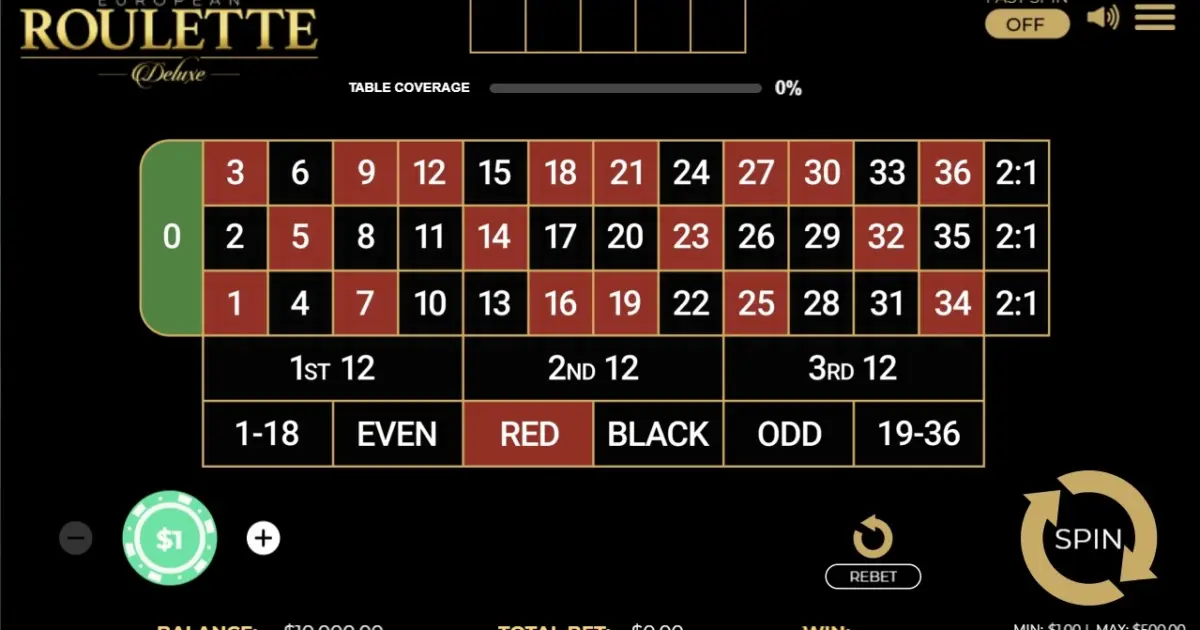
The headline number is a 97.3% RTP, which is the figure Dragon Gaming publishes for this table, and it is the best of the four roulette games in the studio’s range. If you want a straightforward wheel to learn bet types on, or to test how a session actually feels over a few hundred spins, this one is worth your time. What it will not do is give you an angle, because roulette has none.
Below is what the supplied data actually confirms about european roulette deluxe (dragon gaming), what the title implies but does not prove, and what you need to check yourself on the game’s rules screen before you play for money.
European Roulette Deluxe (Dragon Gaming) and the Dragon Gaming roulette range
Dragon Gaming lists four roulette titles, and their published RTPs are not close to each other. This one and European Roulette (Dragon Gaming) both sit at 97.3%, while American Roulette (Dragon Gaming) is listed at 94.74% and Double Dragon Roulette at the same 94.74%. That spread of roughly 2.6 percentage points is the single most useful thing in the whole dataset. Within one studio, in one lobby, you can pick a table that returns about 97.3 units per 100 staked over the long run, or one that returns about 94.74.
The studio’s average across its four roulette games is 96.02%, so this table sits well above its own house average and slightly above the 96.97% average across the wider review corpus. Nothing in the data explains what “Deluxe” changes compared with the plainer European Roulette title — the RTPs are identical, so the difference is presumably presentation, bet interface or table furniture rather than maths. The supplied facts do not say, and you should not assume it adds a racetrack, call bets or side wagers.
The wheel, the pockets and the edge
The title says European, and the variant hint supplied with this game says the same: a European wheel has 37 pockets, a single zero, and a house edge of 2.70% on every standard bet. That is the normal reading, and it lines up neatly with the published 97.3% RTP, because 100 minus 2.70 is 97.3.
Treat that as a strong, consistent hint rather than a confirmed fact about this specific table. The dataset does not include a pocket count, a rules description or a paytable for this game. Open the rules screen and count the pockets, or check the layout for a second green zero, before you stake real money. On a double-zero wheel the pocket count rises to 38 and the house edge on standard bets jumps to 5.26%, with the five-number basket bet at 7.89% — roughly double the cost per spin.
The other thing to check is whether French rules apply. La Partage returns half your stake on even-money bets when zero lands; En Prison holds the bet for one more spin. Either one cuts the even-money house edge to about 1.35%, the best standard bet available in roulette. The supplied facts say nothing about La Partage or En Prison here, and a published 97.3% suggests they are not in play, since French rules would push even-money returns higher than that. Verify it rather than hoping.
97.3% in practice
A 97.3% RTP means that across an enormous number of spins, the game is designed to pay back about 97.30 for every 100 staked. The missing 2.70 is the house edge. It is not a promise about your session, your hour or your week, and it does not warm up or cool down.
Put it in stake terms. Betting 1 unit per spin at 40 spins an hour, you stake 40 units and the expected cost is about 1.08 units per hour. Betting 5 units per spin, that becomes roughly 5.40 units per hour. The edge scales with total turnover, not with how clever the bet is, so the two levers that actually matter are stake size and spin count.
Variance is a separate story. Straight-up numbers hit about once in 37 spins on a single-zero wheel and pay 35 to 1, so short sessions swing hard in both directions. Even-money bets land close to half the time and produce a flatter, longer session on the same bankroll. Neither is better value — 2.70% either way on a European wheel. They just deliver that same cost in very different shapes.
Building a bet you understand
The table below sets out the standard bets on a 37-pocket single-zero wheel: what each pays, the true odds against it, and the resulting edge. Confirm the layout in-game matches before you use it.
| Bet | Numbers covered | Payout | True odds | House edge |
|---|---|---|---|---|
| Straight up | 1 | 35:1 | 36:1 | 2.70% |
| Split | 2 | 17:1 | 17.5:1 | 2.70% |
| Street | 3 | 11:1 | 11.33:1 | 2.70% |
| Corner | 4 | 8:1 | 8.25:1 | 2.70% |
| Line | 6 | 5:1 | 5.17:1 | 2.70% |
| Column or dozen | 12 | 2:1 | 2.08:1 | 2.70% |
| Red/black, odd/even, high/low | 18 | 1:1 | 1.06:1 | 2.70% |
Read the straight-up line carefully, because it contains the whole game. The true odds are 36 to 1 and the payout is 35 to 1. That one-pocket gap, repeated across every bet on the layout, is the entire house edge. Combining bets does not dodge it: covering 24 numbers with two dozens still costs 2.70% of what you stake, and so does splitting your chips across ten numbers.
Systems, streaks and independent spins
If you came here looking for a betting system, the honest answer is the useful one: none of them work. Martingale, Fibonacci, D’Alembert, Labouchere, waiting for five reds — every one of them leaves expected value exactly where it was. Each spin is independent. The wheel has no memory of the last result, the last hundred results, or the colour that has not appeared for a while.
No number, colour or sector is ever due, hot or cold. On an RNG wheel, tracking previous results tells you nothing predictive about the next spin. The scoreboard some tables display is a record, not a signal.
What progressions do change is the shape of your risk. Doubling after each loss converts a lot of small wins into an occasional very large loss, and it runs into two hard walls: your bankroll and the table maximum. A run of eleven losing even-money bets is uncommon but entirely ordinary, and by then a 1-unit start has become a 1,024-unit bet. The average outcome is unchanged; the tail risk is much worse. Flat staking is not a winning strategy either, but it makes your cost per hour predictable, which is a genuine advantage when the goal is entertainment time rather than profit.
Free demo and staying in control
A free demo is available for this table, which makes it easy to learn the layout, chip denominations and bet-placement controls without money on the line. Use the demo to check the things the dataset does not tell you: count the pockets, look for a second zero, read the paytable, and find the minimum and maximum stakes for inside and outside bets. Those limits are not in the supplied facts and they matter, because a low table maximum on even-money bets caps any progression you might have been considering.
Demo results do not predict real-money results. A demo session can run 300 spins above expectation or 300 below, and neither tells you anything about tomorrow. What it does show you is the pace: how many spins an hour you actually play, which is the number that turns a 2.70% edge into a real hourly cost.
Roulette is 18+ entertainment, not income. Set a budget before you open the game, treat it as the price of the session rather than a stake you expect back, and stop when it is gone. If play stops feeling like entertainment, close the table and use the operator’s deposit limits, time-outs or self-exclusion tools.
Who should play European Roulette Deluxe (Dragon Gaming)
This suits a player who wants a clean, conventional wheel with a competitive published return and no gimmicks to decode. At 97.3%, it is the strongest RTP in Dragon Gaming’s four-title roulette range and above the 96.97% corpus average, so if you are choosing inside that lobby, this table or its identically-priced sibling are the two sensible picks. Choosing the 94.74% alternatives instead roughly doubles your expected cost per spin.
It is less suitable if you specifically want French rules, a racetrack for call bets, or multiplier mechanics. None of those are confirmed in the available facts, and a game funding multipliers would show a different straight-up payout on its own paytable. It is also the wrong game if you are hunting a system, because there is nothing here to beat.
Ranked 65 and sitting in the 71st percentile for popularity, it is a reasonably well-played table rather than a headline release. Start in the free demo, verify the wheel and the limits, then decide with the real numbers in front of you.
Frequently Asked Questions
Can I play European Roulette Deluxe (Dragon Gaming) free with no download?
Yes, a free demo is available for this table, so you can try it in-browser without depositing. Use it to check the layout, chip sizes and bet limits, since those stake minimums and maximums are not published in the data available here. Demo outcomes do not predict real-money results.
What is the European Roulette Deluxe (Dragon Gaming) RTP?
Dragon Gaming publishes a 97.3% RTP for this table. Over a very large number of spins the game is built to return about 97.30 per 100 staked, leaving a 2.70% theoretical cost. It says nothing about a single session, and it does not shift based on recent results.
How many pockets does the wheel have and what is the house edge?
The title and the supplied variant hint both point to a European wheel: 37 pockets, one zero, 2.70% house edge on every standard bet. That matches the 97.3% RTP figure, but the pocket count is not confirmed in the data, so count the pockets on the rules screen before betting real money.
Does the Martingale or any pattern system work on this roulette?
No. Spins are independent and the wheel has no memory, so Martingale, Fibonacci, D'Alembert and streak-watching all leave expected value unchanged. Progressions only reshape variance, trading frequent small wins for rare large losses, and they hit bankroll and table-maximum ceilings fast. No number or colour is ever due.
How does it compare with the other Dragon Gaming roulettes?
It is the best-priced of the four. This table and European Roulette (Dragon Gaming) are both listed at 97.3%, while American Roulette (Dragon Gaming) and Double Dragon Roulette sit at 94.74%. The studio average is 96.02%, so choosing one of the 97.3% tables roughly halves your expected cost per unit staked.




