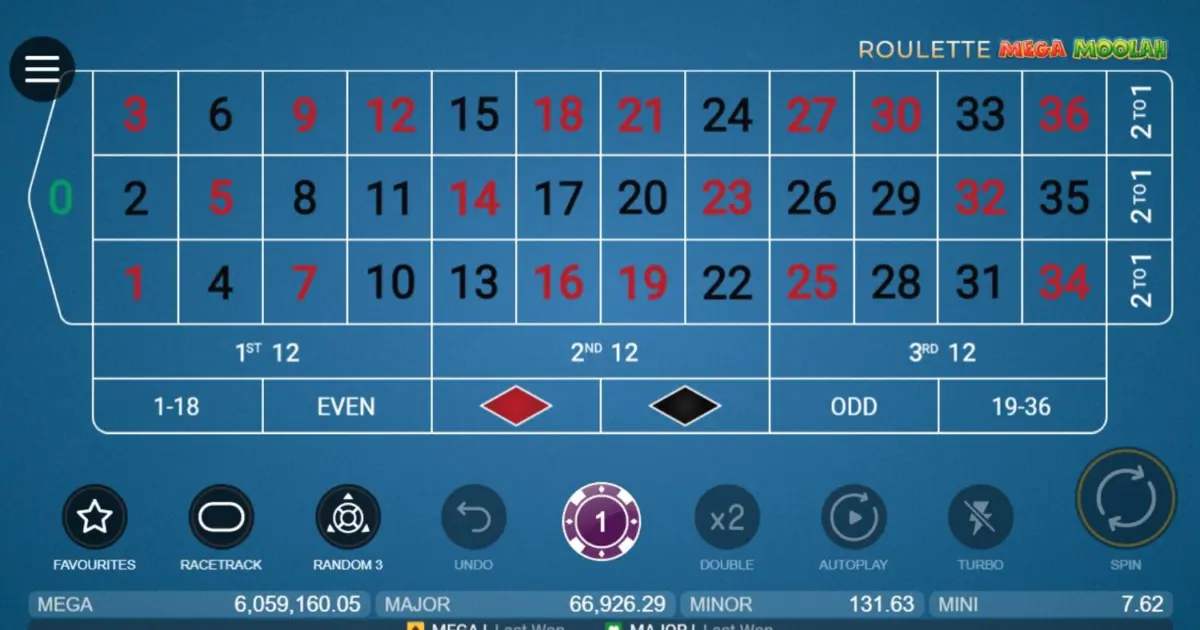
Roulette Mega Moolah is a Switch Studios table listed at a 97.3% return to player, which is marginally above the 96.97% average across the roulette games catalogued here. That RTP figure is the one hard number available for this table, and it is enough to tell you the game is priced in the normal range for online roulette. What it does not tell you is which wheel you are spinning, and that is the question worth settling before you stake anything.
A free demo is available, so you can open the rules screen and the paytable at no cost and answer that question yourself in under a minute.
What kind of roulette is Roulette Mega Moolah?
The facts supplied for this table do not specify the pocket count, and no variant hint is attached to the title. That is a genuine gap rather than a detail to gloss over, because pocket count is the single biggest driver of cost in roulette.
On a single-zero European wheel there are 37 pockets and the house edge is 2.70% on every standard bet. On a double-zero American wheel there are 38 pockets and the edge rises to 5.26%, with the five-number basket bet worse again at 7.89%. That is roughly double the cost per spin for identical-looking bets on an identical-looking layout. If the table applies French rules — La Partage or En Prison — half your even-money stake comes back when zero lands, dropping the even-money edge to about 1.35%, the best standard bet in the game.
The name references a jackpot brand, but nothing in the supplied information confirms a progressive jackpot, a side bet, or any multiplier mechanic on this table. Do not assume one is there, and do not assume it is absent. The rules screen will say. Until you have read it, treat the wheel type and any bonus layer as unknown.
Return to player and house edge
The listed return to player is 97.3%. Over a very large number of spins, that implies an average return of 97.30 units for every 100 staked, with the remaining 2.70 units retained by the house. The arithmetic there is a close match for a single-zero wheel, where the theoretical return on standard bets is 36/37, or 97.297%. That is suggestive, not conclusive — a published RTP can be rounded, and a game with a jackpot or multiplier layer can arrive at the same headline figure by a different route.
What the figure does confirm is the pricing tier. Switch Studios averages 97.33% RTP across its 16 games, so this table is typical of the studio rather than an outlier in either direction. Against the wider roulette corpus it runs 0.33 percentage points better than average.
House edge applies per spin, not per session. At 2.70% you are paying roughly 2.70 units in expectation for every 100 you cycle through the table, whether that is one 100-unit bet or fifty 2-unit bets. Total turnover is what costs you money, and staking more per spin or spinning faster both increase turnover. Neither changes the percentage.
Reading the Switch Studios paytable before you bet
Open the paytable first. On a classic wheel you are checking that straight-up numbers pay 35:1, splits 17:1, streets 11:1, corners 8:1, and the even-money bets 1:1. Those figures are the standard, and any deviation is the game charging you more than the pocket count alone implies.
Multiplier-style roulette formats fund their headline multipliers by cutting the base straight-up payout — often to 29:1 — so the effective return on a straight bet is not comparable to a classic table without reading the game’s own numbers. Nothing supplied here says this table does that, which is precisely why the paytable check matters. The same applies to any jackpot contribution: if part of your stake feeds a progressive pool, the published RTP may include jackpot returns you will realistically never see.
Also confirm what the zero does to even-money bets. A table with La Partage will say so in the rules, and it is worth finding, because 1.35% versus 2.70% is a halving of your cost on red/black, odd/even and high/low. Table limits and whether a racetrack with call bets is offered are not stated in the information available, so check both on screen if minimum stake or neighbour betting matters to how you play.
Bet coverage, variance and session length
Bet selection does not change expected value on a standard wheel. It changes how quickly your balance moves. The table below shows the payouts and true odds on a single-zero wheel, which is the layout the 97.3% figure points toward — verify it on the rules screen before treating it as this table’s confirmed maths.
| Bet | Pockets covered | Payout | True odds (37 pockets) |
|---|---|---|---|
| Straight up | 1 | 35:1 | 36:1 |
| Split | 2 | 17:1 | 17.5:1 |
| Street | 3 | 11:1 | 11.33:1 |
| Corner | 4 | 8:1 | 8.25:1 |
| Dozen / column | 12 | 2:1 | 2.08:1 |
| Red / black, odd / even | 18 | 1:1 | 1.06:1 |
Every row carries the same 2.70% cost. The gap between payout and true odds is one pocket in each case, which is the entire house edge expressed six different ways. A straight-up number lands about once in 37 spins, so long dry runs are normal and not a fault in the wheel. Even-money bets win close to half the time, which stretches a bankroll over more spins but does not make the game cheaper. If you want a longer session from a fixed budget, lower your stake per spin rather than switching bet type. For a like-for-like feel at smaller stakes, Low Stakes Roulette from the same studio carries the same 97.3% listing.
Patterns, hot numbers and the gambler’s fallacy
Spins on an RNG wheel are independent. The result of the last spin has no influence on the next, and no number, colour or sector is ever due. A run of eight reds does not shorten the odds on black; the next spin is 18/37 for black on a single-zero wheel regardless of what came before. Racetrack statistics displays and hot/cold number panels are presentation, not information, and they have no predictive value here.
Betting systems do not change expected value. Martingale, Fibonacci, D’Alembert, Labouchere, waiting for five reds — every one of them redistributes variance and leaves the 2.70% or 5.26% cost per unit staked untouched. Martingale in particular converts a modest edge into a real risk of a single catastrophic sequence, because doubling after each loss runs into the table maximum faster than most people expect. Seven consecutive losses on an even-money bet is roughly a 1 in 128 event, and it will happen inside a normal session length.
The honest version is simple: there is no bet, sequence or staking pattern on this or any roulette table that makes the maths work in your favour. Choose bets for the session length and swing size you want, and price the game at its stated cost.
Trying the demo
Play Roulette Mega Moolah free before committing money. The demo is the fastest way to confirm the pocket count, read the paytable, see whether zero triggers La Partage, and find the table minimum and maximum. Those four checks decide whether the game suits you, and none of them require a stake.
Treat demo results as a sample, not a forecast. A demo session can run well above or well below the theoretical return over a few hundred spins, and it says nothing about what real-money play will do. Use it to learn the interface and the rules, not to test a staking idea.
Roulette is 18+ entertainment, not a way to make money. Set a budget before you open the game, stake only what you are comfortable losing, and stop when that budget is gone rather than chasing it. If play stops feeling like entertainment, close the game and use the deposit limits, time-outs and self-exclusion tools your operator provides.
If you want to compare formats within the studio, Extreme Multifire Roulette is the multiplier-style option and a useful contrast for seeing how payout structures differ.
Verdict on Roulette Mega Moolah
The listed 97.3% RTP puts this table in the normal band for online roulette and slightly ahead of the site average, and the free demo removes any reason to guess at the details. That is a fair starting position.
The reservation is what is not documented. Pocket count, La Partage, table limits, call bets and any jackpot or multiplier layer are all unconfirmed in the information available, and each of them changes either your cost per spin or how the game plays. A table advertising a jackpot name without a documented jackpot mechanic is worth two minutes of reading before you stake.
Do that reading in the demo. If the rules screen confirms a single-zero wheel at 35:1 straight up, you are playing standard 2.70% roulette at a fair price. If it shows a double-zero wheel or a reduced straight-up payout, the real cost is higher than the headline figure suggests and Sweep&Win Roulette is worth checking as an alternative at the same listed RTP.
Frequently Asked Questions
Can I play Roulette Mega Moolah free with no download?
Yes. A free demo is available for this Switch Studios table and runs in the browser, so there is nothing to install. Use it to confirm the pocket count, the straight-up payout and the table limits before staking real money, since none of those details are documented outside the game itself.
What is the Roulette Mega Moolah RTP?
The listed return to player is 97.3%. That is 0.33 percentage points above the 96.97% average across the roulette titles catalogued here, and in line with the 97.33% average across the 16 Switch Studios games. RTP is a long-run average and says nothing about any individual session.
What is the house edge and which wheel does this table use?
A 97.3% RTP implies a 2.70% house edge, which matches a single-zero 37-pocket wheel. The wheel type is not confirmed in the available information, though. A double-zero wheel would cost 5.26%, and French rules would cut the even-money edge to about 1.35%. Check the rules screen.
Does any betting system work on this table?
No. Spins are independent and the wheel has no memory, so Martingale, Fibonacci, D'Alembert and pattern-based approaches all leave the house edge unchanged. They only reshape variance. Martingale doubles stakes after losses and hits the table maximum quickly, turning a normal losing run into a large single loss.
Who is Switch Studios and how does this compare to their other roulette games?
Switch Studios has 16 games catalogued here, averaging 97.33% RTP. Sweep&Win Roulette, Low Stakes Roulette and Extreme Multifire Roulette all carry the same 97.3% listing, so the choice between them comes down to stake range and format rather than return. Extreme Multifire is the multiplier-style option.




