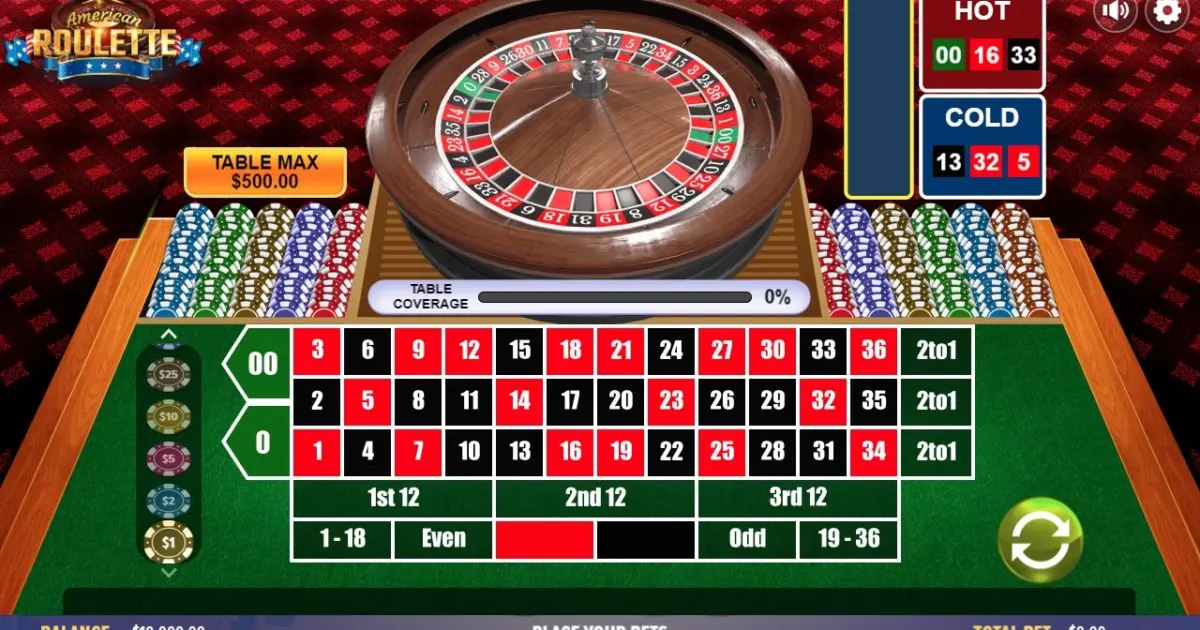
The number that decides this one is 94.74%. That is the published RTP for american roulette (dragon gaming), and it is the exact figure a 38-pocket double-zero wheel produces on standard bets. If you want to play this table because you enjoy the American layout, the demo is free and the maths is at least honest about itself. If you are choosing between roulette tables on cost, Dragon Gaming publishes European wheels at 97.3% and there is no scenario where the double-zero version is the better financial choice.
The rest of this review covers what that 5.26% actually costs, what FACTS does not tell us about this specific build, and why no betting pattern will move the number.
What kind of roulette is American Roulette (Dragon Gaming)?
The title and the RTP point the same direction: a double-zero American wheel with 38 pockets, containing the numbers 1 to 36 plus a single zero and a double zero. On that wheel every standard bet carries a house edge of 5.26%, and the five-number basket bet (0, 00, 1, 2, 3) is worse still at 7.89%. The 94.74% RTP in FACTS is exactly 100% minus 5.26%, which is strong corroboration rather than proof.
Treat it as a strong hint and confirm it on the game’s own rules screen before betting real money. FACTS does not tell us the pocket layout Dragon Gaming has used, whether the wheel is the standard American sequence, or whether the basket bet is even offered on the felt. Those are rules-screen questions.
What FACTS also does not include: table minimums and maximums, whether a racetrack or call bets are available, and whether any side bet or multiplier sits on top of the base game. The absence of limits matters most. Without knowing the maximum outside bet, you cannot tell how quickly any progression would hit the ceiling, and you cannot size a session sensibly. Check the limits panel first.
Return to player and house edge
An RTP of 94.74% means the theoretical long-run return is 94.74 units for every 100 staked, with 5.26 retained by the house. On a $1 spin that is an expected cost of about 5.3 cents. Spin 100 times and the expected loss is roughly $5.26, though real short sessions swing widely in both directions around that line.
The mechanism is simple and worth understanding, because it is the whole game. A straight-up number pays 35:1. On a 38-pocket wheel the true odds against any single number are 37:1. The house keeps the difference on two pockets rather than one, and that gap is replicated across every standard bet type, which is why red/black, dozens and columns all carry the identical 5.26% edge. Bet selection changes nothing about expected value here.
For context from FACTS: this table sits 2.23 percentage points below the 96.97% corpus average, and below Dragon Gaming’s own 96.02% average across four games. The studio’s European Roulette (Dragon Gaming) is listed at 97.3%, which is the standard single-zero 2.70% edge. Same studio, roughly half the cost per spin.
Reading the Dragon Gaming paytable before you bet
Standard roulette payouts are fixed by the bet type, and on a conventional wheel they run: straight-up 35:1, split 17:1, street 11:1, corner 8:1, six-line 5:1, column and dozen 2:1, and the even-money bets at 1:1. FACTS does not confirm Dragon Gaming’s paytable, so read it on screen and check those numbers match.
Two specific things are worth looking for. First, whether a five-number basket bet exists and what it pays. At 6:1 it carries that 7.89% edge, the worst standard bet in roulette, and it exists only on double-zero layouts. Second, whether any part of the paytable has been reduced to fund a bonus feature. Lightning-style formats do exactly this, cutting the straight-up payout below 35:1 to pay for multipliers, which changes effective RTP on inside bets. FACTS lists no multiplier or side bet for this table, so the default assumption is a classic build, but the paytable is the only place to confirm it.
Also check whether any rule returns part of an even-money stake when zero lands. French rules such as La Partage cut the even-money edge to about 1.35%, but they are a single-zero convention and FACTS gives no indication they apply here.
Bet coverage, variance and session length
Expected value is flat across bet types on this wheel. What you are actually choosing is variance: how often you win and how large the swings are. Outside bets hit close to half the time and produce long, slow sessions. Straight-up bets hit once in 38 spins on average and produce long dry runs punctuated by a 36-unit return.
| Bet type | Pockets covered | Payout | True odds (38 pockets) | House edge |
|---|---|---|---|---|
| Straight-up | 1 | 35:1 | 37:1 | 5.26% |
| Split | 2 | 17:1 | 18:1 | 5.26% |
| Street | 3 | 11:1 | 11.67:1 | 5.26% |
| Corner | 4 | 8:1 | 8.5:1 | 5.26% |
| Basket (0, 00, 1, 2, 3) | 5 | 6:1 | 6.6:1 | 7.89% |
| Six-line | 6 | 5:1 | 5.33:1 | 5.26% |
| Column or dozen | 12 | 2:1 | 2.17:1 | 5.26% |
| Red/black, odd/even, high/low | 18 | 1:1 | 1.11:1 | 5.26% |
Note the even-money bets cover 18 of 38 pockets, not half. That is 47.37%, and the missing 2.63% on each side is the two zeros. It is the single clearest illustration of what the double-zero layout does to your session.
Patterns, hot numbers and the gambler’s fallacy
Spins on an RNG wheel are independent. The wheel has no memory, the software has no memory of the previous result, and a number that has not appeared in 200 spins is exactly as likely on the next spin as any other. No number, colour or sector is ever due. Scoreboards showing recent results are decoration, not information, and tracking them has no predictive value.
Betting systems do not change this. Martingale, Fibonacci, D’Alembert, Labouchere and “wait for five reds then bet black” all leave expected value at exactly 94.74% on this wheel. What they change is the shape of your losses. A doubling progression converts many small losses into occasional very large ones, and the 5.26% edge applies to every unit you stake, so staking more per spin increases expected loss in absolute terms rather than reducing it.
Progressions also collide with table limits, and FACTS does not tell us what those limits are here. That is a real problem for anyone planning a progression: the system fails the moment the required stake exceeds the maximum, which is precisely when you most need it to continue.
Trying the demo
Free demo play is available for this table, which makes it a no-download way to learn the American layout: where the 00 sits, how the basket bet is placed, and how the outside bet boxes are arranged. That is the genuine value here. Learn the felt, get comfortable with bet placement, and see how the interface handles repeat and clear.
What the demo cannot do is tell you anything about future real-money results. Demo sessions run on the same RNG and the same 5.26% edge, and a good run in free play carries no information about the next session.
Roulette is entertainment, not income. Play only if you are 18 or over, decide your budget before you open the game, treat that amount as the cost of the entertainment, and stop when it is gone rather than trying to win it back.
If you want to compare structures side by side, European Roulette Deluxe (Dragon Gaming) at 97.3% is the same studio’s single-zero build, and Double Dragon Roulette is listed at the same 94.74% if you want another double-zero option.
Verdict on American Roulette (Dragon Gaming)
This is a competently positioned double-zero table with a published RTP of 94.74% and, by the numbers, no reason to choose it over a single-zero wheel from the same studio. The 5.26% edge is roughly double the 2.70% you get on a European layout, and it applies to every standard bet regardless of how you arrange your chips.
Play it in demo if you specifically want the American layout, want to practise placing the basket bet, or are curious how the extra pocket feels across a few hundred spins. Play it with real money only with a fixed budget and a clear understanding that each unit staked costs about 5.3% in expectation.
Before you commit anything, open the rules screen and confirm three things FACTS does not cover: the pocket count and wheel sequence, the full paytable including whether the basket bet is offered, and the table minimum and maximum. Ranked at 70 with a 69.1 popularity percentile, it is a reasonably visited table, but popularity is not a price signal.
Frequently Asked Questions
Can I play American Roulette (Dragon Gaming) for free?
Yes, a free demo is available, so you can play American Roulette (Dragon Gaming) free with no download and no deposit. It is a sensible way to learn the double-zero layout and the interface. Bear in mind that demo results tell you nothing about future real-money outcomes, since every spin runs on the same RNG.
What is the American Roulette (Dragon Gaming) RTP?
The published RTP is 94.74%, meaning a theoretical long-run return of 94.74 units per 100 staked. That is 2.23 percentage points below the 96.97% average across the games in our database, and below Dragon Gaming's own 96.02% average. On $1 spins the expected cost is about 5.3 cents per spin.
Which wheel is this and what is the house edge?
The 94.74% RTP and the title both point to a 38-pocket American wheel with 0 and 00, giving a 5.26% house edge on standard bets and 7.89% on the five-number basket bet. Confirm the pocket count on the game's rules screen before betting real money, since FACTS does not state it directly.
Does the Martingale system work on this table?
No. Martingale and every other progression leave the expected return at 94.74%, because spins are independent and the 5.26% edge applies to every unit staked. Progressions turn frequent small losses into rarer large ones and run into table limits, which FACTS does not list for this game, so check them before planning any staking plan.
How does it compare to European Roulette (Dragon Gaming)?
European Roulette (Dragon Gaming) is listed at 97.3% RTP against 94.74% here, which is the standard 2.70% versus 5.26% house edge difference between single-zero and double-zero wheels. Same studio, same basic game, roughly half the cost per spin on the European table. On price alone, the single-zero version wins.




