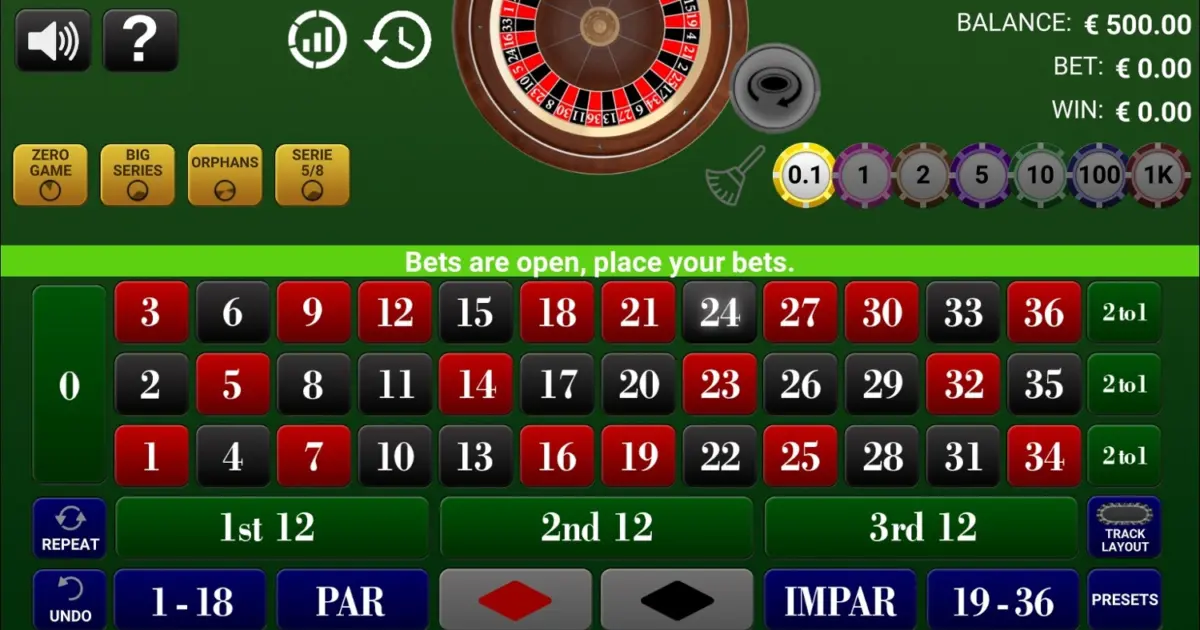
If you want a clean, no-frills roulette table to learn on, this one does the job. GameArt lists European Roulette at an RTP of 97.3%, and a free demo is available so you can place bets without spending anything. There is no jackpot, no multiplier gimmick and nothing to unlock — the maths is the product.
What FACTS does not tell us is the table minimum and maximum, whether a racetrack is offered for call bets, or whether any French-style zero rule applies. Those all matter, and you should read the game’s own rules screen before you put money on it.
European Roulette and the GameArt roulette range
GameArt has a single roulette title on record here, so there is no in-house family to compare against — no stripped-back “Pro” version, no premium variant with extra bet options. That is worth knowing if you like sticking with one studio’s interface across several tables. You get one build, and this is it.
Because the range is that narrow, most comparison shopping happens against other studios. European Roulette (Red Tiger) lists the same 97.3% RTP, so any choice between the two comes down to interface, bet layout and how the racetrack is handled rather than expected value. European Roulette Pro also sits at 97.3% and is usually the pick if you want a faster, more stripped-down betting surface.
Sitting at the 74th popularity percentile on this site, GameArt’s table gets a reasonable amount of traffic without being a headline name. Its 97.3% sits marginally above the 96.97% average across the tables catalogued here — a gap of about a third of a percentage point, which is real but small.
The wheel, the pockets and the edge
The title points to a single-zero wheel, and a single-zero wheel means 37 pockets: numbers 1 to 36 plus one green zero. On that layout the house edge is 2.70% on every standard bet — straight-up, split, street, corner, dozen, column, red/black, odd/even, high/low. All of them. There is no bet on the felt that gets you a better deal.
The reason is structural. A straight-up number pays 35:1. The true odds against hitting it are 36:1, because there are 37 pockets and only one of them is yours. That single-pocket gap between the payout and the truth is the entire house edge, and it is baked into every other bet type by the same arithmetic.
Treat the wheel type as a strong hint rather than a confirmed rule. The name says European, and the 97.3% RTP is exactly what a standard single-zero wheel produces, which is consistent. But FACTS does not confirm the pocket count directly, and it says nothing about whether La Partage or En Prison applies. If a French rule were in play, even-money bets would carry roughly a 1.35% edge instead — a meaningful difference. Check the rules screen and confirm it yourself.
97.3% in practice
An RTP of 97.3% is the long-run return, and “long-run” means hundreds of thousands of spins. It is the mirror of a 2.70% house edge: for every 100 units wagered, the theoretical return is 97.3 units. That is a statement about the game’s design, not a forecast for your session.
Over any realistic number of spins, what you actually see is dominated by variance. A hundred spins of red/black can leave you comfortably up or comfortably down, and neither outcome tells you anything about the RTP being accurate. The figure only becomes visible across volumes no individual player will ever produce.
The practical takeaway is about bet sizing rather than bet selection. Since every standard bet on a single-zero wheel carries the same 2.70%, the only thing under your control is how much you put at risk and how fast you cycle it. Spinning quickly at high stakes exposes more money to the same edge in less time. Slower play with smaller units exposes less. The percentage does not move; your total wagered does.
Building a bet you understand
Here is how the standard bets break down on a 37-pocket wheel. Note the last column — it is identical throughout.
| Bet | Numbers covered | Payout | True odds | House edge |
|---|---|---|---|---|
| Straight up | 1 | 35:1 | 36:1 | 2.70% |
| Split | 2 | 17:1 | 17.5:1 | 2.70% |
| Street | 3 | 11:1 | 11.33:1 | 2.70% |
| Corner | 4 | 8:1 | 8.25:1 | 2.70% |
| Line | 6 | 5:1 | 5.17:1 | 2.70% |
| Column or dozen | 12 | 2:1 | 2.08:1 | 2.70% |
| Red/black, odd/even, high/low | 18 | 1:1 | 1.06:1 | 2.70% |
What changes as you move down the table is the shape of the ride. A straight-up bet hits roughly once in 37 spins and pays 35 units when it does, so your balance moves in long flat stretches punctuated by jumps. An even-money bet resolves close to half the time and moves your balance in small steps. Same expected cost, completely different session.
Pick based on how you want to spend your time, not on which bet you think is better value. None of them is.
Systems, streaks and independent spins
Every spin on an RNG wheel is independent of the one before it. The wheel has no memory of the last eight reds, and no number becomes more likely because it has been absent for 200 spins. There is no such thing as a due number, a hot sector or a cold colour on this table.
That is why betting systems do not work. Martingale, Fibonacci, D’Alembert, Labouchère, waiting for five reds and then backing black — none of them changes expected value, because expected value is fixed at 2.70% per unit wagered by the pocket structure. A progression only redistributes your outcomes: it makes small wins frequent and large losses rare but much bigger.
Martingale is the clearest example. Doubling after each loss recovers your position while it works, and it works most of the time. The problem is the tail. A run of eleven losses starting at one unit requires a 2,048-unit bet to continue, and either your balance or the table maximum stops you first. When that happens you are down more than every prior recovery combined. FACTS does not list this table’s limits, which is one more reason to find them before you commit to any staking plan.
Free demo and staying in control
A free demo is available for this table, so you can play European Roulette with no download and no deposit. Demo mode is genuinely useful for two things: learning where the bets sit on the felt, and seeing how much your balance swings across a couple of hundred spins. Watching a straight-up-heavy session for twenty minutes teaches variance faster than reading about it.
What the demo cannot do is predict real-money results. A good run in free play is not a signal, and neither is a bad one — the RNG is the same either way, and so is the 2.70% edge.
Roulette is 18+ entertainment, not a source of income. Set a budget before you open the table, decide what you are willing to lose, and stop when you reach it rather than when you feel like it. If the amount you are staking starts to matter to you, that is the point to walk away, not the point to increase it.
Who should play European Roulette
This suits you if you want a straightforward single-zero table with a competitive listed return and no extra mechanics to learn. 97.3% is a solid number for the category, the demo removes any cost to trying it, and the game does not ask you to understand a bonus round or a multiplier paytable before you place a bet.
It suits you less if you want features. There are no multipliers, no side bets and no jackpot on record here, and GameArt’s single-title range means there is no upgrade path within the studio. If you want the lowest standard even-money edge in roulette, look at a French-rules table instead — French Roulette (NetEnt) lists the same 97.3% headline RTP, but La Partage or En Prison, where offered, cuts the even-money edge to roughly 1.35%. That is the single biggest improvement available to a roulette player, and it comes from rules rather than strategy.
Whichever table you pick, confirm the pocket count, the zero rules and the limits on the game’s own screen first. Those three things determine what you are actually playing.
Frequently Asked Questions
Can I play European Roulette by GameArt for free?
Yes, a free demo is available, so you can play European Roulette free with no download and no deposit. Demo mode uses the same RNG as real money, which makes it useful for learning the bet layout and seeing how balances swing. It cannot predict real-money outcomes, though.
What is the European Roulette RTP on the GameArt table?
The listed RTP is 97.3%, slightly above the 96.97% average across the roulette tables catalogued here. That is a long-run figure measured over hundreds of thousands of spins, not a session forecast. Across any realistic number of spins, variance dominates completely and your actual results can sit well either side of it.
What is the house edge and how many pockets does this wheel have?
The name and the 97.3% RTP both point to a standard single-zero wheel: 37 pockets and a 2.70% house edge on every standard bet. FACTS does not confirm the pocket count or whether La Partage applies, so check the game's rules screen. A French zero rule would cut the even-money edge to about 1.35%.
Does the Martingale system work on this table?
No. No betting system changes expected value, because the 2.70% edge is fixed by the pocket structure. Martingale makes small wins frequent and large losses rare but far bigger, and doubling after eleven losses needs a 2,048-unit stake. Table limits are not listed here, so confirm them before planning any progression.
Which bet should I choose to make my balance last longest?
Even-money bets — red/black, odd/even, high/low — resolve nearly half the time and move your balance in small steps, so a given budget typically survives more spins. They carry exactly the same 2.70% edge as a straight-up bet on a single-zero wheel. The difference is variance, not value.




