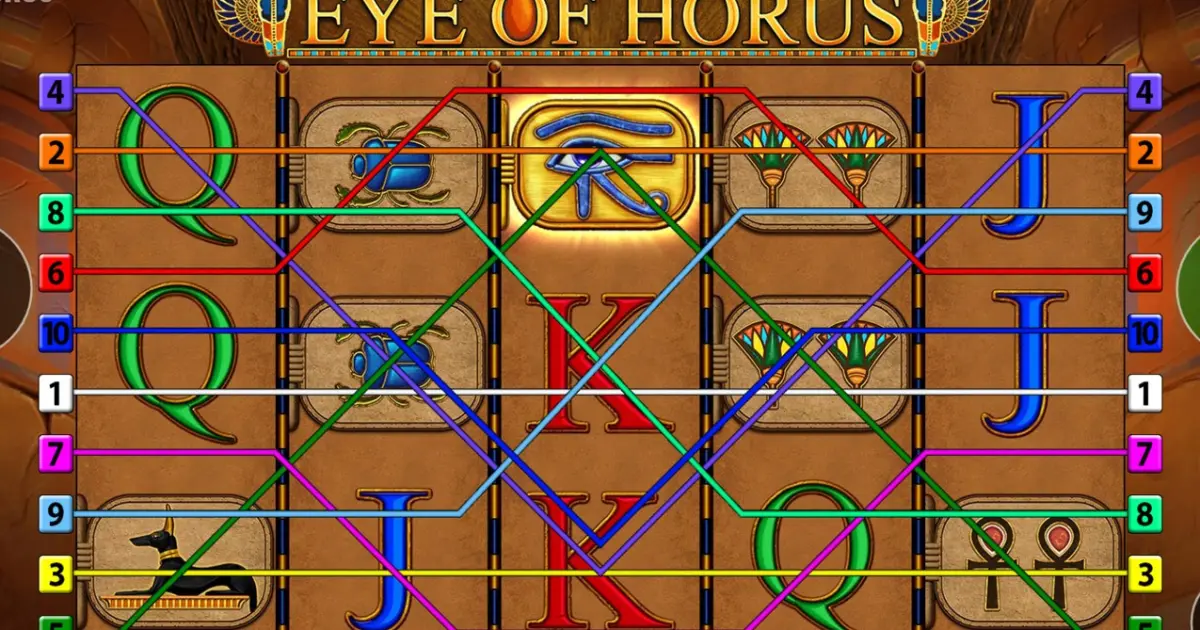
The Eye of Horus slot is a Reel Time Gaming title that returns 96.31% to players over a very large number of spins, sitting above both the provider’s own average and the broader catalogue benchmark. It ranks in the 98.7th percentile for popularity among reviewed games, so you will find it in most major lobbies without difficulty.
First look at the Eye of Horus slot
Reel Time Gaming has published eleven titles in total, and this is the one that draws the most players by a wide margin. The name references the Eye of Horus, a symbol from Egyptian mythology, but the review data available here describes no specific visual elements, so I will not speculate on graphics or animation style.
What the numbers do tell you: this is the provider’s highest-ranked game by popularity and one of its better RTP performers. It carries a free demo, which means you can evaluate the rhythm of play before staking a penny. For a slot that has been circulating long enough to reach a 259th overall rank while still sitting in the top one percent of player interest, the staying power speaks for itself.
The practical question is whether the underlying mathematics justify the attention. The sections below work through what we know and, equally important, what Reel Time Gaming has not disclosed.
How a round plays out
The FACTS available for this title confirm it is a slot machine but do not specify reel count, payline structure, or symbol set. I cannot describe what happens on each spin beyond the broad category. What I can say is that Reel Time Gaming, as a provider known for straightforward mechanics, typically builds games around conventional reel spins with no cascading symbols or expanding grids in their standard titles — though I cannot confirm that pattern applies here without published documentation.
Many slots in this provider’s catalogue carry free-spin features triggered by scatter symbols and a wild symbol that substitutes for standard paying icons. Whether Eye of Horus includes those mechanics specifically is not stated in the data I have. If that matters to you, the demo version will answer the question in under two minutes of play.
Reading the 96.31% return figure
RTP is a long-run theoretical average. At 96.31%, the game is designed to return £96.31 for every £100 wagered across millions of spins. No single session will match that figure. A short run of fifty spins could return 40% or 300% with equal statistical legitimacy.
What the comparison figures tell you matters more than the raw number in isolation:
| Metric | Value |
|---|---|
| This game’s RTP | 96.31% |
| Reel Time Gaming average | 95.50% |
| Catalogue-wide average | 95.71% |
| Gap above corpus average | +0.60% |
| Provider game count | 11 |
| Popularity rank (overall) | 259 |
| Popularity percentile | 98.7 |
| Free demo available | Yes |
Against the provider’s own portfolio, Eye of Horus returns roughly 0.81 percentage points more than the average Reel Time Gaming title. That gap compounds over extended sessions. Across 10,000 spins at one pound each, the difference between 96.31% and 95.50% is £81 retained rather than lost.
The +0.60% above corpus average is a meaningful margin in a market where most games cluster within half a point of 96%. Compare it to Eye of Horus Megaways, the sequel format that returns only 95.45% — 0.86 points lower despite sharing the brand. If the visual style appeals to you, the original delivers materially better long-run economics.
Why volatility changes your bankroll maths
Reel Time Gaming has not published a volatility classification for this title. That absence matters. Without knowing whether the game is rated low, medium, or high volatility, you cannot plan session length or predict swing behaviour from the data alone.
As a general principle: low-volatility slots return frequent small wins that stretch a bankroll across many spins but rarely deliver single large payouts. High-volatility slots produce long dry spells punctuated by occasional bigger returns, requiring a deeper starting balance to survive the troughs. Medium sits between those poles with moderate frequency and moderate size.
Your practical option is the free demo. Track how often a winning spin lands over the first one hundred or two hundred plays. If you see wins every three to five spins consistently, you are looking at low volatility behaviour. If ten or fifteen spins pass blank between hits, that points higher. The RTP figure stays the same regardless — volatility governs the shape of the session, not its endpoint.
Bet sizing and what’s missing
No minimum or maximum stake range is published for Eye of Horus in the available data. This means I cannot map specific bet levels to specific bankroll durations. The reader’s workaround is the same as for volatility: the demo will display the stake selector, letting you confirm the floor before you fund an account.
Where general guidance applies: at any given stake per spin, your total action is stake multiplied by number of spins. A £1 bet across 500 spins means £500 total wagered. At 96.31% RTP, the expected loss across that sequence is roughly £18.50 — but variance will scatter the actual outcome far from that number in either direction. Set your session budget around the worst-case swing, not the expected one.
Where Eye of Horus sits among Egyptian-themed slots
The catalogue data assigns zero other titles to a matching theme category for this game, so no direct Egyptian-theme comparison set exists within this review corpus. That is unusual for a game drawing on one of the most popular slot themes in the industry.
Within Reel Time Gaming’s own output, the alternatives worth comparing are Fishin’ Frenzy at 96.12% RTP — still above the corpus average, with a completely different aesthetic — and El Torero at 96.08%. Neither reaches Eye of Horus’s 96.31%, and both carry fewer provider-level distinctions. If you specifically want Egyptian imagery with the best available maths from this studio, the original title is the only option among their eleven games.
The honest verdict
Eye of Horus clears the two bars that matter most for a first decision: it returns above average, and it is the provider’s flagship by popularity. The 0.60-point edge over the corpus average is real, compounding, and easy to justify when you compare it against the Megaways version that loses 0.86 points for the same brand familiarity.
The gaps are honesty gaps in the data, not necessarily flaws in the game. No volatility rating, no published stake range, no visual description beyond the title’s mythological reference. Treat those absences as signals to play the demo before committing funds.
Play only what you can comfortably lose. An 18+ slot session is paid entertainment, not income. Set a budget before your first spin, stop when it is gone, and never increase stakes to chase a previous loss — every spin is independent and no outcome changes the odds on the next one.
Frequently Asked Questions
Can you play Eye of Horus for free before betting real money?
Yes, a free demo version is available for this Reel Time Gaming slot. The demo lets you test stake levels, observe win frequency, and gauge volatility behaviour without risking funds. However, demo outcomes carry no predictive weight for real-money play since both use identical random number generation with the same underlying maths.
What is the RTP of Eye of Horus and is it good?
The published RTP is 96.31%, which exceeds both the Reel Time Gaming portfolio average of 95.50% and the broader catalogue average of 95.71% by roughly half a percentage point. Over tens of thousands of spins this margin translates to measurable retained value compared to below-average alternatives.
Is Eye of Horus a high or low volatility slot?
Reel Time Gaming has not published a volatility classification for this title in available review data. You can infer volatility patterns from the free demo by tracking how many spins pass between winning outcomes, or by checking whether the game's paytable shows a small number of high-value symbols versus many closely grouped payouts.
How does Eye of Horus compare to the Megaways version?
Eye of Horus returns 96.31% RTP while Eye of Horus Megaways returns 95.45% — a gap of 0.86 percentage points favouring the original. Both sit within the same provider portfolio. The original also ranks higher in popularity, suggesting players have responded positively to its mechanics and mathematics.
Who makes the Eye of Horus slot and what other games does the studio produce?
Reel Time Gaming developed this title as one of eleven published slots. Other offerings from the same studio include Fishin' Frenzy at 96.12% RTP and El Torero at 96.08%. Eye of Horus outperforms both on RTP and is the provider's most widely played game by a significant margin.




