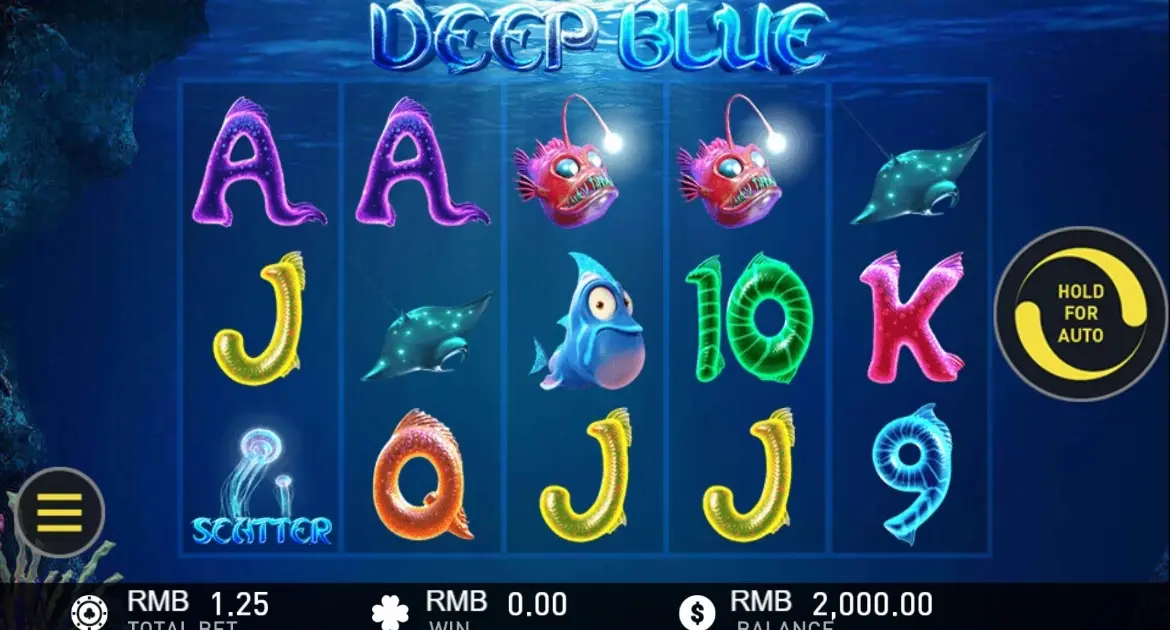
Deep Blue is a slot machine from Gameplay Interactive, and the honest headline is that the published data on this deep blue slot is thin: no return figure, no volatility rating, no stake range. What you do get is a free demo and a popularity position inside the top 15% of the catalogue. Whether that is enough to justify real money is a decision the numbers cannot make for you.
First look at Deep Blue
The verifiable facts are short enough to list in full. Gameplay Interactive is the studio, the game is classified as a slot machine, and it sits at rank 2,959 by popularity, which places it in the 85.2nd percentile. That percentile is a measure of traffic and interest, not of quality or of how the game pays.
| Detail | Value |
|---|---|
| Provider | Gameplay Interactive |
| Game type | Slot machine |
| RTP | Not published |
| Volatility | Not published |
| Stake range | Not published |
| Popularity rank | 2,959 (85.2nd percentile) |
| Provider catalogue size | 118 games |
| Provider average RTP | 96.69% |
| Site-wide average RTP | 95.71% |
| Free demo | Available |
Three of the four figures that normally drive a slot decision are absent here. That absence is not neutral information you can shrug off; it is the single most important thing to know before deciding whether to play for stakes.
How a round plays out
FACTS gives no reel layout, no payline or ways count, and no feature list, so anything written here about specific symbols, bonus rounds or multipliers would be invention. It is worth being blunt about that, because plenty of pages will describe features this title may not have.
What can be said in general terms: most slot machines resolve a round the same way. You set a stake, the reels resolve, and a random number generator determines the outcome independently of every spin before it. Many slots layer wilds, scatters and free-spin triggers on top of that base, and some sell a feature entry outright, but none of those mechanics are confirmed for Deep Blue.
The practical route is the Deep Blue free demo. A demo run shows you the layout, the paytable, the stake steps and how often small returns land, all without money at risk. It will not predict your real-money results, because outcomes are random, but it does answer the descriptive questions that the published data leaves open.
Reading the unpublished return figure
Return to player is a long-run average, not a session forecast. A 96% figure means a game returns about £96 for every £100 staked across a very large sample, often millions of spins. Across 500 spins at £1, your actual result can land far above or far below that line, because variance dominates at small sample sizes.
Gameplay Interactive has not published an RTP for this title, so treat any percentage quoted elsewhere as unverified. The useful reference points are the averages: the studio’s 118 games average 96.69%, and the site-wide average across all reviewed slots is 95.71%. The provider therefore trends roughly one point above the wider field, which is a reasonable prior but not evidence about this specific game.
If the exact figure matters to your decision, check the game’s own information screen in the demo or client. Many slots display RTP there even when no public spec sheet exists, and a number read off the game itself beats a number read off a review.
Why unrated volatility changes your bankroll maths
Volatility describes the shape of the outcomes rather than their average. Low volatility means frequent small returns, shallow swings and longer sessions from a given balance. High volatility means long stretches of nothing punctuated by larger hits, which needs a bigger bankroll relative to your stake to survive.
The rating is not published for Deep Blue, and that changes how you should approach it. When you cannot tell whether a game pays every few spins or every few hundred, you cannot size a bankroll with confidence. The conservative response is to assume the wider variance of the two until the demo shows otherwise.
A demo session of several hundred spins gives you a rough feel for hit frequency and swing depth. Watch how long the dry runs get and how much of your demo balance disappears between returns. That observation is descriptive only; every spin remains independent, so a long gap makes the next spin no likelier to pay. No slot is ever due, warm or overdue.
Bet sizing without a listed minimum
No minimum or maximum stake is recorded for this title, so the limits will only be visible once the game loads. Check them in the demo before you decide anything, because the gap between a game’s floor and ceiling determines whether it fits your budget at all.
The arithmetic is straightforward once you know the floor. A £0.20 spin gives a £40 balance 200 spins; the same balance at £2 a spin gives you 20. Stake size does not change the expected return per pound wagered, only how quickly your budget resolves and how much variance you feel along the way.
Decide your total session budget first, then divide by the number of spins you want, and let that quotient set your stake. Working the other way round, picking a stake and hoping the balance lasts, is how sessions end earlier than planned. No staking pattern, progression or timing alters the underlying maths of an independent random outcome.
Where the deep blue slot sits among Gameplay Interactive slots
No theme is recorded for this game, and the theme grouping contains no other titles, so there is no thematic peer set to compare against. The meaningful comparison is with the rest of the studio’s 118-game catalogue.
The clearest contrast is Fountain of Fortune, which carries a published 97.0% return — above the provider’s 96.69% average and more than a point above the site-wide 95.71%. If a confirmed RTP is a requirement for you, that is the stronger starting point. For a look at how the studio handles other formats, Pharaoh and Monsters Cash are both in the same range of the catalogue, though neither has a published return figure either, so they share Deep Blue’s documentation gap.
That pattern matters. Missing specs across several titles suggests an inconsistent disclosure habit rather than an oversight on one game, which is worth weighing if transparency is part of how you choose.
The honest verdict
Deep Blue is a hard title to recommend on paper, because the paper is nearly blank. There is no return figure, no volatility rating and no stake range, and the popularity percentile of 85.2 tells you people find it without telling you anything about how it plays. The provider’s 96.69% average is mildly encouraging context, not a substitute for a number attached to this game.
The sensible sequence is simple: load the demo, read the in-game information screen, run a few hundred spins, and only then decide whether it earns your money. If Fountain of Fortune’s documented 97.0% suits you better, that is a defensible choice too. This is also a genuine Deep Blue no download option, so testing it costs nothing but time.
Slots are paid entertainment for over-18s, not an income. Set a budget you are comfortable losing before you start, keep to it, and stop when it is gone rather than topping up. If play stops feeling like entertainment, that is the moment to close the game.
Frequently Asked Questions
Can I play Deep Blue for free?
A free demo of Deep Blue is available, so you can load it without depositing or downloading anything. Demo mode is the practical way to see the reel layout, paytable and stake steps that Gameplay Interactive has not published. Keep in mind that demo results are random and tell you nothing about how a real-money session will go.
What is the RTP of Deep Blue?
No RTP figure has been published for Deep Blue, so any percentage quoted elsewhere should be treated as unverified. For context, Gameplay Interactive's 118 games average 96.69%, against a site-wide average of 95.71%. Check the game's own information screen once it loads, since many slots display their return figure there.
Is Deep Blue high or low volatility?
The volatility rating is not published for this title, which makes bankroll planning harder. Low volatility means frequent small returns and longer sessions; high volatility means deeper dry spells and bigger swings. Until a demo run of several hundred spins shows you the pattern, assume the wider variance and size your stake accordingly.
Who makes Deep Blue and what else do they produce?
Gameplay Interactive develops Deep Blue and has 118 games in its catalogue, averaging 96.69% RTP. Other titles include Fountain of Fortune at a published 97.0%, plus Pharaoh and Monsters Cash. Like Deep Blue, those last two have no published return figure, which points to inconsistent disclosure across the range.
How does Deep Blue compare to Fountain of Fortune?
Fountain of Fortune has the documentation advantage: a published 97.0% return, above the provider's 96.69% average and the 95.71% site-wide figure. Deep Blue publishes no RTP at all. Both come from Gameplay Interactive, so if a confirmed return figure drives your decision, Fountain of Fortune is the clearer choice.