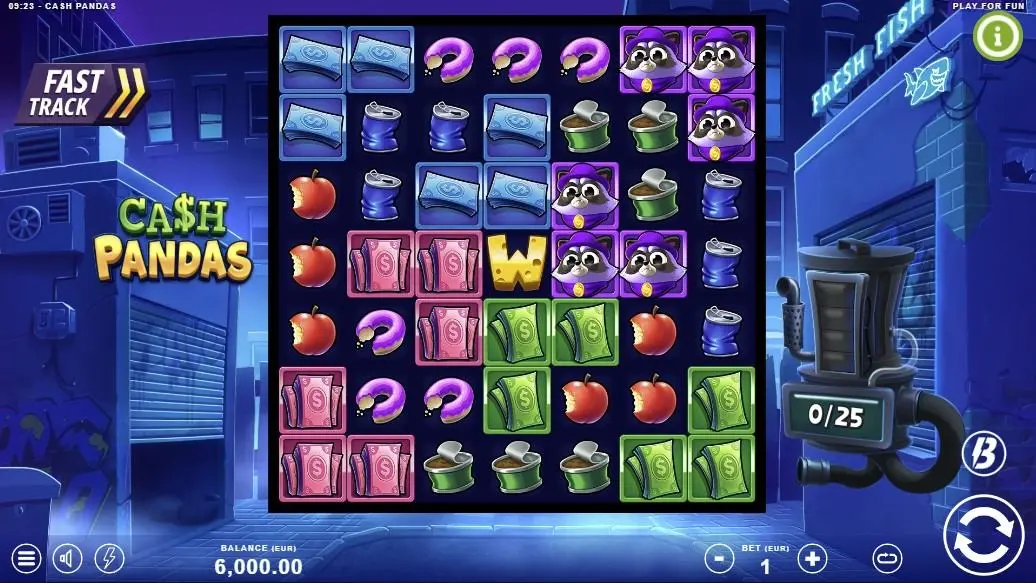
Straight answer first: on the numbers available, the cash pandas slot is a fair-value game rather than a standout one. Its 96.16% RTP is above the 95.71% average across the slots in our database and marginally above SlotMill’s own 96.08% house average. What you do not get is a published volatility rating, a max win figure or a stated stake range, so a chunk of the decision has to be made in the demo rather than on the spec sheet.
Is Cash Pandas worth playing?
It is worth a look if you are comfortable judging swing by feel, and worth skipping if you need a documented risk profile before you commit a bankroll. The case for it rests on two figures. First, a return-to-player percentage of 96.16%, which places it in the upper half of the market by a small but real margin. Second, its popularity: ranked 2955 overall, it sits in roughly the 85th percentile of the titles we track, which tells you a meaningful number of people keep coming back to it rather than trying it once.
The case against is thinner but still matters. SlotMill has not published volatility, hit frequency, a maximum win multiplier or a minimum and maximum bet. None of those absences make a game bad. They do mean you cannot plan a session around them in advance, and they mean any specific figure you see quoted for this title elsewhere should be treated as unverified until SlotMill says otherwise.
Here are the confirmed figures in one place.
| Specification | Detail |
|---|---|
| Provider | SlotMill |
| RTP | 96.16% |
| Reels | 7 |
| Primary theme | Money and wealth |
| Secondary theme | 7-Reels |
| Category | Slot Machine |
| Popularity rank | 2955 (85.2nd percentile) |
| Free demo | Available |
| Volatility | Not published |
| Max win | Not published |
What 96.16% RTP means over 1,000 spins
RTP is a long-run statistical average, not a session forecast. A 96.16% figure means that across an enormous sample of spins the game is built to return £96.16 for every £100 staked, leaving a theoretical house edge of 3.84%.
Scale that to something you might actually play. At £0.50 a spin, 1,000 spins puts £500 through the game. The mathematical expectation is a return of about £480.80, so an average loss near £19.20. At £1 a spin the same 1,000 spins wager £1,000 for an expected return around £961.60.
Now the important caveat: almost nobody lands on that number. A thousand spins is a small sample in statistical terms, and the results spread widely around the average. You might finish well ahead or lose the entire £500. The percentage only tightens toward 96.16% across hundreds of thousands of spins, aggregated across every player.
The 0.45 percentage point edge over the 95.71% corpus average is worth about £4.50 per £1,000 wagered compared with a typical game. Real, but small enough that it should not be the only reason you pick a title.
How volatile is the cash pandas slot?
SlotMill has not published a volatility rating for this game, so any claim you read that it is low, medium or high is someone’s guess. That absence is worth stating plainly rather than papering over.
What you can do is understand the axis you are being asked to judge. Low volatility games pay smaller amounts more often; balances drift down gently, sessions last longer at a given stake, and the required bankroll is modest. High volatility games pay less often but larger when they do; balances can fall for long stretches, and the bankroll needed to ride out a dry spell is several times bigger. Medium sits between the two. Volatility does not change RTP at all. Two games can both return 96.16% in theory while producing completely different session experiences.
Since the rating is missing, the demo is your measuring tool. Run a few hundred spins at a fixed stake and watch how the balance behaves: frequent small returns with shallow dips suggests the lower end of the scale, long flat stretches punctuated by occasional jumps suggests the higher end. Treat that as a rough read on rhythm only. Demo results are independent random outcomes and predict nothing about a future real-money session.
What the Money and wealth theme brings to the game
The theme label tells you the presentation leans on imagery of money and prosperity, and the title points at pandas. That is genuinely as far as the confirmed information goes. SlotMill has not published a description of the artwork, the symbol set or the audio, so this review will not invent one. Load the free demo if the look and feel matters to you; it takes thirty seconds to judge for yourself.
Money and wealth is one of the most crowded categories in the market, with 549 titles in our database carrying that tag. That has a practical upside: if the aesthetic appeals but the maths does not, substitutes are plentiful. It also means the theme itself is not a differentiator, and any release in this bracket has to stand on its numbers.
The second tag, 7-Reels, is the more unusual one. Most slots use three or five reels. A seven-reel layout changes the geometry of how symbols can line up and generally supports a different paytable structure to a standard five-reel grid. How that plays out here depends on the paytable and payout method shown in the game itself, which SlotMill has not detailed publicly.
Stakes, session length and bankroll
No minimum or maximum bet has been published for this title, so check the stake selector in the game before you deposit anything. The arithmetic of session planning does not change regardless of what those limits turn out to be.
Work backwards from money you are content to lose, not from a target. Divide that figure by the number of spins you want, then adjust for the fact that outcomes vary widely around the average. A £50 budget at £0.20 a spin buys roughly 250 spins before variance is accounted for, and the 3.84% house edge means expected cost over those spins is about £2, with actual results scattered on either side. The same £50 at £2 a spin buys 25 spins and a much rougher ride.
One thing that never helps: adjusting stakes according to what just happened. Every spin is an independent event, and no staking pattern, sequence or timing changes the expected return. Increasing your bet after losses raises how fast your money moves, nothing else. Pick a stake you can repeat without flinching and leave it alone.
Alternatives if Cash Pandas is not for you
If the missing volatility rating bothers you but you like SlotMill’s output, the studio has 35 games with a 96.08% average RTP, which is a consistent house standard rather than a couple of headline titles propping up a weak catalogue. Neon Dreams edges slightly ahead on paper at 96.20%, so it is the closer comparison if you want the marginally better theoretical return from the same developer. Fortune Pandas shares the panda angle but returns 96.01%, a 0.15 point step down that costs about £1.50 per £1,000 wagered.
If the return figure is what you care about most, Dogmasons MegaWOOF sits at 96.80% within the same Money and wealth category. That is 0.64 points better than Cash Pandas, worth roughly £6.40 per £1,000 staked over a very large sample. Worth noting that RTP alone does not tell you which game will suit your session; a higher return paired with a much harsher swing profile can empty a small bankroll faster than a lower-RTP game with gentler variance.
Final take
Cash Pandas gives you an above-average theoretical return in a crowded category, from a studio with a steady RTP record, and a seven-reel layout that is less common than the five-reel default. Against that, the spec sheet has real gaps: no volatility rating, no max win, no stake range. The Cash Pandas free demo is the sensible first step, because it costs nothing and fills in exactly the information SlotMill has left out.
Slots are paid entertainment, not income. Play only if you are 18 or over, decide your budget before you open the game, and stop when you reach it rather than when you feel you are owed something. If it stops being fun, close it.
Verdict: a solid, unremarkable option on the numbers. Try it free, form your own view of the swing, and compare it against the alternatives above before committing real money.
Frequently Asked Questions
Can you play Cash Pandas for free?
A free demo of Cash Pandas is available, so you can spin it with virtual credits and no deposit. That matters more than usual here, because SlotMill has not published a volatility rating or stake range for the game. The demo is the only reliable way to see how the 7-reel layout actually behaves during a session.
What is the RTP of Cash Pandas?
The published RTP is 96.16%, meaning the game is designed to return £96.16 per £100 wagered across an extremely large sample of spins. That leaves a theoretical house edge of 3.84%. It sits 0.45 points above the 95.71% average across our database and slightly above SlotMill's own 96.08% catalogue average.
Is Cash Pandas high or low volatility?
SlotMill has not published a volatility rating for Cash Pandas, so nobody can state it with confidence. Low volatility means smaller, more frequent returns and longer sessions at a given stake; high volatility means rarer but larger payouts and a bigger bankroll requirement. Volatility never changes the 96.16% RTP, only the shape of the ride.
Who makes Cash Pandas and what else do they produce?
SlotMill developed it. The studio has 35 titles in our database with an average RTP of 96.08%, which is a fairly consistent standard rather than one or two strong outliers. Other SlotMill slots include Neon Dreams at 96.20%, Tiki Thunder at 96.10% and Fortune Pandas at 96.01%, all within a narrow band.
How does Cash Pandas compare with Dogmasons MegaWOOF?
Dogmasons MegaWOOF carries a higher published RTP at 96.80% against 96.16% for Cash Pandas, a gap worth roughly £6.40 per £1,000 wagered over a very large sample. Both sit in the Money and wealth category, one of 549 such titles. RTP is only one axis, though, and neither game has a published volatility rating to compare.