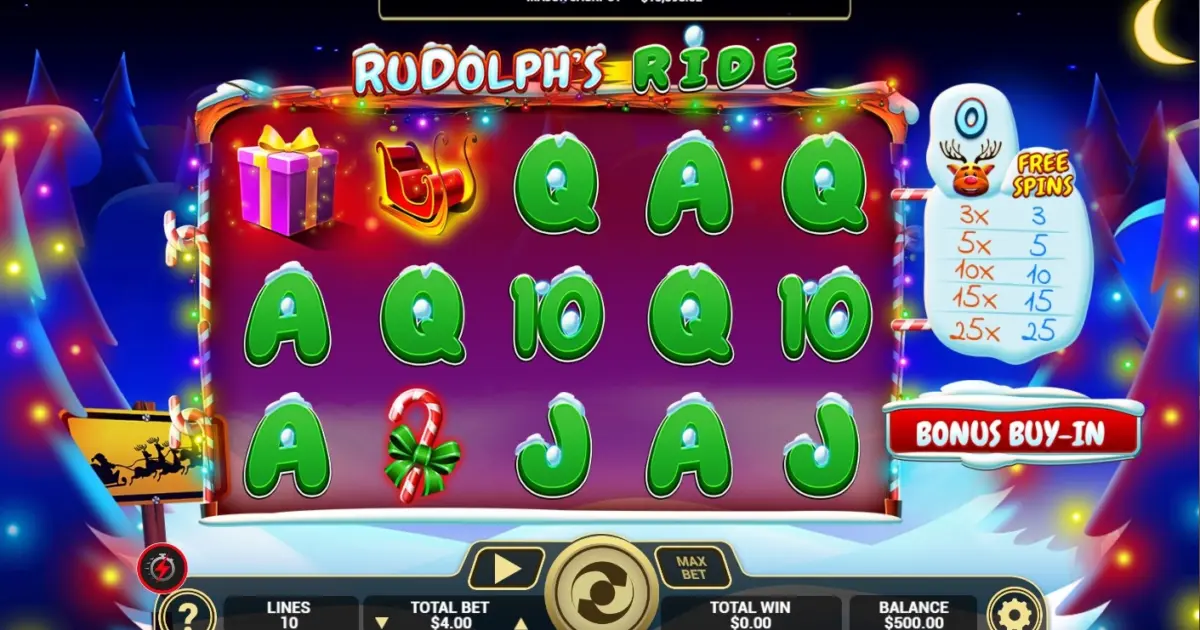
The case for this game is short. The rudolphs ride slot carries a published return to player of 95.28%, sits on five reels, wears a Christmas theme, and comes from Arrow’s Edge. A free demo exists, so the cost of finding out whether the pace suits you is zero. What Arrow’s Edge has not published is almost as informative as what it has.
Rudolphs Ride at a glance
Here is everything the supplier has actually put on record, with nothing filled in by guesswork.
| Field | Value |
|---|---|
| Provider | Arrow’s Edge |
| RTP | 95.28% |
| Reels | 5 |
| Primary theme | Christmas |
| Type | Slot Machine |
| Popularity rank | 2,934 (85.3rd percentile) |
| Arrow’s Edge average RTP | 94.98% across 40 games |
| Average RTP across this catalogue | 95.71% |
| Free demo | Available |
Read that table as a boundary, not a summary. There is no published volatility rating, no stake range, no max win figure, no paylines or ways count, and no description of any bonus feature. If you see a specific free-spin count or multiplier cap quoted for this title elsewhere, nothing in the supplier data supports it. The game suits someone who likes a seasonal theme, is comfortable with a mid-90s return, and is willing to learn the rest from the demo rather than from a spec sheet.
What a 95.28% RTP actually returns
RTP is a long-run statistical average, not a session promise. At 95.28%, the modelled return is £95.28 for every £100 wagered, measured across a sample far larger than any single person plays. The counterpart figure is the house edge: 4.72% of turnover.
Work it through. A hypothetical 1,000 spins at £0.20 is £200 of turnover, which models out to roughly £190.56 returned and about £9.44 retained. Raise the stake to £1 and the same 1,000 spins turn over £1,000, modelling £952.80 back and £47.20 held. The percentage never changes; the cash consequence scales directly with stake and spin count, which is the only lever you control.
Against the 95.71% average across the games catalogued here, this title runs 0.43 percentage points below par. Against the Arrow’s Edge house average of 94.98% it is slightly above. Neither gap is dramatic, but higher-return Christmas games are easy to find: Gates of Olympus Xmas 1000 is published at 96.5%, which is 1.22 points better on the same turnover. Over 1,000 spins at £1 that difference is about £12 in modelled cost.
Unpublished volatility and what your session will feel like
Arrow’s Edge has not published a volatility or variance rating for this game, so the honest answer is that the swing profile is unknown until you watch it. That absence matters, because volatility governs how the 95.28% arrives.
In general terms, a low-volatility slot pays small amounts often. Balances drift rather than lurch, sessions last longer on a fixed budget, and the experience is steady. A high-volatility slot pays rarely but larger, which means long stretches of nothing punctuated by occasional spikes, and a bankroll that needs to be several times deeper to survive the dry runs. Medium sits between the two. The published RTP is identical in all three cases; only the shape of the ride changes.
Without a rating, the demo is your measuring instrument. Spin a few hundred times and watch how often anything lands at all, and how far the balance travels between the small returns. That gives you a practical read on variance that no label would give you anyway. One caution: whatever you observe, every spin is independent, and a quiet stretch tells you nothing about the next one.
The 5-reel layout and how wins are counted
Five reels is the standard modern frame and the one most players already read fluently. What the supplier has not stated is how wins are evaluated across those reels, and that is the single biggest gap in the data.
Across slots generally, five-reel games settle on one of a few systems. Fixed paylines award a prize when matching symbols land on a defined path, usually left to right, and the payline count is printed in the rules. Ways or all-ways games drop paylines entirely and pay for matching symbols anywhere in a column, which produces a large nominal combination count. Cluster and grid games pay for touching groups instead. Each system changes how frequently something registers, even at identical RTP.
Nothing in the published facts tells you which of those this game uses, nor which symbols exist, nor whether wilds, scatters or a free-spin round are present. Those are common slot furniture, not confirmed features here. Open the paytable in the demo first; it is the authoritative source for this title, and it costs nothing to read.
Stake range and sizing a bankroll
No minimum or maximum stake has been published for this game either, so treat the figures below as method rather than specifics, and confirm the real limits in the demo or the game’s own bet panel.
The useful way to size a bankroll is to work backwards from session length. Decide what you are willing to spend, then divide by the number of spins you want. A £40 budget across 400 spins means £0.10 per spin. The same £40 across 100 spins means £0.40. Nothing about the maths changes with stake size, but the higher figure compresses your session and widens the range of outcomes you will actually experience.
If the demo suggests long gaps between returns, the deeper spin count is the more comfortable choice, because thin bankrolls run out during the quiet stretches rather than during the loud ones. Avoid any stake progression sold as a fix. Raising or lowering bets after a result cannot move a 4.72% house edge; it only changes how fast the budget is consumed.
Playing the Rudolphs Ride demo before you commit
Free play is available, and given how much is unstated here it is the sensible first step. The Rudolphs Ride free demo runs in the browser with no download, and it is the only way to confirm the paylines or ways structure, the symbol set, whether any feature round exists, and the real stake limits.
Use it as a test, not a trial run for luck. Demo results are generated by the same independent logic but carry no predictive value whatsoever for later real-money sessions; a strong or weak stretch in free play means nothing about what follows. What the demo does reliably show you is pace, clarity of the interface, and whether a Christmas theme holds your attention for a few hundred spins.
Slots are 18+ and priced entertainment, not a way to make money. Decide your budget before you open the game, treat that amount as spent, and stop when it is gone rather than when you feel close to something. If tracking that gets difficult, deposit limits and time-outs exist for exactly that reason.
Verdict: who should play Rudolphs Ride
This is a reasonable seasonal pick with a documented return that is a little under average and a documentation gap that is wider than average. At 95.28% you are giving up 4.72% of turnover in the long run, which is fair without being competitive. Its 2,934rd rank puts it in the 85.3rd percentile for attention among the games listed here, so it is played, not obscure.
It fits you if you want Christmas theming from a smaller studio and you are content to learn the mechanics by playing rather than by reading. It fits you less well if you compare RTP line by line before staking, in which case Lucky Santa Bonanza at 96.12% covers the same season for less modelled cost. For a sense of the Arrow’s Edge range, Splash Cash sits lower again at 93.54%, which makes this title one of the stronger returns among the 40 games the studio has catalogued. Check the paytable in the demo before you stake anything.
Frequently Asked Questions
Can I play Rudolphs Ride for free?
A free demo is available, and it runs in the browser with no download required. That matters more than usual with this title, because Arrow's Edge has not published its volatility rating, stake range or paytable details. The demo is the only reliable place to check the symbol set, how wins are counted, and the real bet limits.
What is the RTP of Rudolphs Ride and is it good?
The published RTP is 95.28%, meaning a modelled return of £95.28 per £100 wagered across a very large sample, with a 4.72% house edge. That is 0.43 percentage points below the 95.71% average across the games catalogued here, and slightly above the 94.98% Arrow's Edge average. Fair, not class-leading.
How volatile is Rudolphs Ride?
No volatility rating has been published for this game, so the swing profile is genuinely unknown before you play. Low variance means frequent small returns and longer sessions; high variance means rare larger ones and a deeper bankroll requirement. The RTP stays 95.28% either way. A few hundred demo spins will show you which pattern it follows.
Who is Arrow's Edge and what else do they make?
Arrow's Edge is the studio behind this release, with 40 games catalogued here at an average RTP of 94.98%. That places this title slightly above their own house average. Splash Cash, at 93.54%, sits lower on return, while Game of Kings and their Cleopatra release have no published RTP figure at all.
How does Rudolphs Ride compare to Gates of Olympus Xmas 1000?
Gates of Olympus Xmas 1000 is published at 96.5% against 95.28% here, a 1.22 percentage point advantage on identical turnover. Over 1,000 spins at £1 that difference models out to roughly £12. Both are Christmas slots, and the seasonal category is crowded with 467 titles, so RTP is a practical way to narrow the field.