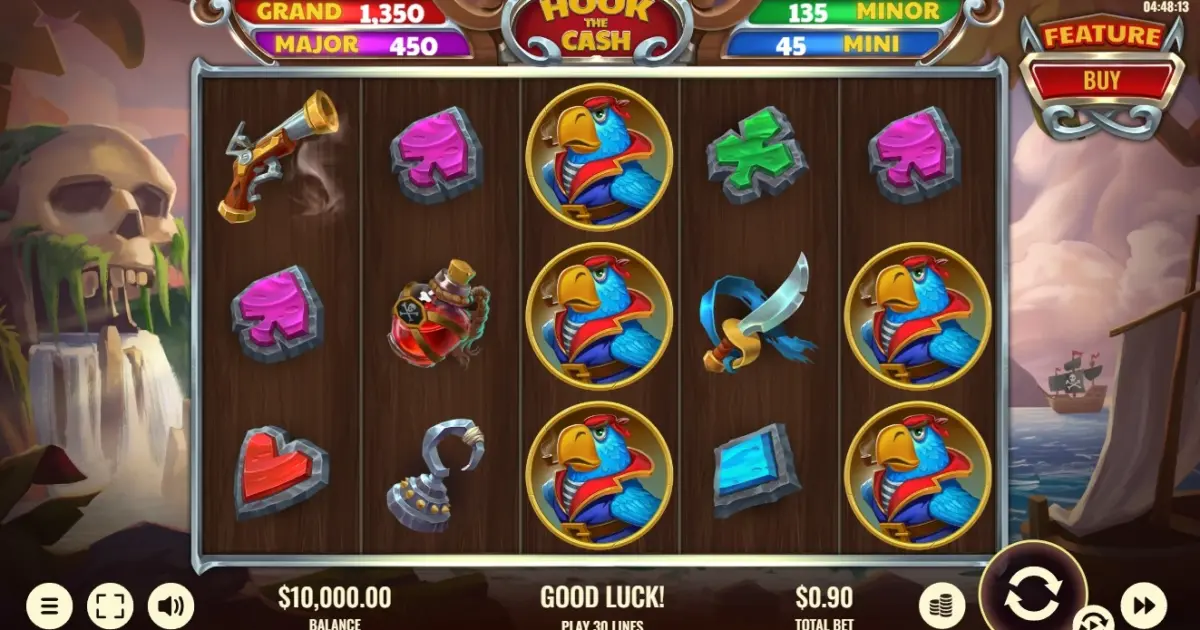
Should you try Hook the cash? If you want a straightforward 5-reel Pirates game you can test free before you commit, it does the job, but its 94.00% return sits below both the provider and site averages — so you are paying a small mathematical premium for the theme. The hook the cash slot makes most sense for short, low-stakes demo sessions or for players who specifically want Platipus’s Pirates catalogue rather than chasing the best percentage on the page.
First look at Hook the cash slot
Hook the cash Slot is a 5-reel entry from Platipus, a studio with 99 titles in this corpus, listed under the Pirates and 5-Reels themes. Its headline numbers are simple: 5 reels, 94.00% RTP, and a Pirates primary theme that puts it in a large peer group of 293 games sharing that tag. There is no volatility rating, no published bet range, and no max win figure supplied in the available data for this review, which matters more than it sounds — without those figures you cannot model swing size or required bankroll with any precision.
What you can see at a glance is where it sits in context. Platipus averages 95.18% across its own catalogue, so this title runs 1.18 points below its maker’s own average. Against the wider corpus average of 95.71%, it is 1.71 points lower. On popularity it ranks 2917, placing it in the 85.4th percentile for visibility on site — not a headline hit, but not obscure either. A rank like that often means fewer community data points and fewer independent write-ups to cross-check, so the absence of detail is worth noting.
For a free-demo review site, the practical first look is this: you can load Hook the cash in demo mode here and get a feel for reel count and pacing without spending. Use that to confirm whether the basic 5-reel structure and Pirates presentation hold your attention, because the maths alone does not make it stand out from higher-return alternatives.
How a round plays out
With 5 reels confirmed, Hook the cash follows the most common slot layout online: five vertical columns that spin and stop independently each round, with symbols landing on rows to form combinations according to the game’s paytable. A 5-reel structure by itself does not tell you how many paylines or ways are active, how wins are evaluated, or whether symbols pay left-to-right, both ways, or in clusters — none of that is in the supplied facts for this title, so it should not be assumed.
Many slots use familiar tools to shape a round — wild symbols that substitute, scatter symbols that may trigger features when enough appear, free spins, or buy-feature options — but those are general concepts, not confirmed features of this specific game. Because the facts block for Hook the cash does not list wilds, scatters, free spins, multipliers, jackpots, hit frequency or any bonus mechanic, the honest description stops at the reel count. If you see a site describing a specific bonus round for this title, treat it as unverified until you can confirm it in the in-game help or paytable.
What you can reliably expect from the format is independence of spins. Each press is a fresh random outcome; previous results do not influence the next. The number of reels influences how the grid looks and how combinations can form, but it does not change that core randomness. The most useful thing demo play gives you here is a sense of pace and readability — how quickly reels settle, how clearly wins are highlighted, and whether the interface makes bet, balance and paytable information easy to find.
| Item | Detail |
|---|---|
| Game | Hook the cash |
| Provider | Platipus |
| RTP | 94.00% |
| Reels | 5 |
| Themes | Pirates, 5-Reels |
| Provider average RTP | 95.18% |
| Corpus average RTP | 95.71% |
| Rank / percentile | 2917 / 85.4th |
| Free demo | Available |
Reading the 94% return figure
Return to Player is a long-run average, not a promise for a single session. A 94.00% RTP means £94.00 returned per £100 wagered across a very large number of spins — millions, not the dozens or hundreds you will actually play. Your short-term results are dominated by variance, and any session can finish well above or well below that average.
To make the figure concrete, take 1,000 spins at £1 a spin. You will have wagered £1,000 in total. At 94.00%, the statistical expectation is £940 returned and a £60 net loss over that sample, before variance. Over 10,000 spins at the same stake, the expectation scales linearly: £10,000 wagered, £9,400 returned, £600 net loss on average. The larger the sample, the closer real results tend to drift toward the theoretical figure, but they never lock to it in any single block of play you will experience.
Context helps. At 94.00%, Hook the cash is 1.71 points under the corpus average of 95.71% and 1.18 points under Platipus’s own average of 95.18%. That difference is small per spin but material over time: on £1,000 wagered, a 95.71% game would expect to return £957.10 versus £940 here — a £17.10 gap in expected return. None of this says the game cannot pay in a short burst; it only says the long-run price of play is a touch higher than average, so budget accordingly and treat demo time as entertainment rather than evidence of future performance.
Why volatility changes your bankroll maths
No volatility rating has been published for Hook the cash in the data available for this review. That absence matters, because volatility is the other half of the maths alongside RTP. Volatility describes how the game’s returns are distributed: whether it tends to pay smaller, more frequent amounts or rarer, larger swings, and how quickly a bankroll can rise or fall around the long-run average.
In general terms, low-volatility games tend to stretch session time on a fixed budget — you see more hits, but individual wins are usually modest, so big swings are rarer and the bankroll line looks smoother. High-volatility games do the opposite: longer quiet stretches punctuated by larger potential swings, which means you need a bigger buffer to ride through dry spells without exhausting your budget. Medium volatility sits between those poles, balancing hit size and hit rate in a way that suits players who want some variation without extreme streaks.
Without a stated figure for this title, you cannot calibrate stake or session length with confidence. The responsible approach is to assume nothing and use demo play to observe pace in broad strokes, while keeping stakes modest and independent of prior results. Every spin remains a separate random event; no pattern of wins or losses makes the next spin more or less likely to pay, and no staking progression can change the underlying expected value set by the RTP.
Bet sizing from bet range upwards
The facts block for Hook the cash does not include a minimum or maximum stake, a default coin size, or the number of bet levels. When a studio does not publish that range in the data feed, the safest line for a review is to say so directly and explain why it matters, rather than to quote a figure you may see elsewhere.
In general, stake range determines how finely you can scale a session. A low minimum lets you extend play and keep hourly cost down, while a higher minimum forces a larger bankroll for the same number of spins. Maximum stake matters mainly to players with larger budgets or to those comparing games on cost-per-spin consistency. Without both ends of the range you cannot calculate spins-per-budget, which is the simplest planning tool you have: budget divided by stake equals the number of spins you can afford before top-ups, before any wins recycle funds.
If you arrive from a site quoting, for example, a 10p minimum or a £100 maximum, check it in the game itself once loaded — the in-game help, paytable or settings panel is the source of truth, and values can vary by casino or jurisdiction. Until you can verify the range on the version you will play, set a total session budget first and treat it as the price of entertainment. Choose a stake that gives you the session length you want on that budget, accepting that wins and losses will still move the balance unpredictably.
Where Hook the cash sits among Pirates slots
With 293 Pirates-themed games in the corpus, Hook the cash is in a crowded field where small RTP differences add up. Its 94.00% places it on the lower side of the Pirates peer group captured in the related data. Against 1 Reel Caribbean Treasure at 95.42%, you keep a little more long-run return for a different take on the Caribbean-Pirate idea — the 1.42-point gap equals £14.20 per £1,000 wagered in expected value terms, which can meaningfully extend demo-like session length at the same stake, even though any single session remains unpredictable.
Jaws and Jewels Power Combo is closer at 94.25%, only 0.25 points above Hook the cash, but still the higher of the two on the numbers alone; if you are choosing purely on percentage while staying inside Pirates, the slightly higher figure is the rational lean, all else equal. Cursed Pirates matches Hook the cash exactly at 94.00%, so the choice between the two comes down to presentation, reel count and how you find the pacing in demo rather than any maths edge. None of these comparisons predict a single session; they only tell you the long-run price tag attached to each theme variant.
Provider context sharpens the picture. Elsewhere in the Platipus catalogue, titles such as Royal Lotus at 95.00% and Crystal Sevens at 95.03% retain a full point more in expected return than Hook the cash, while Urban Neon at 95.34% is the highest of the linked studio peers. If you like Platipus overall but want a slightly better percentage, those are the natural next demos to queue up and compare on feel after you have tried Hook the cash free. Rank and percentile also tell a story: at 2917 and the 85.4th percentile, Hook the cash is not among the most surfaced titles, which may mean fewer side-by-side reviews and fewer community observations to sanity-check any claim you read off-site.
The honest verdict
Hook the cash is a straightforward 5-reel Pirates slot whose value proposition is simplicity and theme rather than standout maths. The 94.00% RTP is playable but undeniably below both the Platipus average and the wider site average, which makes it a slightly more expensive long-run proposition than many alternatives linked above. The bigger caveat is missing information: without published volatility, stake range, or feature details in the supplied facts, you cannot plan bankroll or session shape with precision and should be wary of any review that fills those gaps with specifics.
Try it free first if the theme appeals — demo is available and is the right way to judge pacing and readability without risk. If the numbers matter to you, line it up in practice against a higher-return Pirates option or a higher-return Platipus title from the related set and see which feel you prefer; the maths edge is small per spin but consistent over time, and no staking pattern changes it.
Keep it entertainment, not income. You must be 18+ to play, set a budget you can afford to spend before you start, and stop when that budget is gone. Use deposit or time limits if you find yourself chasing, and remember that free play predicts nothing about real-money outcomes — every spin is independent, wins are never due, and the house edge applies over the long run. If gambling stops feeling enjoyable, step away and seek support.
Frequently Asked Questions
Can I play Hook the cash free before wagering real money?
Free demo is listed as available for Hook the cash, so you can load it here with play money and get a feel for the 5-reel pace. Demo is still random and does not predict real-money results; each spin is independent and the 94.00% return only describes a very long-run average.
What is the RTP of Hook the cash and what does 94.00% actually mean?
Hook the cash has a 94.00% RTP, which is 1.71 points below the corpus average of 95.71%. It means £94.00 returned per £100 wagered across millions of spins. In a 1,000-spin block at £1, you would expect about £940 back and a £60 net loss on average, with wide short-term variance.
What volatility is Hook the cash and how would it affect my session?
No volatility rating is published in the facts for Hook the cash, so a specific risk profile cannot be stated. In general, low volatility stretches bankroll with smaller swings, high volatility needs a larger buffer for rarer bigger swings, and medium sits between. Without a figure, keep stakes modest and treat each spin as independent.
Who makes Hook the cash and what else does the studio offer?
Hook the cash is by Platipus, credited with 99 games in this corpus and a studio-average RTP of 95.18%. Related Platipus titles in the data include Royal Lotus at 95.00%, Crystal Sevens at 95.03% and Urban Neon at 95.34%, all slightly higher than the 94.00% on Hook the cash.
Does playing Hook the cash in demo ever pay real money?
Demo play uses virtual credits and cannot pay real money, even though the advertised 94.00% RTP is the same statistical model. Real-money play carries real risk and the same long-run house edge. If you switch to real stakes, set a budget, treat it as paid entertainment, and remember every outcome is random.