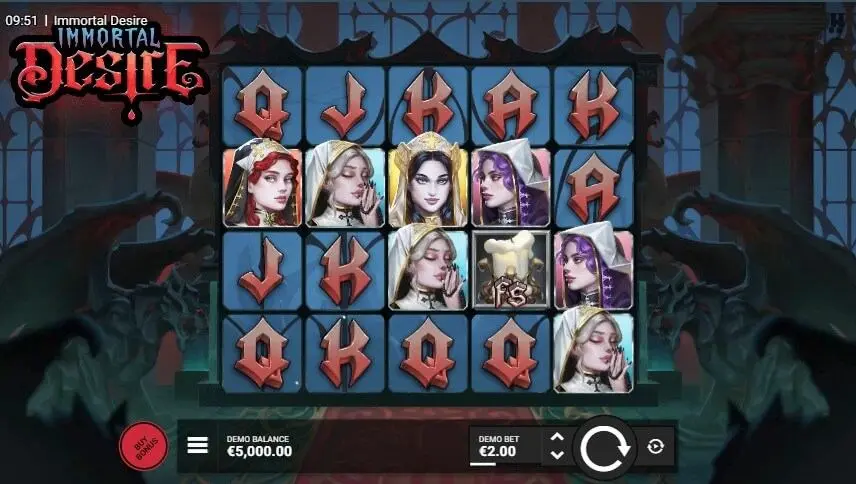
The numbers you can verify on the Immortal Desire slot are a 96.24% RTP, five reels, a horror theme and a free demo that needs no deposit. That return is slightly above both the Hacksaw Gaming house average and the wider database average, which makes it a reasonable pick if you judge games on published percentages. What you cannot verify is the swing pattern, because no volatility rating has been published for this title.
So the honest answer to “should I bother?” is: worth a demo session, with the caveat that you will be discovering the risk profile yourself rather than reading it off a spec sheet.
Immortal Desire slot versus the average slot
Across the games catalogued here, the mean RTP is 95.71%. This one is listed at 96.24%, putting it 0.53 percentage points ahead. That gap sounds trivial and, on a single spin, it is meaningless. Stretched over volume it becomes visible: wager £5,000 in total and the difference between a 95.71% game and a 96.24% game is about £26.50 in expected return. Not life-changing, but it is free — the higher-RTP game costs you nothing extra to choose.
Popularity tells a different story. The game sits at rank 2,816, which places it in the 85.9th percentile for traffic. Plenty of people find it, though it is not a front-page fixture. Popularity has no bearing on what a game returns; it reflects marketing, casino placement and how long a title has been in circulation. Treat rank as a signal of how easy the game is to find, nothing more.
One more framing point. A 0.53-point RTP edge is a structural advantage that never switches off, whereas a good or bad session is noise. If you are choosing between two similar-looking games, the published percentage is the only part of the decision you control.
| Provider | Hacksaw Gaming |
|---|---|
| RTP | 96.24% |
| Reels | 5 |
| Theme | Horror and scary |
| Free demo | Yes |
| Site-wide average RTP | 95.71% |
RTP breakdown: 96.24% in context
Return to player is a long-run average, calculated over simulation runs in the millions. A 96.24% RTP means that across an enormous sample of spins, the game is modelled to return £96.24 for every £100 staked, with the remaining £3.76 being the house margin. That figure describes the maths of the game, not your afternoon.
Scale matters enormously. At £0.50 a spin, 500 spins puts £250 through the game. Theoretical return on that is £240.60 — but the realistic range of outcomes around it is wide enough that £0 and £600 are both entirely ordinary results. Variance dominates at small sample sizes; the average only asserts itself over hundreds of thousands of spins, far more than any individual plays.
Each spin is also independent. The result of the previous spin has no influence on the next, the game does not track what it owes you, and nothing about a run of dead spins makes a paying one more likely. There is no timing, stake pattern or session length that alters the 3.76% margin. The percentage is fixed; only your exposure to it changes.
Volatility profile
No volatility rating has been published for this game, so anyone quoting you a confident “high volatility” figure is guessing. That absence is useful information rather than a dead end: it means you should establish the behaviour empirically in the demo before deciding on a stake.
The general framework still applies. Low-volatility slots pay small amounts frequently, which keeps balance movement gentle and sessions long on a modest bankroll. High-volatility slots pay rarely and larger, producing long flat stretches punctuated by occasional spikes — the same RTP delivered in a lumpier shape, and one that demands a far bigger bankroll relative to stake to survive the flat parts. Medium sits between the two.
What to watch for in a demo run of 200 to 300 spins: how often the balance moves at all, and whether the biggest single win is worth a handful of stakes or dozens. Frequent small returns point towards the low-to-medium end. Long silences broken by one outsized hit point towards the high end. That observation is about the shape of the game, not a prediction of results — a demo sample of a few hundred spins is far too small to estimate RTP or hit frequency reliably.
Hacksaw Gaming as a studio
Hacksaw Gaming has 156 titles catalogued here, with an average RTP across that library of 96.1%. That is a consistent house standard and it sits above the 95.71% database average, so the studio’s games tend to start from a slightly better baseline than the field. Immortal Desire’s 96.24% is marginally above its own studio’s mean.
If you want to compare inside the same catalogue, Wanted Dead or a Wild is listed at 96.38%, the highest of the Hacksaw Gaming slots sitting alongside this one, and Le Bandit at 96.34% is a close second. Both are a shade above the game reviewed here — a difference of roughly 10 to 14 pence per £100 wagered, which is real but small enough that theme preference is a legitimate tiebreaker.
A studio average is a rough quality signal, not a guarantee about any single release. Individual titles vary in RTP, and a studio can ship both 94% and 96.5% games. Check the figure on the specific game you are about to play rather than trusting the brand.
Three Horror and scary alternatives worth comparing
The horror category runs to 479 games here, so there is no shortage of substitutes. Three make instructive comparisons.
- Hand of Anubis is listed at exactly 96.24% — an identical return, which makes the choice between the two purely about presentation and mechanics rather than maths.
- Trickstar Spins sits at 94.0%. That is 2.24 percentage points worse, or an extra £2.24 of expected cost per £100 staked. On RTP alone it is the weaker option.
- Halloween Crystals has no published RTP in our data at all. Without that figure you cannot compare it on value, and an unpublished return is a reason for caution rather than curiosity.
Theme labels tell you the category a game was marketed into, not what it contains. A horror tag is a starting point for narrowing a shortlist; the published percentages are what separate the options once you have one.
Getting the most out of the free demo
The Immortal Desire free demo is available, runs in the browser, and needs no deposit or registration. Use it for the things a demo is genuinely good for: seeing how the reels behave, how fast a session moves, how often the balance shifts, and whether you actually enjoy the game before money is involved.
Be clear about what it cannot do. Demo credits are not real money and demo results do not predict real-money results — a lucky free run and a flat one are both just samples from the same fixed maths. Pay attention to the stake and spin-count controls while you are there; understanding how quickly turnover accumulates at a given bet size is the most transferable thing you will learn.
If you do move to real stakes: this is 18+ entertainment, and it should be budgeted like any other paid entertainment. Decide the amount before you start, treat it as spent, and stop when it is gone rather than topping up. If it stops feeling like a leisure spend, that is the point to close it.
Should you play Immortal Desire?
On the verifiable evidence, it holds up. A 96.24% return is 0.53 points above the database average and a touch above its own studio’s 96.1% mean, across five reels with a no-download demo available. If your shortlist criterion is published RTP, this clears the bar comfortably.
The reservations are about information, not quality. There is no published volatility rating, no max win figure, and no confirmed stake range in the available data, so you cannot plan a bankroll from the spec sheet the way you could with a fully documented title. Treat any max win or hit-frequency number you see quoted elsewhere with suspicion unless the studio published it.
Practical route: run a few hundred demo spins, watch how the balance behaves, and compare the feel against Hand of Anubis at the same 96.24% or Wanted Dead or a Wild at 96.38%. All three are close enough on maths that the deciding factor is which one you would rather sit with — and the demo answers that for nothing.
More from Hacksaw Gaming
- Le Pharaoh — 96.18% RTP
- Cursed Seas — 96.22% RTP
- Strength of Hercules — 96.31% RTP
- King Carrot — 96.3% RTP
- Magic Piggy — 96.19% RTP
- Ze Zeus — 96.34% RTP
- Book of Time — 96.13% RTP
- Chaos Crew 2 — 96.27% RTP
Frequently Asked Questions
Can I play Immortal Desire for free without downloading anything?
A free demo is available for this title and runs in the browser, so there is no download or registration required. It uses play credits rather than real money, which makes it a sensible way to see how the five reels behave and how quickly a session moves before you commit any funds to it.
What is the RTP of Immortal Desire and is that good?
The published RTP is 96.24%, meaning £96.24 returned per £100 staked across a very large sample of spins. That is above the 95.71% average across the games catalogued here and slightly above Hacksaw Gaming's own 96.1% library average, so it is a competitive figure rather than an exceptional one.
Is Immortal Desire a high volatility slot?
No volatility rating has been published for this game, so any confident claim about its risk profile is speculation. You can gauge it yourself in the demo by watching how often the balance moves and how large the biggest single win is relative to your stake. Long dry stretches with occasional spikes indicate higher volatility.
Who makes Immortal Desire and what else do they produce?
Hacksaw Gaming developed it. The studio has 156 titles catalogued here with an average RTP of 96.1%, which sits above the wider database average. Among their other releases, Wanted Dead or a Wild is listed at 96.38% and Le Bandit at 96.34%, both marginally higher than this game's 96.24%.
How does Immortal Desire compare to Hand of Anubis?
Both are listed at exactly 96.24% RTP, so there is no mathematical advantage either way over the long run. Both also sit in the horror category, which spans 479 games here. With the percentages identical, the choice comes down to which presentation and pace you prefer, and the demos let you check that for nothing.