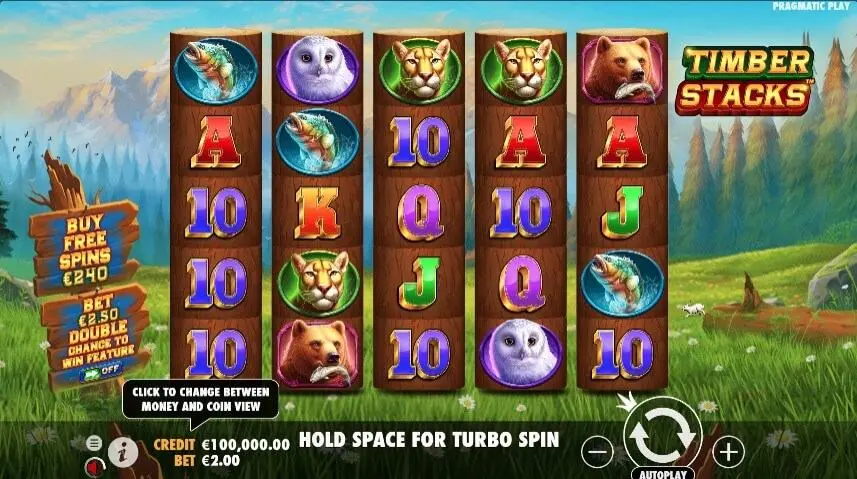
The single number that matters here is the return figure: this Pragmatic Play five-reeler is listed at 96.05% RTP, which sits a little below what the studio typically ships and a little above the average across the games catalogued on this site. If you want a mid-range return from a large, well-known developer and you are happy to test the game in a browser before committing money, the timber stacks slot is a reasonable candidate. If you are hunting for the highest published RTP in Pragmatic Play’s range, there are better places to look, and they are named further down.
Is Timber Stacks worth playing?
Worth a session, yes, provided you go in for the free demo first and judge the pacing yourself. The case for it is arithmetic rather than atmospheric: 96.05% RTP is 0.34 percentage points above the 95.71% average across the games indexed here, so on the published numbers it returns marginally more per unit staked than a typical title in this collection.
The case against is equally plain. Pragmatic Play’s own catalogue of 739 games averages 96.32% RTP, so this release is 0.27 points below the studio’s own standard. That is a small gap, but it is a gap, and there is no shortage of alternatives from the same developer.
On visibility, it ranks 2787 in popularity, placing it in the 86th percentile of games tracked here. That means plenty of people have found it, without it being a headline title. Take that as a signal of decent circulation rather than a quality verdict, because popularity rank measures attention, not payout behaviour.
| Detail | Value |
|---|---|
| Provider | Pragmatic Play |
| RTP | 96.05% |
| Reels | 5 |
| Type | Slot Machine |
| Themes | Animals, Nature, 5-Reels |
| Popularity rank | 2787 (86th percentile) |
| Provider average RTP | 96.32% across 739 games |
| Site average RTP | 95.71% |
| Free demo | Available |
What 96.05% RTP means over 1,000 spins
RTP is a long-run statistical average, calculated over sample sizes far larger than any human session. At 96.05%, the game is modelled to return £96.05 for every £100 wagered across millions of spins. The house edge is the other 3.95%.
Scale that to something you can picture. A thousand spins at £0.20 a spin is £200 staked. Multiply by 96.05% and the theoretical return is £192.10, an expected loss of £7.90. A thousand spins at £1 is £1,000 staked, £960.50 back in theory, £39.50 expected cost.
Those figures are averages, not forecasts. A thousand spins is a tiny sample against the model, so your actual result will land somewhere in a wide band either side of expectation, and the width of that band depends on how the game distributes its wins. Every spin is resolved independently, so nothing that happened on the previous 999 spins changes the odds on the next one.
Compare RTPs where you can. The 0.46-point difference between 96.05% and a 96.51% game is £4.60 of expected cost per £1,000 staked. Small per session, meaningful over a year.
How volatile is the timber stacks slot?
No volatility rating has been published for this title, so anyone quoting you a definitive low, medium or high figure is guessing. That absence is worth knowing about, because volatility affects your session more visibly than RTP does.
The general mechanics are well established. A low-volatility game pays smaller amounts more often, so balances drain slowly and sessions last longer at a given stake. A high-volatility game pays rarely but larger, which produces long dry stretches punctuated by occasional spikes, and it needs a deeper bankroll to survive the gaps without being wiped out early. Medium sits between the two.
Two games can share an identical 96.05% RTP and feel nothing alike, because RTP tells you the total returned over the long run and says nothing about how that total is parcelled out.
With no published rating, the practical approach is to run a few hundred spins in the free demo at a fixed stake and watch the shape of the results: how long the quiet periods run, and how often anything substantial lands. Demo results cannot predict real-money outcomes, but they do show you the rhythm.
What the Animals theme brings to the game
The listed themes are Animals, Nature and 5-Reels, with Animals as the primary label. That tells you the visual framing draws on wildlife and natural surroundings, and nothing more specific than that. Symbol names, character designs, animation style and soundtrack have not been documented in the data available here, so treat detailed descriptions you find elsewhere as someone else’s impression rather than confirmed fact.
Animals slots are a large category: 1,788 games in this collection carry the theme. That volume matters for one reason. Theme is the easiest thing for a studio to swap and the hardest thing to differentiate, which is why it is a weak basis for choosing a game and a strong basis for narrowing a shortlist you have already built on numbers.
Feature sets are also undocumented for this release. Many slots include wilds, scatters, free-spin rounds or purchasable bonus entries, and plenty do not. Without published detail there is no honest way to tell you which of those appear here, which is another argument for loading the demo and finding out directly.
Stakes, session length and bankroll
The minimum and maximum stake for this title are not published in the data available, so check the betting range inside the game itself before your first real-money spin. That is a genuine gap, because stake range determines whether a given bankroll buys a long session or a short one.
The arithmetic is simple enough to do yourself once you know the numbers. Divide your budget by your stake to get your approximate spin count, then adjust downward, because expected loss reduces your balance as you go. A £50 budget at £0.20 a spin is roughly 250 spins before returns are factored in. The same £50 at £2 a spin is 25.
Decide the figure before you open the game, not while you are playing it. And be clear on what no stake plan can do: changing bet sizes, alternating stakes or waiting for a particular moment does not alter the 3.95% house edge, because each spin is an independent event drawn from the same distribution as the last.
Alternatives if Timber Stacks is not for you
If the 96.05% figure is the sticking point, three Pragmatic Play titles publish higher returns. Sweet Bonanza lists 96.51%, the highest of the group, worth about £4.60 more per £1,000 staked in theoretical return. Gates of Olympus and Joker’s Jewels both sit at 96.5%, with Joker’s Jewels being the more stripped-back option if you want fewer mechanics to track.
Staying closer to the same theme space, Strength of Hercules publishes 96.31% and Hercules Power Wild 96.2%, both modest improvements on this game’s figure. Apex Strike Megaways is listed at 96.13% and uses a Megaways-style shifting-ways structure, which typically means a variable number of winning combinations per spin rather than a fixed payline count.
None of these is a straight upgrade. Higher RTP improves long-run expectation by a small margin; it says nothing about swing size or how the game plays minute to minute.
Final take
A competent mid-table release. 96.05% RTP beats the site-wide 95.71% average, trails Pragmatic Play’s own 96.32%, and comes from a studio with 739 catalogued games, so quality control and technical reliability are not in question. The gaps are in documentation rather than execution: no published volatility rating, no stated stake range, no confirmed feature list. That makes the free demo less of a nicety and more of a necessary step, and Timber Stacks no download is available in-browser for exactly that purpose.
One practical note before you play for money. This is 18+ entertainment with a built-in 3.95% cost, so set a budget you are content to spend on an evening out, treat any return as incidental, and stop when the figure you set is gone. If tracking that budget starts feeling difficult, that is the moment to step away rather than to keep spinning.
Worth a look if you want a Pragmatic Play five-reeler with a fair published return. Skip it if you want documented numbers on every specification before you commit.
Frequently Asked Questions
Can I play Timber Stacks for free?
Free play is available for this title, so you can run it in a browser without depositing or registering at a casino. The Timber Stacks free demo uses the same mathematical model as the real-money version, including the 96.05% RTP, which makes it a sensible way to judge pacing and stake options before spending anything.
What is the RTP of Timber Stacks?
The published RTP is 96.05%, meaning the game is modelled to return £96.05 per £100 wagered across a very large sample of spins. That leaves a house edge of 3.95%. It sits 0.34 points above the 95.71% average across games indexed here and 0.27 points below Pragmatic Play's 96.32% catalogue average.
Is Timber Stacks high or low volatility?
No volatility rating has been published for this game, so any firm claim about its risk profile is unverified. Volatility governs how wins are distributed rather than how much is returned overall, which is why two games at 96.05% RTP can feel completely different. Running a few hundred demo spins will show you the rhythm.
Who makes Timber Stacks?
Pragmatic Play developed it. The studio has 739 games catalogued here, averaging 96.32% RTP, and its better-known releases include Sweet Bonanza at 96.51%, Gates of Olympus at 96.5% and Joker's Jewels at 96.5%. All three publish higher returns than this title's 96.05%, though by margins under half a percentage point.
How much bankroll do I need for Timber Stacks?
The stake range has not been published, so check the bet settings inside the game before committing funds. Once you know the minimum, divide your budget by your chosen stake for an approximate spin count: £50 at £0.20 per spin is roughly 250 spins. Expect the 3.95% house edge to shorten that figure.