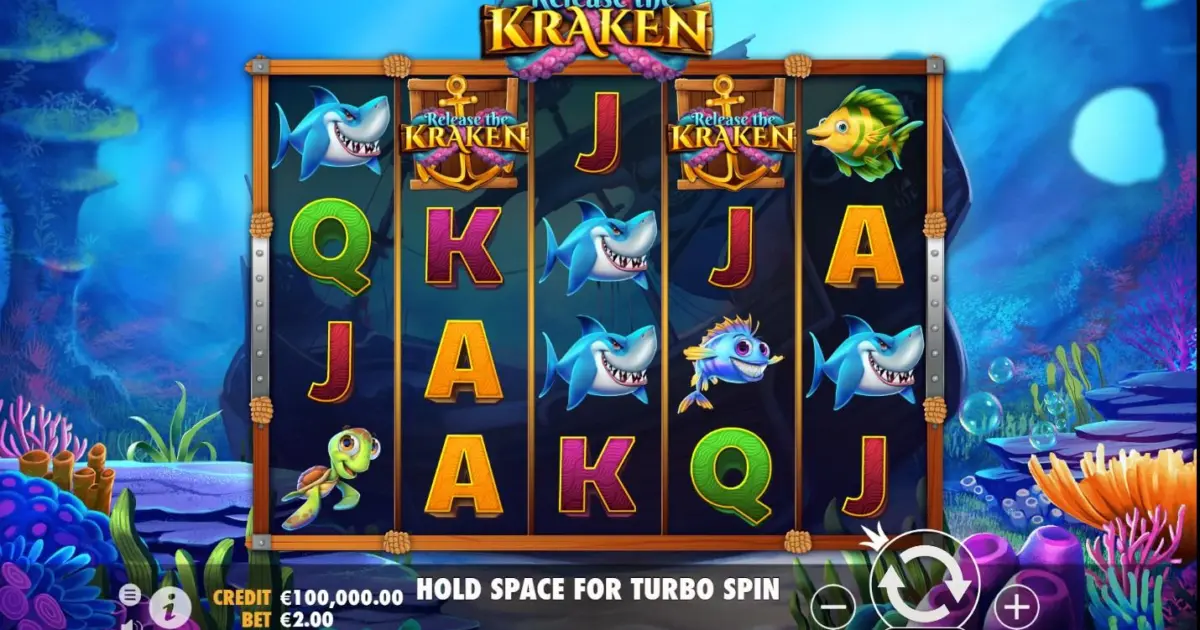
If you play high-volatility slots and want an RTP slightly above the market average, Release the Kraken slot is a reasonable pick from a provider that publishes most of its numbers. If you prefer steady small wins, the volatility alone should steer you elsewhere.
The 5-reel grid explained
Five reels and a visible symbol count per reel define how many ways symbols can line up, and that structure shapes everything downstream — from payline mechanics to how often a single spin feels like a near-miss. A 5-reel layout is the most common configuration in modern video slots because it offers enough positions for bonus triggers without the cognitive overload of a 6- or 7-reel grid.
What you should take from the 5-reel label here is modest: the game follows the mainstream convention rather than experimenting with cascading grids, expanding reels or hold-and-spin mechanics that other Pragmatic Play titles use. Pragmatic Play has not published the exact rows visible per reel on this title, so you cannot verify whether all five reels show three, four or five symbols at once. In practice, most 5-reel slots in the provider’s catalogue display three rows, giving 15 symbol positions per spin, but treat that as an assumption rather than confirmed data.
The practical effect for your sessions: a 15-position grid with 40 fixed paylines (discussed below) means symbols have limited combinations to land in, which is one structural reason the volatility profile skews high. Fewer overlapping win paths per spin generally translates into less frequent but larger payouts.
| Provider | Pragmatic Play |
|---|---|
| RTP | 96.5% |
| Volatility | High |
| Reels | 5 |
| Paylines | 40 |
| Theme | Ocean and sea |
| Bet range | $/£/€0.20 – $/£/€100 |
| Free demo | Yes |
Paylines, ways and how Release the Kraken pays
This title uses 40 paylines. That number is fixed rather than selectable, meaning every spin activates all 40 lines simultaneously and your total stake per spin equals the line bet multiplied by 40. Many slots in this provider’s catalogue offer adjustable paylines; this one does not, based on what is stated in the metadata.
With 40 lines on a 5-reel grid, win paths stretch left to right across a range of rows. How many adjacent symbols constitute a win on each line, and which symbols pay what, are not published in the data available here. What you can say with confidence is that 40 paylines is a mid-range figure — fewer than the 100+ lines some older provider titles carried, more than the 10- or 20-line setups found in simpler slots like Joker’s Jewels, which pairs a lower line count with a lower-volatility profile.
If you are comparing mechanics rather than just numbers, that contrast matters. Fewer lines with lower volatility produces shorter intervals between small wins; more lines with high volatility produces longer intervals and a wider spread between the best and median session outcomes.
96.5% RTP put in context
96.5% RTP means that across a very large number of spins — millions, not hundreds — the game is programmed to return €96.50 for every €100 wagered, before you factor in the variance that determines whether you personally experience that average.
Contextualise that against two benchmarks. Pragmatic Play’s own portfolio averages 96.32% RTP, placing this title marginally above the provider norm. Across the full corpus of games reviewed on this site, the average is 95.71%, so Release the Kraken sits 0.79 percentage points above market. That is a meaningful edge in percentage terms — 79 cents per €100 wagered over the long run — but it does not alter what happens over 200 or 500 spins in a single session, where volatility dominates.
Within the provider’s own output, two other popular titles carry the same 96.5% figure: Gates of Olympus and the cluster-pays Sweet Bonanza. RTP is identical across all three, so the differentiator between them is entirely mechanical and visual, not statistical. If RTP is your primary filter, all three are equivalent.
Missing from the published data: a max-win multiplier or cap. Treat any figure quoted on third-party sites with caution.
Volatility and hit patterns
Pragmatic Play classifies this game as high volatility. That single label carries substantial implications for session planning and it is the most decision-relevant fact after RTP.
High volatility means outcomes are heavily skewed: a small fraction of spins produce most of the returns, while the majority of spins result in zero or near-zero payouts. You should expect extended losing sequences and plan your bankroll accordingly. A slot with 96.5% RTP and high volatility does not return money “steadily” — it returns it in irregular bursts separated by dry periods that can feel punishing.
The data available here does not include a hit-frequency percentage (the proportion of spins that return any win, however small). Many high-volatility slots in this range sit between 15% and 25% hit frequency, meaning roughly one spin in five or six returns anything at all. Without a confirmed figure for this specific title, use that range as a planning assumption rather than a fact.
For practical budgeting: if hit frequency is genuinely in that range, a session of 100 spins might produce wins on 15–25 of them. The size of those wins varies widely, and the distribution is what volatility controls. The maths does not change whether you play at 0.20 or 100 per spin.
Choosing a stake between $/£/€0.20 and $/£/€100
The stake range spans 500x from minimum to maximum, which is wide but standard for Pragmatic Play’s 40-line titles. The floor of 0.20 represents the cheapest full coverage of all 40 paylines; anything below that is unavailable.
How to think about this range in relation to high volatility: because losing sequences are longer, the number of spins your bankroll can absorb matters more than it would in a low-volatility game. At 0.20 per spin, a 20-unit bankroll lasts exactly 100 spins. At 2.00 per spin, the same bankroll lasts 10 spins. Neither guarantees a win arrives in that window.
At the ceiling of 100 per spin, a single unlucky sequence of 20 spins without a return costs 2,000 units. That is the practical ceiling the maximum stake imposes on how much risk a single session can carry. The minimum stake exists to let you sample the game’s variance pattern with a smaller commitment; the maximum stake is designed for players who specifically chase the upper tail of the payout distribution.
There is no stake here that improves your expected return. RTP applies uniformly across the range. The only variable you control is how long you can survive the variance before your bankroll exhausts.
Demo play versus real money
Free play is available for this title without deposit or registration on this review site. Demo mode uses the same math model as real-money play — the same 96.5% RTP, the same high volatility, the same stake range — so it is genuinely useful for experiencing how the variance feels. What it cannot do is tell you whether you will win or lose when real money is at stake, because the outcome of any spin is independent of every previous spin.
Use the demo to answer a narrow question: can you tolerate the dry spells that high volatility produces? If 200 demo spins leave you bored or frustrated by the gaps between wins, real money at the same tempo will amplify that frustration and add financial cost to it. If the rhythm suits you and you enjoy the anticipation, you have learned something useful about your own preferences.
When you move to real play, set a loss limit before you start and treat the cost of spinning as the price of entertainment, not an investment. This game is for adults 18 and over only. No amount of play, on demo or real, makes any result predictable.
Verdict on Release the Kraken
The strengths are concrete: 96.5% RTP places it above both the provider average and the broader market, the stake range accommodates different bankrolls, and free demo access lets you verify the variance profile before committing money. Those are not trivial advantages.
The weaknesses are equally concrete: high volatility demands a larger bankroll to survive losing sequences, 40 fixed paylines eliminate the option of reducing line coverage to stretch a session, and the absence of a published max-win figure or hit-frequency percentage means you are making decisions with incomplete information — a notable gap when the data comes directly from the provider.
The 99.1 popularity percentile tells you that a great many players have tried this game and kept coming back, which is either a sign it delivers a satisfying experience or a sign that high-volatility appeal outlasts rational expectations. Both readings are valid.
Overall: a competent, above-average-RTP entry in a crowded high-volatility niche. It does not differentiate itself on numbers you can verify, but it does not disadvantage you on the numbers you can. If you want a sea-themed slot from a provider that publishes its RTP, this is a safe pick among many similar options.
Frequently Asked Questions
Can I play Release the Kraken for free without a deposit?
Yes, a free demo version is available on this site with no registration or deposit required. The demo uses the same game math as real-money play, including the 96.5% RTP and high volatility rating, so the experience mirrors what you would encounter at a casino. It will not pay real money, but it lets you judge whether the variance suits your preferences.
What does 96.5% RTP mean for my actual results?
Over millions of spins the game is programmed to return 96.5% of all money wagered, meaning 96.50 in currency for every 100 wagered across the entire player pool. Your personal session could return far more or far less, especially given the high volatility classification. RTP is a long-run statistical property, not a per-session promise.
Is Release the Kraken a high-volatility slot and what does that mean?
Pragmatic Play classifies this title as high volatility. In practice this means wins arrive less frequently but tend to be larger when they do appear. Losing sequences between payouts can be long, requiring a bigger bankroll to survive than a low-volatility game would. The 40 fixed paylines contribute to this pattern.
How does Release the Kraken compare to Gates of Olympus?
Both carry identical 96.5% RTP and come from the same provider, so the statistical expectation is the same. Gates of Olympus uses a cluster-pays mechanic with multipliers rather than 40 fixed paylines, and its visual theme draws on Greek mythology instead of ocean imagery. Choose based on which mechanic and aesthetic you prefer, since neither has a mathematical edge.
What is the minimum and maximum stake for this game?
The stake range runs from 0.20 to 100 in dollars, pounds or euros per spin. The 0.20 minimum covers all 40 paylines simultaneously. The 100 maximum represents the highest single-spin risk available. Neither end of the range changes the 96.5% RTP or the volatility classification; it only scales the monetary size of outcomes.




