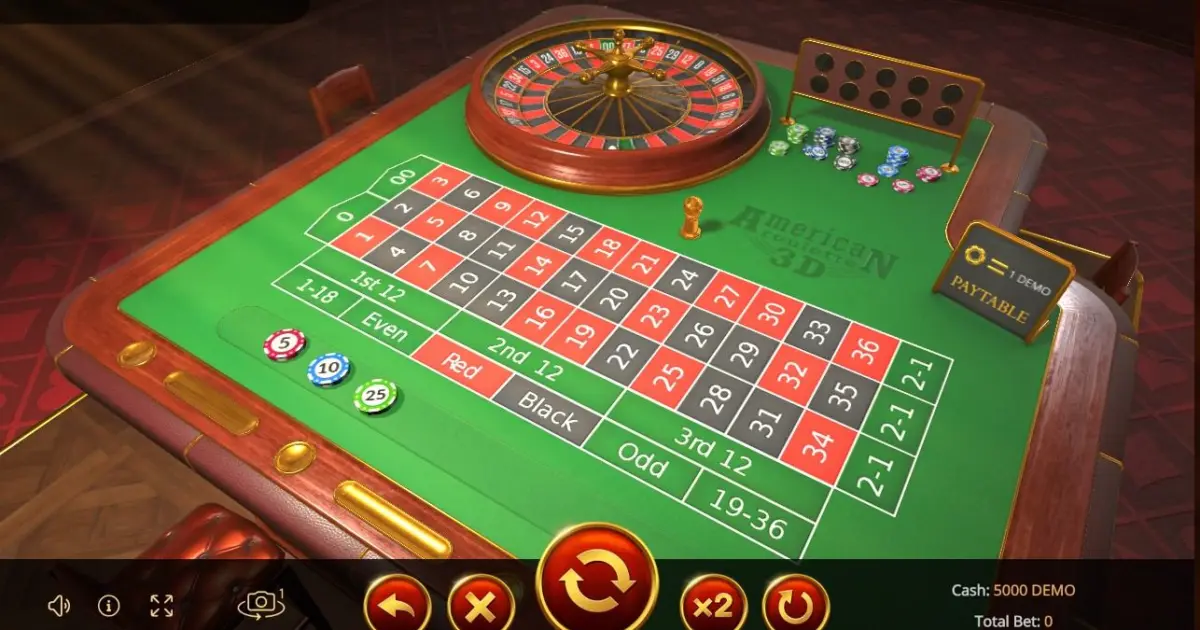
American Roullete 3D (Evoplay) roulette puts a double-zero wheel behind a cinematic 3D camera angle, and the maths is exactly what the title tells you: a 94.7% return, roughly one bet in nineteen lost to the house on average. If you want to know whether this table is worth your time, the answer depends entirely on whether you have weighed 94.7% against what is available elsewhere on the market — because there are roulette games returning more than 97%.
What kind of roulette is American Roullete 3D (Evoplay)?
The title points to a double-zero American wheel: 38 pockets numbered 0 through 36 plus a 00. Evoplay layers this behind a full 3D presentation with animated camera work, but the presentation is cosmetic. Underneath the motion, the bet layout, payouts and odds behave like any standard American roulette table.
You should confirm the pocket count and available bet types on the game’s own rules screen before wagering real money, because the “3D” descriptor tells you about the rendering engine, not about any structural change to the wheel itself. Evoplay has only three games in the roulette category, so this table sits alongside their European Roulette (Evoplay), which uses a single-zero wheel and returns 97.3% — a useful comparison when deciding whether the 3D presentation is worth the difference in odds.
The subcategory is “Roulette” with no multiplier or bonus-feature wrapper. This is a standard wheel with a glossy coat of paint. Nothing about the 3D angle changes the arithmetic.
Return to player and house edge
The published RTP for this table is 94.7%. That figure is consistent with the theoretical return of a standard American double-zero wheel, where the house edge on every bet except the five-number basket sits at 5.26%. The maths is straightforward: on a 38-pocket wheel, a straight-up number pays 35 to 1 while the true odds against hitting it are 37 to 1. That two-pocket gap is the entire house advantage, and it applies uniformly across all standard bets on the layout.
Against Evoplay’s own portfolio, which averages 96.0% RTP across their roulette range, this table sits below their house average. Against the broader market average of 96.97%, it trails by 2.27 percentage points. None of that means the game is broken or manipulated — it means you are playing the wheel with the worst standard odds in roulette.
Reading the Evoplay paytable before you bet
The paytable on this table should show the standard American roulette payouts: 35:1 for a single number, 17:1 for a split, 11:1 for a street, 8:1 for a corner, 5:1 for a six-line, 2:1 for dozens and columns, and 1:1 for the even-money outside bets. The one payout that deserves your attention is the five-number basket covering 0, 00, 1, 2 and 3, which pays 6:1 and carries a house edge of 7.89% — the worst bet in the game by a wide margin.
There is no French-rule variation here. La Partage and En Prison exist only on single-zero layouts, so even-money bets on this table do not receive the half-stake return that makes them the best bet elsewhere. If that feature matters to you, it is structurally impossible on a double-zero wheel, not a matter of this particular game omitting it.
Bet coverage, variance and session length
The table below shows how each bet type on an American wheel trades payout against true odds. The gap between the two columns is the house edge, and it is identical for every bet except the basket.
| Bet type | Payout | True odds against | House edge |
|---|---|---|---|
| Straight up | 35:1 | 37:1 | 5.26% |
| Split | 17:1 | 18:1 | 5.26% |
| Street | 11:1 | 12:1 | 5.26% |
| Corner | 8:1 | 9:1 | 5.26% |
| Line | 5:1 | 6:1 | 5.26% |
| Dozen / Column | 2:1 | 3:1 | 5.26% |
| Even money | 1:1 | 19:18 | 5.26% |
| Five-number basket | 6:1 | 33:1 | 7.89% |
Choosing inside or outside bets changes the shape of your variance, not its direction. A straight-up number gives you the highest single-spin swing in both directions. A red/black bet gives you frequent small outcomes. Over enough spins, both converge to the same expected loss per unit wagered. What differs is how long you can entertain yourself before the house edge exhausts a given bankroll: inside bets burn faster per spin but pay more when they hit, outside bets stretch a session but never deliver a result that makes the grind feel worthwhile.
Patterns, hot numbers and the gambler’s fallacy
Each spin on this table is an independent event. The wheel has no memory, the RNG has no streaks, and no sequence of previous outcomes shifts the probability of the next result. A number that has not appeared in two hundred spins is exactly as likely to appear on the next spin as one that appeared three spins ago: 1 in 38 on a double-zero layout.
The 3D presentation can make this feel otherwise. Animated balls, camera angles that track the landing pocket, and spin histories displayed on-screen all create an illusion of pattern where none exists. This is entertainment design, not a data signal. No tracking sheet, no colour-streak observation and no progression system — Martingale, Fibonacci, D’Alembert, Labouchere — changes the expected value of a single bet or a long session. They redistribute when you win and lose within a fixed negative-expectation framework, and they accelerate your approach to table limits, at which point recovery becomes mathematically impossible.
Trying the demo
A free demo is available for this table. Use it to familiarise yourself with the 3D interface, the bet placement mechanics and the pacing before committing real money. The demo uses the same RNG and the same paytable, so it will not produce different outcomes — it simply lets you navigate the interface without financial consequence.
Remember that roulette is a negative-expectation game on every bet on this table. Set a budget before you start, treat the session as paid entertainment rather than income, and stop when that budget is spent. You must be 18 or over to play for real money, and if you find yourself chasing losses or extending a session beyond what you intended, that is a signal to stop and step away.
Verdict on American Roullete 3D (Evoplay)
This is a competent execution of the American wheel with a visually engaging 3D layer. It ranks in the 96th percentile for popularity, which tells you players find the presentation appealing. The maths, however, are the maths of 5.26% on every standard bet, and no amount of camera work changes that.
If you are choosing between roulette tables, the 2.6-point RTP gap between this game and a single-zero alternative is not trivial over a long session — it is roughly half your expected loss. Evoplay’s own European Roulette addresses that gap directly, and the European Roulette from Red Tiger returns the same 97.3% with a different visual approach. The Penalty Roulette from Evoplay offers a completely different format at 96.0% if you want a break from the standard wheel layout.
Play American Roullete 3D if you want the double-zero experience and the presentation. Skip it if you are optimising for expected value, because a single-zero wheel does the same job with a smaller penalty.
Frequently Asked Questions
Can I play American Roullete 3D by Evoplay for free?
Yes, a free demo version is available. It uses the same RNG and paytable as the real-money game, so you can explore the 3D interface and bet placement mechanics without financial risk. The demo does not predict real-money results or offer different odds.
What is the RTP on American Roullete 3D by Evoplay?
The published RTP is 94.7%, which is consistent with the theoretical return of a standard double-zero American roulette wheel. This places the game below Evoplay's portfolio average of 96.0% and below the broader roulette market average of 96.97%.
What house edge applies to American Roullete 3D (Evoplay)?
The house edge is 5.26% on all standard bets, which comes from the 38-pocket layout that includes both 0 and 00. The five-number basket covering 0, 00, 1, 2 and 3 carries a worse edge of 7.89%. This is nearly double what a single-zero European wheel imposes.
Do betting systems or hot number tracking work on American Roullete 3D?
No. Every spin is an independent event with fixed probabilities regardless of what preceded it. Progression systems like Martingale or Fibonacci redistribute the timing of wins and losses without changing expected value, and they increase the speed at which you reach table limits where recovery becomes impossible.
Is American Roullete 3D worth playing compared to European Roulette by Evoplay?
If you are optimising for return, no. Evoplay's European Roulette returns 97.3% on a single-zero wheel, which cuts the house edge from 5.26% to 2.70% — nearly halving your expected loss. The 3D presentation on American Roullete 3D is a visual preference, not an odds improvement.




