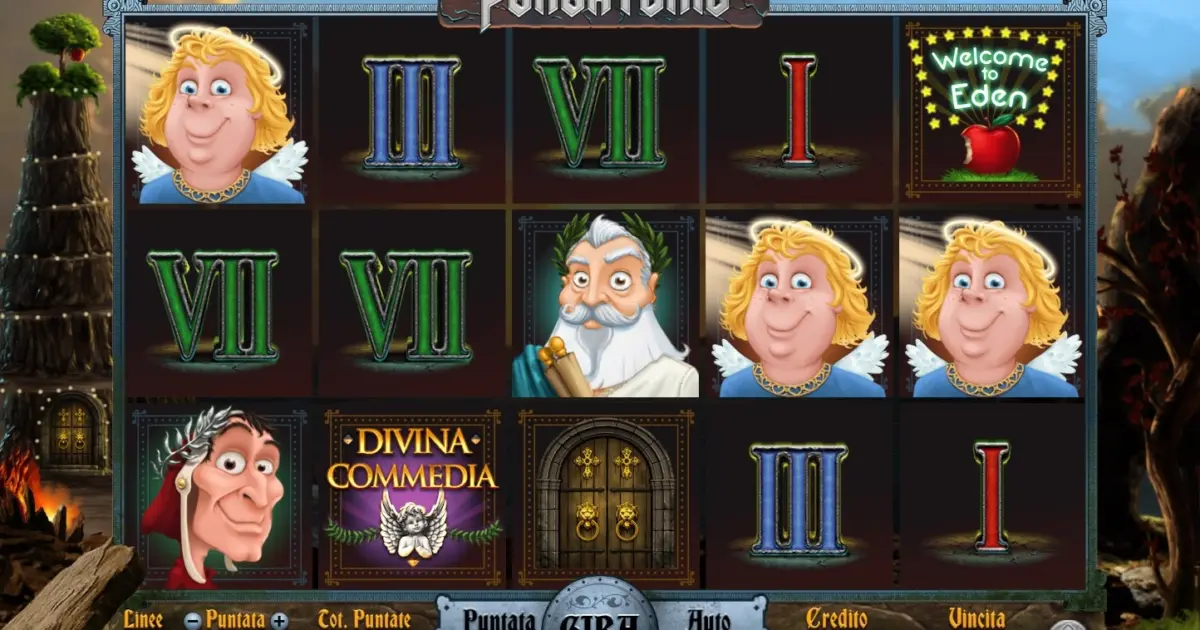
Giocaonline’s Divina Commedia – Purgatorio slot returns 94.66% RTP, sitting 1.05 points below the corpus average of 95.71%. That gap is the most consequential number in this review, because it compounds across every spin and every session. The game is available as a free demo, Giocaonline publishes 31 titles with an average RTP of 94.71%, and this particular entry ranks at the 99.1st popularity percentile across the full review set. Whether those figures make it worth your time depends on what you want from a session.
Divina Commedia – Purgatorio at a glance
| Attribute | Value |
|---|---|
| Provider | Giocaonline |
| RTP | 94.66% |
| Reels | 5 |
| Volatility | Not published |
| Free demo | Available |
| Popularity percentile | 99.1 |
| Review-set rank | 186 |
| Provider average RTP | 94.71% |
| Corpus average RTP | 95.71% |
The table tells a straightforward story: this is a five-reel slot from a small Italian provider whose portfolio averages 94.71% RTP. The game itself at 94.66% lands almost exactly at that provider mean. Volatility data is absent from Giocaonline’s published information, which is a meaningful gap for session planning — you are operating without a key risk parameter. The 99.1st percentile for popularity suggests strong player interest relative to the rest of the corpus, though that metric reflects search and play volume rather than quality.
Players comparing titles within Giocaonline’s catalogue will find Cook & Spin at a slightly lower 94.47% RTP, while Lunapark Cash edges ahead at 94.73%. The spread across the provider’s output is narrow, so provider choice alone does not dramatically change your expected return.
What a 94.66% RTP actually returns
RTP is a long-run statistical average calculated across millions of simulated spins. It does not describe any individual session, streak, or bonus round. What it does describe is the expected cost of playing over a very large sample.
At 94.66% RTP, the theoretical house edge is 5.34%. Across 1,000 spins at a hypothetical £1 stake per spin, the expected return is £946.60, meaning the house retains £53.40. The corpus average of 95.71% would produce an expected return of £957.10 over the same 1,000 spins — a difference of £10.50. Over 10,000 spins, that gap widens to £105. Over 100,000 spins, it reaches £1,050.
The practical implication is that you are paying approximately £1.05 extra in expected losses per £100 wagered compared to the median game in our review set. That figure sounds small in isolation, but it accumulates linearly with your total stake volume. If you routinely play ten thousand spins per month across several games, the choice between a 94.66% title and a 96% title represents roughly £134 in additional expected cost per month at £1 per spin.
Compared to Giocaonline’s own portfolio average of 94.71%, this game returns 0.05 points lower — essentially at the provider mean. If you have already decided to play within this provider’s catalogue, Divina Commedia – Purgatorio is neither the best nor the worst choice on RTP. De Magorum from the same provider sits at 94.47%, meaning you would sacrifice another 0.19 points of return by choosing that title instead.
Volatility and what your session will feel like
Giocaonline has not published a volatility rating for this game, and that absence matters. Volatility (sometimes called variance) determines how the RTP is distributed across spins. Two games can share a 94.66% RTP and produce entirely different experiences: one might return frequent small wins with shallow troughs, the other might deliver long dry spells followed by occasional large payouts.
Without a published volatility figure, you cannot plan a bankroll with confidence. If this game turns out to be high volatility, a £50 budget might exhaust within 50–100 spins at lower stakes before any meaningful return materialises. If it is low volatility, the same budget could sustain 300+ spins of steady, small-credit activity. The difference is not trivial — it determines whether your session feels entertaining or frustrating.
The practical approach is to play the demo version for a substantial sample (at least 200–300 spins) and observe the distribution yourself: count how many spins pass between wins, note whether payouts cluster at small values or occasionally spike, and record the longest losing streak you encounter. That personal observation substitutes for the published figure. Many five-reel video slots from smaller providers tend toward medium-to-high volatility, but treating a general trend as a fact about this specific game would be wrong.
The 5-reel layout and how wins are counted
This game uses a five-reel format, which is the dominant configuration in online slots. Five reels provide more symbol positions than the older three-reel mechanical format, which allows for more complex pay structures, expanded symbol sets, and typically multiple bonus mechanics. However, the specific number of paylines or ways to win in this title is not published in the available data, so you will need to check the game’s information screen before spinning.
General principles apply across five-reel games: more active lines usually mean more opportunities to hit a winning combination on any given spin, but they also mean that a higher portion of your stake is consumed each spin if the lines are fixed. A five-reel, ten-line game at £0.20 per line costs £2.00 per spin. The same configuration at twenty lines costs £4.00. Your effective cost per spin depends on line count multiplied by line stake, so always verify the total cost before confirming a spin.
Without published payline or ways data, the demo becomes essential reading. The information or help screen inside the game will specify exact win patterns, and the paytable will show which symbols pay the most and whether any special symbols (wilds, scatters) alter the base-game maths. Treat those in-game references as authoritative rather than relying on any third-party summary.
Stake range and sizing a bankroll
No stake range is published for this game, which is another gap in the available information. Stake range determines the floor and ceiling of your per-spin cost and directly affects how long any budget will last.
The general principle for sizing a bankroll is straightforward: divide your total session budget by the number of spins you want to sustain. If you want 500 spins from a £50 budget, your maximum acceptable per-spin cost is £0.10. If you want 1,000 spins from £100, the ceiling is £0.10 per spin. These numbers assume you accept the possibility of ruin — a sequence of losses that exhausts your budget before reaching your target spin count — which is always present regardless of RTP.
Because volatility data is missing here, the bankroll calculation carries extra uncertainty. A medium-volatility game might see 80–120 losing spins in a typical session; a high-volatility game can exceed 200. Without knowing which regime this slot operates in, you should treat any bankroll plan as a rough guide and set a hard stop-loss before you start rather than adjusting mid-session. Chasing losses by increasing stake size does not change expected value — every spin remains independent, and the house edge applies uniformly across all bet levels.
Playing the Divina Commedia – Purgatorio Slot demo before you commit
The free demo is available, and given the missing volatility and stake-range data, it is the most efficient way to build your own understanding of this game’s behaviour. Demo play replicates the same random number generator logic as real-money play in virtually all regulated online slots, so the win distribution you observe in the demo reflects what you would experience with actual stakes. What it does not replicate is the emotional weight of real losses, which changes how you respond to variance.
Use the demo to answer three specific questions: how many spins pass between wins, what the longest losing streak looks like across 200+ spins, and whether the total per-spin cost (once you identify the line count and minimum line stake) fits within your intended budget. If the answers satisfy you, the transition to real-money play is a budget decision rather than a discovery one.
This game costs real money to play outside the demo, and it should be treated as paid entertainment. Set a session budget before you spin, accept that the money allocated is spent the moment you deposit it, and stop when the budget is gone regardless of whether you have had wins. No sequence of results creates an obligation for a win to follow. Only play with money you can afford to lose, and if gambling stops being entertaining, stop playing.
Verdict: who should play this game
Divina Commedia – Purgatorio occupies an unusual position: it is one of the most-played titles in the corpus by percentile (99.1st) yet sits meaningfully below the median RTP. That combination suggests the theme or presentation draws players in, but the mathematical return does not reward them at competitive levels. You are paying a visible premium over the review-set average for the experience.
If you are comparing games purely on RTP and want the most return per pound wagered, this is not the strongest choice available. The 1.05-point gap below corpus average is not catastrophic, but it is consistent and unavoidable across a long career of play. If you have already decided to play within Giocaonline’s catalogue, the spread is narrow enough that personal preference on layout and theme is a better tiebreaker than 0.05 or 0.19 points of RTP.
Given the missing volatility figure, the responsible recommendation is to spend time in the demo before committing real funds. The game is fun enough to warrant that curiosity, and the free version costs nothing to try. Just go in with clear eyes about what the numbers mean: a below-average return, an undefined risk profile, and a popularity ranking that reflects what other players chose rather than what is mathematically optimal.
Frequently Asked Questions
What is the RTP for Divina Commedia – Purgatorio?
The published RTP is 94.66%, which means the game returns an expected £94.66 per £100 wagered across a very large sample of spins. This places it 1.05 percentage points below the corpus average of 95.71% and almost exactly at Giocaonline's provider portfolio mean of 94.71%.
Can I play Divina Commedia – Purgatorio for free?
Yes, a free demo version is available. The demo uses the same random number generator logic as the real-money game, so you can observe win frequency, payout sizes, and overall session behaviour without risking any funds. Use it to build a mental model of the volatility before deciding whether to play for real money.
Who makes Divina Commedia – Purgatorio and what else do they produce?
Giocaonline is the provider, with 31 titles in its published catalogue and a portfolio average RTP of 94.71%. Other games from the same provider include Cook & Spin and De Magorum, both rated at 94.47% RTP, and Lunapark Cash at 94.73%. The RTP spread across their output is very narrow.
What is the volatility of this slot?
Giocaonline has not published a volatility rating for Divina Commedia – Purgatorio. This is a meaningful gap for planning purposes, because volatility determines how the RTP is distributed across individual sessions. The recommended approach is to observe win patterns over at least 200 demo spins to estimate the variance yourself.
Does Divina Commedia – Purgatorio have a high popularity ranking?
Yes, it sits at the 99.1st popularity percentile within the review set, ranked 186 overall. That percentile reflects player interest measured by search and play volume relative to other games in the corpus. It does not indicate quality or expected return, and the game's 94.66% RTP is below the corpus average despite its popularity.




