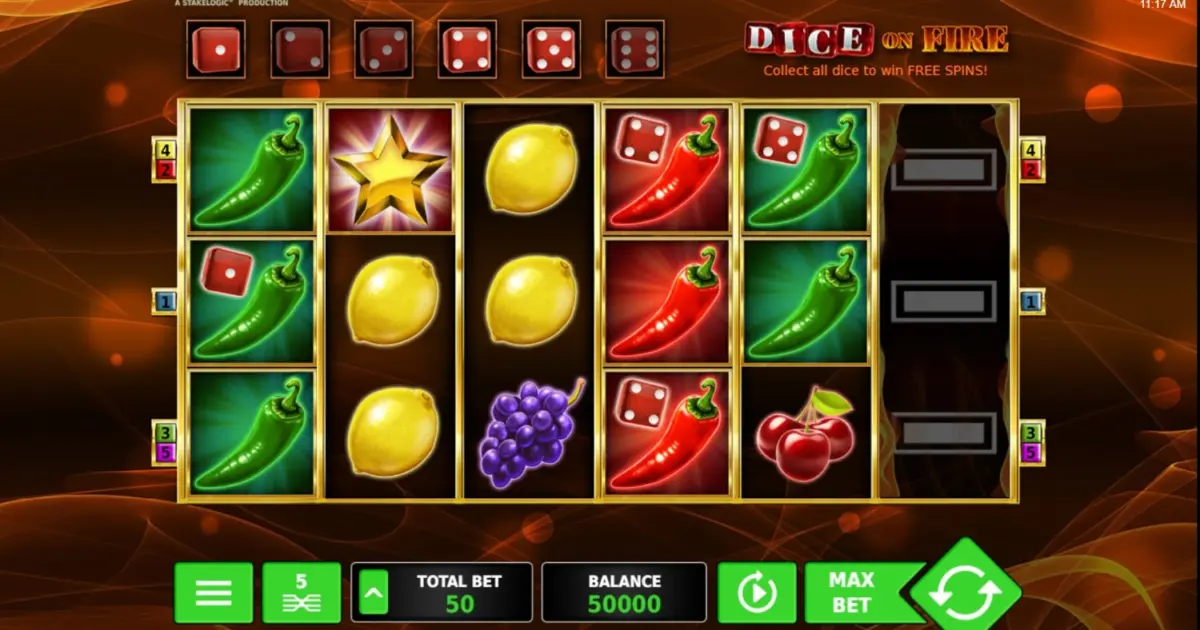
If you want the short answer: the dice on fire slot from Stakelogic runs at a published RTP of 96.23%, uses a six-reel grid, and can be tried in free demo mode before any money is involved. That RTP is 0.52 percentage points above the 95.71% average across the games in our database, and 0.67 points above Stakelogic’s own 95.56% house average across 182 titles. Several important figures — volatility rating, paylines, stake limits, maximum win — are not published in the data available here, and the sections below explain what each absence means rather than filling the gap with guesswork.
The 6-reel grid explained
Six reels is one column wider than the classic five-reel layout that still dominates the market. That extra column matters for a reason that has nothing to do with theme or presentation: it changes the arithmetic of how symbols can line up. On a five-reel game, a winning combination usually needs to start on the leftmost reel and run three, four or five positions across. Add a sixth reel and the top-tier combination becomes a six-symbol line, which is rarer than a five-symbol one on comparable reel strips.
Designers compensate in different ways. Some widen the grid but keep the minimum win at three symbols, so short wins stay frequent while the longest ones become genuinely scarce. Others switch away from fixed lines entirely, because a six-reel grid multiplies the number of possible paths across the screen and fixed paylines become an awkward fit. Which route Stakelogic took here is not specified in the data available, so treat the reel count as a structural fact rather than a clue about pay frequency. What it does tell you reliably is that this is a modern build, not a three-reel classic remake, and that the top combinations span a wider screen than most older games ask for.
Paylines, ways and how the Dice on Fire slot pays
The payline count for this title is not published in the data available, so nobody should quote you one. Here is what the two main systems mean in general, so you can identify which you are looking at within a few spins of opening the game.
Fixed paylines are defined paths across the reels. A 25-line game pays only along those 25 shapes, every spin covers all of them, and your total stake is divided across them. The number tells you how many chances a single spin buys, but it says nothing about how generous those chances are — a 10-line game and a 50-line game can share an identical RTP.
The “ways” or “all ways” system, common on wider grids, drops defined shapes and pays any symbol that appears on consecutive reels from the left, regardless of row position. Six reels with three rows produces 729 ways; four rows produces 4,096. Those large numbers look dramatic in marketing but describe combinatorics, not payouts.
Many slots also use wilds that substitute for standard symbols and scatters that trigger a bonus round. Whether either appears here is not stated in FACTS, so check the in-game paytable, which is the only authoritative source for a specific game’s rules.
96.23% RTP put in context
Return to player is a long-run statistical average, not a session promise. At 96.23%, the game is modelled to return £96.23 for every £100 wagered across a sample far larger than any individual will ever play — millions of spins, not thousands. Over 1,000 spins at £1, the mathematical expectation is a £37.70 loss, but the realistic spread around that figure is wide enough in both directions that the average is close to useless as a prediction for one session. The larger the sample, the closer actual results drift toward the published figure.
| Figure | Value |
|---|---|
| Provider | Stakelogic |
| RTP | 96.23% |
| Reels | 6 |
| Primary theme | Food |
| Type | Slot Machine |
| Popularity rank | 2,650 (86.7th percentile) |
| Provider average RTP | 95.56% across 182 games |
| Free demo | Available |
Against Stakelogic’s catalogue, this is at the upper end: Wild Buzz sits at 96.20% and Manimals at 96.01%, both a shade lower. Among the 355 food-themed games in our database, Lucky Turkey returns 97.17%, nearly a full point higher, which over a long sample is a meaningful edge if RTP is your deciding factor.
Volatility and hit patterns
No volatility rating is published for this title in the data available, which is a genuine gap. Volatility describes the shape of the distribution around that 96.23% average, and two games with identical RTP can produce completely different sessions.
Low volatility means frequent small wins. Your balance drains slowly, sessions last longer on the same bankroll, and the biggest results are modest. Medium volatility sits in between and is where most mainstream releases land. High volatility means long stretches returning nothing, punctuated by rarer, larger payouts — the same average return, delivered in fewer, bigger pieces. A high-volatility game needs several hundred spins of bankroll to survive a bad run, where a low-volatility game can be played comfortably on a fraction of that.
Hit frequency — the share of spins returning anything at all — is also unpublished here, and is not derivable from RTP. A 96.23% game could hit on 20% of spins or 45% of spins.
One thing does not vary: every spin is an independent event. No game is due, warm or cold, and no sequence of past results shifts the odds of the next one.
Choosing a stake when the limits are not published
Minimum and maximum bet figures for this game are not included in the data available, so check them in the game window before your first spin. The method for choosing a stake does not depend on knowing them in advance.
Work backwards from the session you want. Decide the amount you are prepared to lose in full, then divide by the number of spins you want it to cover. A £40 budget across 200 spins points to £0.20 a spin. Across 400 spins, £0.10. Because the RTP figure returns some of your wagers along the way, a £40 budget usually produces more spins than the raw division suggests — but plan on the raw number, because the variance can run against you early.
Stake size does not change the percentage. A £5 spin and a £0.10 spin on the same game face identical odds; the only thing that scales is how fast your balance moves. Raising or lowering stakes mid-session changes nothing about expected value either, since each spin is settled independently of the last.
Demo play versus real money
The free demo runs on the same maths as the paid version, with virtual credits standing in for cash. That makes it genuinely useful for two things: learning the paytable and the interface, and getting a rough feel for how often the game returns something. It is useless for one thing — predicting your real-money results. A good demo run is small-sample noise, not a signal.
Demo credits also change behaviour. Nobody feels a virtual £200 drawdown, so the swings that would end a real session pass unnoticed. Keep that in mind when the stakes are real.
Slots are paid entertainment, priced at roughly 3.77% of everything you wager on this title over a long run. Play only if you are 18 or over, set a budget before you start, and treat the money as spent the moment you deposit it. If a session stops being fun, close it.
Verdict on Dice on Fire
A solid, above-average return wrapped in an incomplete spec sheet. The 96.23% RTP is the strongest argument in its favour: it beats Stakelogic’s 95.56% catalogue average and the 95.71% figure across our whole database, and in a market where plenty of titles sit in the low 95s or worse, that gap is worth having. A popularity rank of 2,650 puts it in the top 15% of games by traffic, so it is not obscure.
The reservations are about information, not quality. Without a published volatility rating, payline count or stake range, you cannot plan a bankroll properly until you have the game open in front of you. Load the demo first, read the paytable, watch fifty spins, and decide from there. If RTP is your primary filter, BBQ Rush at 96.33% is a close food-themed alternative worth a side-by-side look.
Frequently Asked Questions
Can I play Dice on Fire for free?
A free demo is available for this title, running on the same mathematics as the paid version with virtual credits instead of cash. That makes it a sensible way to read the paytable and learn the interface before committing money. Results in demo mode carry no predictive value for real-money play.
What is the RTP of Dice on Fire?
The published RTP is 96.23%, meaning a modelled return of £96.23 per £100 wagered across a very large sample of spins. That is 0.52 percentage points above the 95.71% average across the games in our database, and above Stakelogic's own 95.56% catalogue average across 182 titles.
Is Dice on Fire high or low volatility?
No volatility rating is published for this game in the data available, so treat any figure quoted elsewhere with caution. Volatility determines whether the 96.23% return arrives as frequent small wins or rare larger ones, which directly affects how much bankroll a session needs. Check the game's own information panel.
Who makes Dice on Fire and what else do they produce?
Stakelogic developed it. The studio has 182 games in our database with an average RTP of 95.56%, including Manimals at 96.01% and Wild Buzz at 96.20%. This title sits at the higher end of that range, which is the main reason it stands out within the provider's own catalogue.
How does Dice on Fire compare to Lucky Turkey?
Lucky Turkey returns 97.17% against 96.23% here, a gap of nearly a full percentage point in its favour. Both are food-themed games, one of 355 in that category in our database. Over a long sample that difference is meaningful, though volatility and structure also shape how a session actually feels.