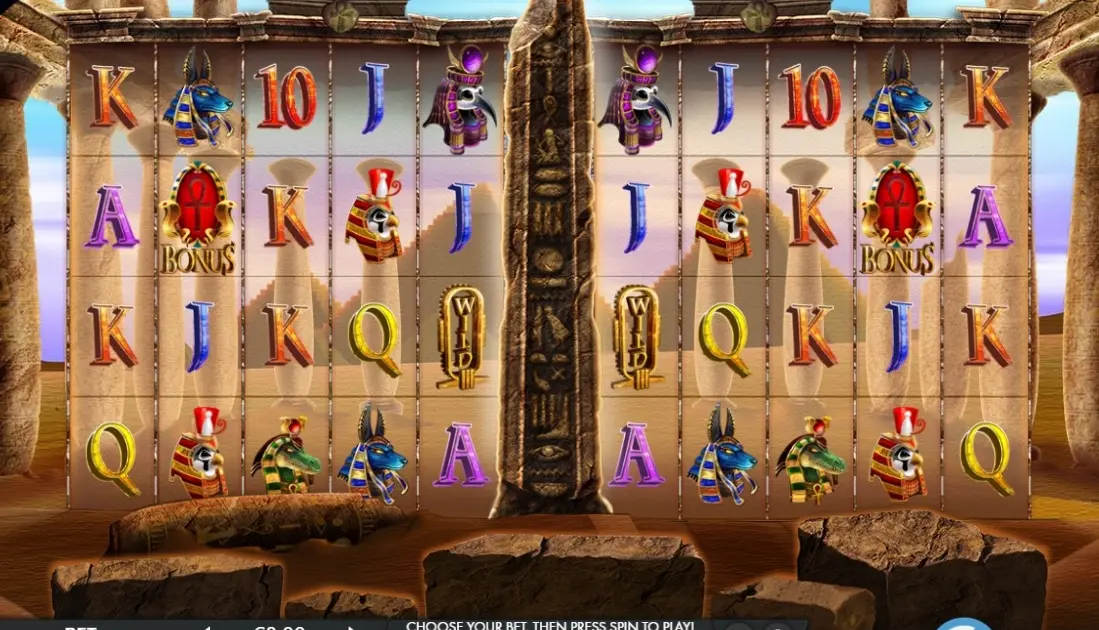
Temple of Luxor is worth a look if you filter by return first and features second, because its 97.10% RTP is notably above average. Genesis Gaming has not published volatility, reel layout or stake limits for this title in the data available here, so the decision comes down to the maths you can verify and whether you are comfortable trying an unlisted profile in demo first. You can test the temple of luxor slot as a free demo with no balance at risk before you decide.
| Detail | Figure |
|---|---|
| Game name | Temple of Luxor |
| Provider | Genesis Gaming |
| RTP | 97.10% |
| Provider average RTP (100 games) | 96.88% |
| Corpus average RTP | 95.71% |
| Difference vs corpus average | +1.39 percentage points |
| Popularity rank | 2,640 (86.8th percentile) |
| Category | Slot Machine |
| Free demo available | Yes |
Temple of Luxor at a glance
Temple of Luxor is a Slot Machine from Genesis Gaming, a studio with 100 titles on record and an average RTP of 96.88% across that catalogue. This game sits just above its own provider’s average at 97.10%, and a full 1.39 percentage points above the corpus average of 95.71% across all tracked slots. That gap matters because RTP is the only figure you can compare apples-to-apples before you spin.
Its popularity rank is 2,640, which puts it in the 86.8th percentile for visibility on site. In practical terms that means it is not among the most-trafficked top 100 titles, but it is far from obscure — enough players have viewed it to place it in the upper half of the catalogue for attention. Rank tells you nothing about the maths, but it helps set expectations for how much community discussion or ancillary information you will find elsewhere.
What is missing is just as important for your shortlist. Genesis Gaming has not published a volatility rating, reel configuration, payline or ways count, stake range, or max win figure for this title in the data supplied here. You should treat any numbers for those fields quoted on other sites with caution unless they cite the provider directly. If you prefer to choose games where you can see volatility and reel structure before committing, the absence here means you will need to judge the feel in the free demo rather than on the spec sheet.
For who it suits, the profile is simple: players who prioritise a higher-than-average theoretical return and are comfortable testing an otherwise unlisted game in demo will get the most from it. If you need a fully documented sheet with confirmed volatility and exact stake limits up front, consider comparing it to more fully specified Genesis Gaming titles such as Galapagos Islands before you decide.
What a 97.10% RTP actually returns
RTP is a long-run statistical average, not a promise for a single session. A 97.10% RTP means that for every £100 wagered in total, the game is designed to return £97.10 to players collectively, keeping £2.90 as the house edge, when measured over many millions of spins. Every spin is independent; the figure does not make wins more likely at any particular time and demo results do not predict real-money outcomes.
To make that concrete, take a simple, illustrative example where a minimum stake is hypothetical because no published minimum is available here. If you imagine £0.20 per spin, 1,000 spins would mean £200 staked in total. At the theoretical 97.10% return, the expected return across that sample would be £194.20, for an expected net loss of £5.80. This is still a small-sample illustration — your actual results over 1,000 spins could be well above or well below that average — but it shows how a high RTP compresses the long-run cost per spin rather than removing variance.
Compared with the corpus average of 95.71%, Temple of Luxor keeps 1.39 percentage points less per £100 wagered over the long run. On the same £200 staked example, the corpus-average game would be expected to return about £191.42, for an expected loss of £8.58. The 97.10% figure therefore saves about £2.78 in theoretical loss per £200 staked versus the average game. That saving compounds as you increase spins, but it never turns a negative-expectation game into a positive one.
It is also useful to compare within the provider. Genesis Gaming’s own average is 96.88%, so Temple of Luxor returns 0.22 percentage points more than the typical Genesis Gaming slot in theory. Related titles from the same studio are clustered nearby: Tres Huevos also lists 97.10%, and Galapagos Islands lists 97.07%. If you are choosing on return alone, any of those three gives you similar long-run value, so you would then decide on theme, availability and which demo feel you prefer.
Unlisted volatility and what your session will feel like
Genesis Gaming has not published a volatility rating for Temple of Luxor in the data supplied here, so there is no official low, medium or high label to anchor expectations for swing size or session length. Missing data is itself useful information: it tells you to avoid assumptions and to treat any volatility label you see elsewhere as unverified unless Genesis Gaming confirms it.
In general terms, volatility describes how a slot tends to distribute returns. Low-volatility slots tend to produce more frequent, smaller wins, which can keep a bankroll ticking over and extend play time, but they rarely produce large single-spin swings. High-volatility slots tend to do the opposite — longer stretches without a win, with the possibility of larger swings when a win lands — which can shorten sessions on a limited budget unless stakes are kept low. Medium volatility sits between those two patterns.
Without a published rating, you cannot know in advance which pattern Temple of Luxor is designed to follow, and you should not infer it from the theme or from RTP. A 97.10% RTP and an undisclosed volatility can coexist in any combination; the RTP tells you the long-run average, volatility tells you the journey. Every spin remains independent, so no session is ever due a win to balance earlier results.
The most honest way to gauge the feel is to use the free demo to observe the pacing over a meaningful sample, while remembering that demo variance mirrors real-money variance but does not guarantee the same outcomes. If you prefer to plan bankroll precisely before you start, you may be more comfortable with a title where volatility is stated on the sheet. That is a valid reason to park this one until more documentation appears, even though the return figure itself is attractive.
The reel layout and how wins are counted
The reel count, row count and the number of paylines or ways have not been published for Temple of Luxor in the facts available here. That means there is no confirmed figure for how many reels the game uses or how it evaluates winning combinations.
As a general concept, the reel layout defines the grid you see on screen — for example, many slots use five reels with three or four rows — and the win-counting system defines how symbols must line up to create a win. Paylines are fixed patterns across the reels that are checked on each spin, while ways systems count matching symbols on consecutive reels regardless of their exact row position. Both systems still require you to stake per spin, and neither changes the independence of each spin.
Because the layout is unlisted here, you should not assume a standard 5×3 grid or any specific number of paylines. Any site claiming 10 paylines, 243 ways or similar for this title is adding detail that is not present in the verified facts for this review. The absence does not make the game better or worse; it simply means you cannot factor grid size or line count into your comparison until the provider publishes it.
If grid size is central to how you choose — for instance, if you prefer more ways for more frequent line hits as a concept, or fewer lines for simpler evaluation — use the demo to see how wins are presented on screen and check the in-game help file for the definitive count. Until that is confirmed, treat Temple of Luxor as unlisted on structure and lean on the one hard figure you do have, the 97.10% RTP, for any numerical comparison.
Stake range and sizing a bankroll
No minimum stake, maximum stake or default coin size has been published for Temple of Luxor in the data supplied for this review. Without that, there is no provider-verified way to calculate a precise bankroll requirement or a recommended session budget for this specific game.
In general, stake range interacts with bankroll in a straightforward way: your total exposure is stake per spin multiplied by spins played, and a sensible budget divides that total into a portion you are comfortable spending as entertainment. A lower stake per spin extends the number of spins you can take for a fixed budget, which can smooth the experience of normal variance. A higher stake per spin does the opposite, bringing larger swings on both winning and losing sequences. This relationship holds for any slot; it does not depend on this title’s undisclosed limits.
Because the limits are missing here, the cautious approach is to open the demo, note the actual minimum and maximum the game allows in the interface, and then decide whether those limits fit the budget you set before you play. Do not rely on third-party stake tables that do not cite Genesis Gaming directly, and do not assume that because other Genesis Gaming titles share a common range, this one will match.
It can help to compare with a documented peer while you wait for full details. For example, The Boom Squad from the same provider lists a 97.06% RTP, very close to Temple of Luxor’s 97.10%, so you can see how a fully documented sheet presents stakes and judge whether you prefer that transparency. Whatever you choose, decide your total spend in advance for the session, keep stakes flat, and treat each spin as independent.
Playing the Temple of Luxor demo before you commit
The free demo for Temple of Luxor is available, which lets you try the game without wagering real money and without downloading additional software. That is the safest way to answer the questions the spec sheet cannot answer here — how the rounds play, how wins are displayed, and whether the pacing suits the length of session you prefer. You can also try the Tres Huevos comparison in demo alongside it, since it shares the same 97.10% RTP, to see if you prefer one presentation over the other on otherwise similar maths.
Use the demo with the same discipline you would bring to a paid session, so the practice translates. Set a hypothetical budget and a spin count before you start, keep a flat stake, and note how long the balance would have lasted. Remember that demo play cannot predict real-money results and that every spin remains independent, so a good run in demo does not make a paid session more likely to be profitable.
If you do move to real-money play, keep gambling as paid entertainment for adults. You must be 18 or older. Decide on a budget you can afford to spend, use any deposit limits or time-outs your operator offers, and stop when that budget is reached. If you ever feel your play is no longer fun or is difficult to control, use self-exclusion tools and seek support from an independent responsible-gambling organisation. Keeping the activity time-boxed and budget-capped is the simplest way to keep it enjoyable.
Verdict: who should play Temple of Luxor
Temple of Luxor earns a place on a shortlist first on its 97.10% RTP, which is 1.39 points above the corpus average and a touch above Genesis Gaming’s own 96.88% average. For players who sort by long-run value and are willing to test the feel in demo, that return figure is a clear, verified reason to try it. The free availability means you can confirm whether the pacing suits you without any financial commitment.
The trade-off is transparency. With no published volatility, reel layout or stake range in the data available here, you cannot fully model session length or swing size before you start. That will not bother players who are happy to learn the game by playing the demo, but it is a drawback if you prefer to plan from a complete spec sheet. Popularity at rank 2,640 suggests you will find less write-up about it than for top-100 titles, so expect to rely on your own testing rather than community summaries.
Overall, Temple of Luxor suits return-focused players who value a free demo to validate an unlisted profile and who will set a firm budget before they spin. If you want a fully documented alternative with almost identical long-run value, the same provider’s Galapagos Islands at 97.07% or Tres Huevos at 97.10% are sensible side-by-side comparisons in demo. Every spin is independent and no pattern changes the house edge, so choose the presentation you enjoy within a budget you have already decided you are comfortable spending.
Frequently Asked Questions
Can I play Temple of Luxor for free without risking real money?
Free demo play for Temple of Luxor is available, so you can try the game without wagering real cash. Demo spins use play money and do not pay real winnings, and every spin remains independent. Use it to see the pacing and interface, set a hypothetical budget and remember that demo results do not predict paid outcomes.
What is the RTP of Temple of Luxor and what does it mean for my session?
Temple of Luxor has a 97.10% RTP, meaning it is designed to return £97.10 per £100 wagered over many millions of spins. That is 1.39 percentage points above the corpus average of 95.71% and slightly above Genesis Gaming's 96.88% average. RTP is a long-run average, not a promise for any 100 or 1,000-spin session.
What volatility does Temple of Luxor have?
Genesis Gaming has not published a volatility rating for Temple of Luxor in the data available for this review, so there is no official low, medium or high label to cite. Treat any label you see elsewhere as unverified. In general, low volatility favours smaller, more frequent wins and longer sessions, while high volatility brings larger swings and shorter average sessions on a fixed budget.
Who makes Temple of Luxor and what else do they offer?
Temple of Luxor is made by Genesis Gaming, a studio with 100 games on record and an average RTP of 96.88% across its catalogue. Peers with almost identical returns include Tres Huevos at 97.10%, Galapagos Islands at 97.07% and The Boom Squad at 97.06%. Comparing those in demo is a useful way to judge presentation on similar maths.
Will playing the Temple of Luxor demo pay real money?
Demo play does not pay real money; it uses virtual credits so you can learn the game at no cost. Real-money wins are only possible when you wager actual funds with an operator, where the same 97.10% RTP and independent spins apply over the long run. Keep any paid play within an entertainment budget you set in advance.