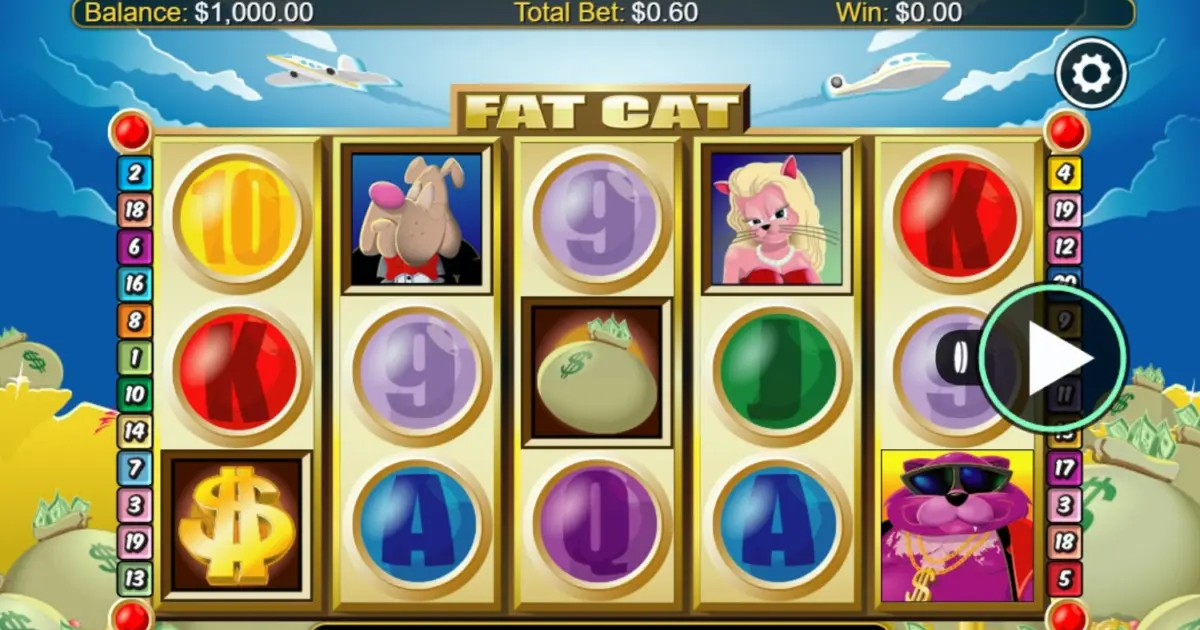
The short answer: the maths here is better than average. The fat cat slot from Nextgen Gaming carries a published RTP of 96.59%, which sits 0.88 percentage points above the 95.71% average across the games in this database, and it is playable in free demo form before you risk anything. What it does not come with is a published volatility rating, a stated stake range or a confirmed max win, so there are real gaps in the picture you should know about before you decide.
Fat Cat at a glance
This is a five-reel release from Nextgen Gaming, catalogued under the Animals theme with secondary tags for 5-Reels and Money and wealth. It sits at rank 2,622 for popularity, which places it in the 86.9th percentile — more attention than the large majority of titles, without being a headline name. Nextgen has 121 games in this database, and their average RTP across that catalogue is 95.76%, so this particular title is running above its own studio’s house standard as well as above the wider field.
| Field | Value |
|---|---|
| Provider | Nextgen Gaming |
| RTP | 96.59% |
| Reels | 5 |
| Primary theme | Animals |
| Other themes | 5-Reels, Money and wealth |
| Type | Slot Machine |
| Popularity rank | 2,622 (86.9th percentile) |
| Provider catalogue size | 121 games |
| Provider average RTP | 95.76% |
| Database average RTP | 95.71% |
| Free demo | Available |
Who it suits: anyone who screens games on RTP first and is comfortable with an animal-and-money theme. Who it does not suit: anyone who needs volatility and max-win figures published up front before committing a bankroll. Those numbers are absent here, and absent data is worth treating as a reason for caution rather than optimism.
What a 96.59% RTP actually returns
RTP is a long-run average, not a session forecast. A 96.59% figure means that across an extremely large number of spins — millions, not thousands — the game is modelled to return £96.59 for every £100 wagered, with the remaining £3.41 retained as house edge. Work it through at a nominal £0.20 per spin: 1,000 spins puts £200 through the game, and the theoretical return on that is £193.18, an expected cost of £6.82. Run 5,000 spins at the same stake and the expected cost rises proportionally to £34.10.
The word “theoretical” is doing heavy lifting. Over 1,000 spins the variance around that figure is wide enough that you could finish well up or lose the entire £200. Neither outcome tells you anything about whether the RTP is accurate, and neither changes what the next spin does — every spin is an independent event resolved by its own random number draw.
Against the field, 96.59% is a genuine advantage: 0.88 points above the 95.71% database average, and 0.83 above Nextgen’s own 95.76%. In pure edge terms that difference is worth roughly £8.80 per £1,000 wagered compared with the average title. It is not dramatic, but it compounds across a long playing history. If you want more headroom still, Wolfpack Pays from the same studio is listed at 97.76%, the highest RTP among the Nextgen titles here.
Unpublished volatility and what your session will feel like
There is no volatility rating in the data for this game, so anyone quoting one is guessing. That matters, because volatility governs the shape of your session far more visibly than RTP does. Two games with identical 96.59% returns can feel completely different: a low-volatility build pays small amounts often, drifts your balance down gently and stretches a modest bankroll over hundreds of spins; a high-volatility build swallows long dry stretches and concentrates its return into rare large hits, which means the same bankroll can vanish before the maths has any room to express itself.
With the rating unknown, the practical approach is to find out empirically. Run a few hundred demo spins and watch two things: how frequently anything lands at all, and how far your balance swings from its starting point. A balance that grinds slowly downward with regular small returns points to lower variance. Long gaps punctuated by occasional spikes point to higher variance. Neither reading is a prediction of real-money results — it is just a description of the pattern you observed in a small sample.
For a comparison point at similar maths, Lightning Gems 96 runs at 96.48%, close enough that any difference in how the two sessions feel comes down to volatility and mechanics rather than return.
The 5-reel layout and how wins are counted
Five reels is the standard modern layout, and it is the foundation almost every mainstream slot mechanic is built on. What FACTS does not tell us is how this particular game resolves wins: the payline count is not listed, and there is no indication of whether it uses fixed lines, a ways-based system or cluster payouts.
That distinction is worth understanding in general terms. Fixed-payline games award on defined symbol paths, usually left to right, and the line count sets how many chances each spin has. Ways-based games drop the path requirement and pay on matching symbols in any position across adjacent reels, which typically produces more frequent small awards. Many five-reel slots also include wilds that substitute for other symbols, and scatters that trigger free-spin rounds — but whether this title has either is not documented here, so treat those as general genre features rather than confirmed mechanics.
The practical consequence: check the in-game paytable on your first demo spin. It will tell you the line or ways count, the symbol hierarchy and any special symbols, all of which the published data omits.
Stake range and sizing a bankroll
No minimum or maximum stake is published for this game, so you will see the range only when you load it. The sizing logic does not change regardless of what those limits turn out to be. Divide the money you have set aside by the number of spins you want from the session, and let that quotient set your stake. Two hundred spins from a £40 budget means £0.20 a spin. Wanting 500 spins from the same £40 means £0.08, and if the game’s minimum is above that, either accept fewer spins or pick a different game.
One thing worth stating plainly: no staking pattern changes the expected value of a slot. Raising your bet after losses, lowering it after wins, alternating stakes or waiting for a “quiet” period all leave the 3.41% house edge exactly where it was. Larger stakes simply move more money through the same percentage faster. Stake size controls how long your session lasts and how big the swings feel — nothing more.
Playing the Fat Cat slot demo before you commit
A Fat Cat free demo is available, which is the sensible first stop given how much of the spec sheet is blank. Demo mode runs the same certified maths on play-money credits, so you can read the paytable, count the paylines or ways, see how often symbols connect and get a feel for the swing size without spending anything. It will not, however, predict your real-money results — a few hundred spins is far too small a sample to reveal anything reliable about a 96.59% long-run average, and demo credits can never be converted to cash.
Keep the basics in place before you switch to real stakes. This is 18+ entertainment. Decide what the session is worth to you before you start, treat that amount as the price of the entertainment rather than an investment you expect back, and stop when it is gone rather than topping it up. If tracking the spend stops being comfortable, that is the signal to close the game.
Verdict: who should play Fat Cat
On the one number that is fully documented, this game does well. 96.59% RTP beats both the 95.71% database average and Nextgen’s own 95.76% house figure, and among Nextgen Gaming slots it is one of the stronger returns on offer. Add an 86.9th-percentile popularity ranking and free demo access, and it is a reasonable candidate for a shortlist.
The reservation is the missing information. Without a volatility rating, a stake range or a confirmed max win, you cannot plan a bankroll properly from the published data alone — you have to load the demo and work it out. If you prefer a game whose numbers are less patchy, Hercules Power Wild sits in the same Animals-adjacent 96% band at 96.20% and is worth putting side by side with this one. If RTP alone is your filter, this title earns its place; if you want the full picture before your first spin, budget some demo time first.
Frequently Asked Questions
Can I play Fat Cat for free without downloading anything?
A free demo of Fat Cat is available and runs in the browser, so there is no download or install involved. Demo mode uses the same certified game maths as the real-money version but awards play-money credits only, which means nothing you win in the demo can be withdrawn or converted to cash.
What does the 96.59% RTP on Fat Cat mean in practice?
It means the game is modelled to return £96.59 for every £100 wagered across an extremely large sample of spins, leaving a 3.41% house edge. At £0.20 a spin, 1,000 spins wagers £200 with a theoretical return of £193.18. Short sessions deviate widely from that average in both directions.
Is Fat Cat a high volatility slot?
Nextgen Gaming has not published a volatility rating for this title, so any figure quoted elsewhere is unverified. The practical workaround is to run a few hundred demo spins and observe how often wins land and how far your balance swings. That gives you a rough feel for variance, not a guarantee.
Who is Nextgen Gaming and what else do they make?
Nextgen Gaming is the studio behind Fat Cat, with 121 titles catalogued here at an average RTP of 95.76%. Their range includes Wolfpack Pays at 97.76%, the highest RTP of their games in this database, plus Lightning Gems 96 at 96.48% and The Snake Charmer at 95.35%.
How much should I bet per spin on Fat Cat?
The stake range is not published, so you will see the limits when the game loads. Size your bet by dividing your session budget by the spins you want: £40 across 200 spins is £0.20 each. No staking pattern alters the 3.41% house edge, since every spin resolves independently.