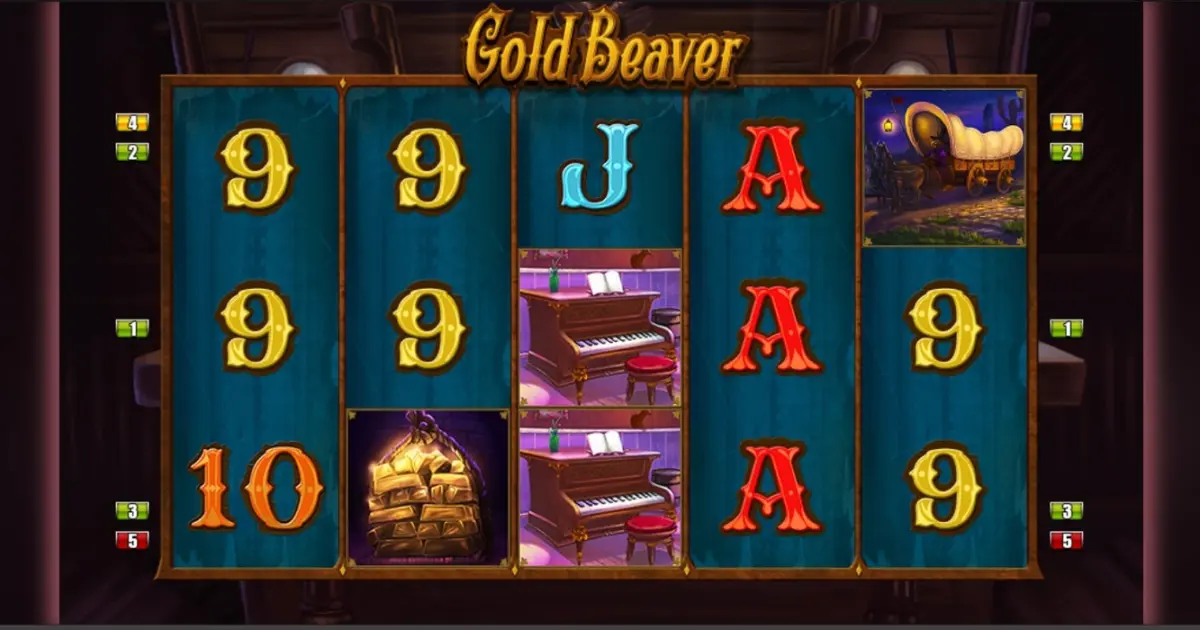
If you want a quick answer: this is a five-reel Merkur Gaming machine with a published return of 95.99%, and a free demo you can load without spending anything. That return sits 0.28 percentage points above the average of every game in our database, which makes it ordinary rather than generous. Most of the detail sheet is blank, though, and that absence should shape how you approach it.
First look at the Gold Beaver slot
Merkur Gaming has 182 titles in our database, which puts it in the mid-sized bracket of studios with a long land-based heritage behind them. This one is classified as a slot machine across five reels, and its published return is 95.99%. It ranks 2581 by popularity here, which places it in the 87.1st percentile of traffic — a genuinely busy title rather than an obscure one, even though it is not a headline release.
What Merkur has not published is where this gets interesting. There is no stated payline or ways count, no volatility rating, no hit frequency, no maximum win multiplier, no listed bonus mechanic. That is not a criticism of the game; it is a fact about the documentation. If you see a specific max win figure or free-spin count quoted for this title elsewhere, nothing in the official data supports it, and you should treat the source with scepticism. The numbers that do exist are the return, the reel count and the format — and those three are enough to make a sensible decision.
| Provider | Merkur Gaming |
|---|---|
| RTP | 95.99% |
| Reels | 5 |
| Free demo | Yes |
| Site-wide average RTP | 95.71% |
How a round plays out
You set a stake, you spin five reels, and the outcome is settled by a random number generator before the animation finishes. That is the whole loop. Every spin is independent: the reels have no memory of the last result, no accumulating pressure toward a payout, and no state that a player can read or influence.
Because the payline structure is not published, it is worth being clear about what is and is not knowable. Many five-reel slots run on fixed lines, some on a ways system where any matching left-to-right combination pays, and the two feel quite different in practice — a ways game tends to produce more small hits, fixed-line games more distinct near-misses. Which of those applies here is not documented, so load the demo and watch the paytable rather than taking anyone’s word for it.
The same applies to features. Wilds, scatters, free-spin rounds and bonus buys are all common across the modern catalogue, but none of them is listed for this title in the data available. Assume nothing until the in-game paytable tells you otherwise. The paytable is authoritative; a review that invents a feature list is not.
Reading the 95.99% return figure
95.99% RTP means £95.99 returned per £100 wagered, averaged across a sample far larger than any human session — millions of spins, not thousands. The remaining 4.01% is the house edge, and it is the only part of the figure you can rely on being expressed over the long run.
Over 1,000 spins at £0.50 you would stake £500, with an expected return of about £479.95 — a theoretical loss near £20. But that expectation is an average over a huge number of identical sessions, not a forecast for yours. Real 1,000-spin runs scatter widely around it, and the width of that scatter depends on volatility rather than on RTP.
For context: the average return across every game in our database is 95.71%, so this one sits 0.28 points above it. Merkur’s own catalogue averages 96.04%, so it sits marginally below its studio stablemates. Those are small gaps, and they matter less than the difference between, say, 95.99% and 96.25%. For comparison, Lucky Pharaoh from the same studio publishes 96.25%, which is roughly 26 pence less theoretical cost per £100 staked.
Why unpublished volatility changes your bankroll maths
Merkur has not assigned a volatility rating to this title, and that gap is worth more attention than the RTP question. Volatility describes how returns are distributed over time, and it is the single biggest driver of how a session actually feels.
Low volatility games pay small amounts often. Balances drift downward gently, sessions last a long time on a modest bankroll, and the biggest single result is usually a small multiple of the stake. High volatility games do the opposite: long stretches returning nothing, punctuated by occasional larger results, with swings wide enough that a bankroll sized for a low-volatility game can be gone in a few dozen spins.
The practical consequence of the rating being absent is that you cannot size your bankroll from the spec sheet. You have to observe. Run the free demo for a couple of hundred spins at a fixed stake and watch two things: how often something returns, and how far the balance drops between returns. That gives you a rough read on risk profile. What it does not give you is a prediction — demo results and real-money results are drawn from the same random process, and neither one forecasts the other.
Bet sizing when the stake range is unpublished
No minimum or maximum stake is listed in the available data, which means the operator’s own game window is your only reliable source. Check it before your first spin rather than after.
The arithmetic that matters is spins per session. A £50 bankroll supports 500 spins at £0.10 and 25 spins at £2.00, and those are different activities entirely. Decide how long you want to play first, then divide your budget by that number to find your stake. Working the other way round — picking a stake that feels right and seeing how long it lasts — is how sessions end earlier than intended.
One thing stake sizing cannot do is change the maths. The 4.01% house edge applies identically at every stake level, and no progression, timing pattern or bet-sizing system alters expected value by a single penny. Raising stakes after losses increases the size of your swings, nothing else. Stake size controls session length and variance, never the edge.
Where Gold Beaver sits among 5-Reels slots
Our database holds no other titles tagged under this theme label, so there is no direct thematic peer group to compare against. The useful comparison is within the studio instead, and Merkur Gaming slots give you three reasonable reference points.
Hide and Seek publishes 96.07% and Centurio publishes 96.08%, both a fraction above this title and both close enough that the difference is academic over a normal session. The clearest step up in stated return is Lucky Pharaoh at 96.25%. If your only criterion is the published number, that is where to look first.
On popularity, the 87.1st percentile placement says players do keep coming back to this one, which usually reflects something the spec sheet does not capture — pacing, paytable design, or simple familiarity from land-based cabinets.
The honest verdict
A fair return, a well-established studio, and a documentation gap you should fill yourself before committing money. 95.99% is competitive against the 95.71% database average and slightly behind Merkur’s 96.04% house average, so nothing here argues strongly for or against it on returns alone. The missing volatility rating is the real reason to start in demo mode: without it, any bankroll figure you set is guesswork.
The Gold Beaver free demo costs nothing and answers the questions the data sheet leaves open — paytable structure, feature set, pacing, how far the balance travels between returns. Spend two hundred spins there before you decide.
Slots are 18+ and priced entertainment, not income. Set a budget you are comfortable losing before you start, treat it as spent the moment you sit down, and stop when it is gone rather than topping up. If tracking that becomes difficult, deposit limits and self-exclusion tools exist at every licensed operator and take under a minute to set.
Worth a look if you already enjoy Merkur’s style. If you want the highest published return in this studio’s catalogue, Lucky Pharaoh’s 96.25% is the better starting point.
Frequently Asked Questions
Can you play Gold Beaver for free?
A free demo is available for this title, so you can spin it with virtual credits and no deposit. That matters more than usual here, because Merkur Gaming has not published a volatility rating or stake range, and the demo is the only way to observe pacing and read the paytable before you risk real money.
What is the RTP of Gold Beaver?
The published return is 95.99%, meaning £95.99 returned per £100 staked across a very large sample of spins. That leaves a 4.01% house edge. It sits 0.28 points above the 95.71% average across our whole database and just under Merkur Gaming's own 96.04% catalogue average.
Is Gold Beaver high or low volatility?
Merkur Gaming has not published a volatility rating for this game, so no honest answer exists from the spec sheet alone. Run a couple of hundred demo spins at a fixed stake and watch how often returns land and how far the balance falls between them. That observation is your best available guide.
Who makes Gold Beaver and what else do they produce?
Merkur Gaming develops it, a studio with 182 titles in our database and an average published return of 96.04% across them. Other examples include Hide and Seek at 96.07%, Centurio at 96.08% and Lucky Pharaoh at 96.25%, the highest stated return of the three.
How does Gold Beaver compare to Lucky Pharaoh?
Lucky Pharaoh publishes 96.25% against this title's 95.99%, a gap of 0.26 percentage points, or roughly 26 pence less theoretical cost per £100 staked. Both come from Merkur Gaming. Neither publishes a volatility rating, so the return figure is the only documented basis for choosing between them.