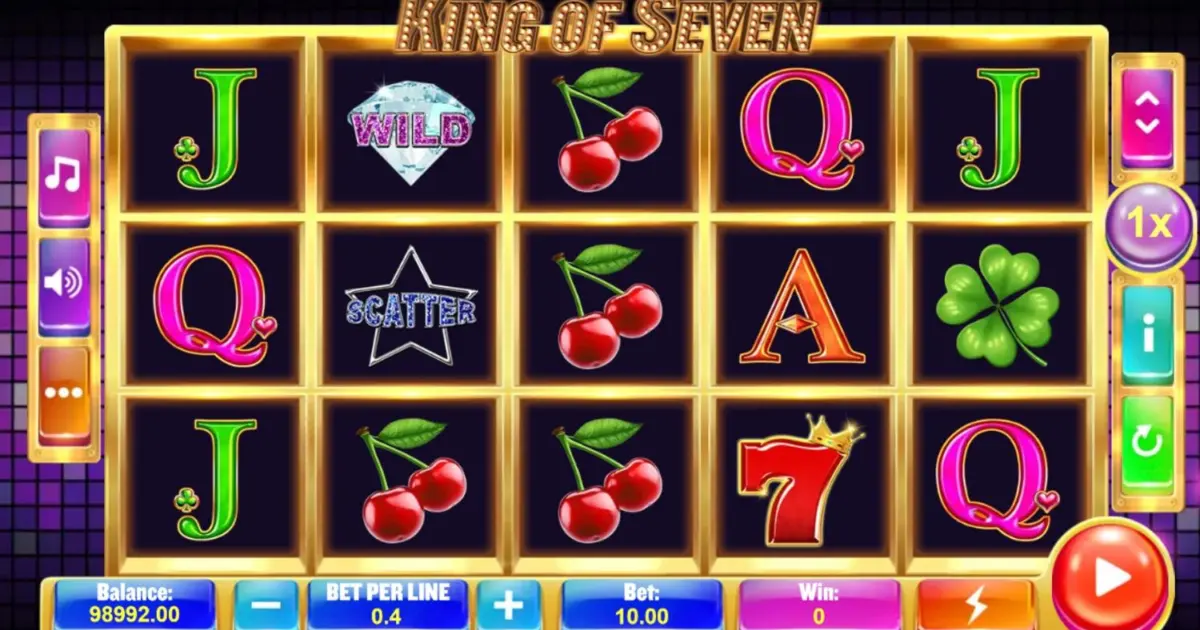
The short answer: this is a 5-reel release from Triple Profits Games (TPG) with a free demo available, and almost no published maths attached to it. There is no confirmed RTP figure, no official volatility rating, and no stated stake range. That does not make it a bad game, but it does mean you are judging it on feel rather than numbers, which changes how you should approach it.
King of Seven slot at a glance
Here is everything that is actually on the record for the king of seven slot. Anything not listed below has not been published, and you should be sceptical of sites that quote figures for it anyway.
| Detail | Value |
|---|---|
| Game name | King of Seven |
| Provider | Triple Profits Games (TPG) |
| Reels | 5 |
| Category | Slot Machine |
| Theme label | 5-Reels |
| Popularity rank | 2,538 |
| Popularity percentile | 87.3 |
| Games in the TPG catalogue | 85 |
| Average RTP across our catalogue | 95.71% |
| Free demo | Available |
The popularity percentile is the one number doing real work here. Sitting at 87.3 means more players open this title than roughly seven in eight of the games we track, despite a rank of 2,538 in absolute terms. So it gets traffic. It suits someone who is browsing the TPG catalogue casually and is comfortable playing a game whose return figure they cannot verify. It does not suit anyone who builds a session plan around published percentages.
What an unpublished RTP figure means for your returns
RTP, return to player, is a long-run statistical average. It describes what a machine pays back across an enormous number of spins, not what happens in your next fifty. A game running at the catalogue average of 95.71% returns roughly £95.71 for every £100 wagered across a very large sample, meaning about £4.29 per £100 is the house edge. Over 1,000 spins at £0.20 a spin, that is £200 staked and an expected return near £191.42. Individual sessions scatter widely around that line in both directions.
For this game, no such figure has been published. Triple Profits Games has not released an RTP for King of Seven, so any percentage you see quoted elsewhere should be treated as unverified. The practical consequence is simple: you cannot compare it on value against any other title, and you cannot estimate what a given bankroll should survive. Treat the 95.71% catalogue average as context for what typical machines do, not as a stand-in for this one. Where a provider stays quiet on RTP, the cautious reading is to assume nothing better than average.
Unstated volatility and what your session will feel like
Volatility describes the shape of the ride rather than the size of the return. Low-volatility machines pay small amounts often, so balances drift down gently and sessions last longer on a given budget. High-volatility machines pay rarely and larger, which means long dry stretches punctuated by occasional spikes, and a bankroll that needs to be several times deeper to see the game’s full behaviour. Medium sits between the two.
No volatility rating has been published for this title, so you cannot know in advance which of those patterns you are buying into. The free demo is the only way to form a view, and even then you are sampling, not measuring. Watch two things while you play: how many spins pass between any return at all, and how large the biggest return is relative to your stake. Frequent small returns point towards the low end; long gaps with rare spikes point towards the high end. Note also that every spin is independent. A stretch without returns does not make the next spin more likely to pay, and a machine is never due, hot or cold.
The 5-reel layout and how wins are counted
Five reels is the standard modern layout, and it tells you the structural basics: symbols land in five vertical columns, and combinations are read across those columns. What it does not tell you is how many paylines or ways the game uses, because that figure has not been published either. Across the wider market, 5-reel machines are counted in several different ways. Fixed-payline games award on specific patterns; “ways” games pay when matching symbols land anywhere in adjacent columns; cluster games ignore columns and pay on groups.
Each of those structures produces a different rhythm, so identifying which one applies is the first thing to do in the demo. Check whether the paytable lists a line count, whether wins are highlighted along set paths, and whether the stake divides evenly across lines. Many slots also include wilds that substitute for other symbols, scatters that trigger free spins, or a paid bonus-buy option, but none of those features are confirmed for this game, and you should not assume any of them are present until the paytable shows you.
Stake range and sizing a bankroll
The minimum and maximum bet for this title have not been published, which removes the usual starting point for planning. Normally you would take the minimum stake, multiply it by the number of spins you want the session to last, and check that against what you are willing to spend. Without a stake range you have to do that backwards: decide your total budget first, open the demo to read the actual bet selector, and only then work out a per-spin figure.
A workable rule of thumb across slots generally is to keep a single spin at around 1% or less of the session budget, so that ordinary variance does not end things in a handful of spins. A £50 budget therefore points to stakes near £0.50 or below. Bear in mind that no stake pattern, progression or timing changes the expected value of a slot; raising or lowering your bet changes the size of the swings and how long your money lasts, nothing else. If the bet selector only offers larger increments than your budget comfortably supports, that is a reason to pick a different game rather than to stretch.
Playing the King of Seven demo before you commit
A King of Seven free demo is available, and given how little is documented, it is the sensible first step. Play it in a browser with no download, and use it to fill in the gaps that the provider left: the bet range, the paytable, the line or ways structure, and any bonus mechanics. Run enough spins that you get a rough sense of how often returns arrive. Keep in mind that demo results do not predict real-money outcomes; the sample is short and the variance is wide, so a lucky or flat demo session tells you about that session only.
Slots are paid entertainment, not a way to make money. Play only if you are 18 or over, decide your budget before you start and stop when it is gone, and treat anything you get back as a bonus rather than a plan. If tracking a budget stops feeling easy, that is the point to take a break.
Verdict: who should play King of Seven
This one comes down to how much you need to know before you spin. The game is popular, sitting in the 87.3rd percentile for traffic, and it is one of 85 titles in the Triple Profits Games catalogue, so there is an audience for it. But with no RTP, no volatility rating and no stake range on record, there is nothing to compare and nothing to plan against. If you want documented numbers, a title with a published return figure is the better use of your bankroll.
If you are simply exploring Triple Profits Games (TPG) slots, the demo costs nothing and answers most of the questions this review cannot. Worth doing alongside a few stablemates for context: Lucky 7 (Triple Profits Games) covers similar sevens-and-numbers territory from the same studio, while Fortune Tiger and Gemstone Legend give you a wider read on how this developer builds its games. None of those three has a published RTP either, which is itself a useful signal about how much this provider discloses.
Frequently Asked Questions
Can you play King of Seven for free?
A free demo of King of Seven is available, so you can spin it in a browser without depositing. That is particularly useful here because Triple Profits Games has not published an RTP, volatility rating or stake range for the title, leaving the demo as the only way to check the paytable and bet options yourself.
What is the RTP of King of Seven?
No RTP has been published for King of Seven, and any figure quoted elsewhere is unverified. For context, the average across the games we track is 95.71%, which returns about £95.71 per £100 wagered over a very large sample. Without a confirmed number you cannot compare this game's value against others.
Is King of Seven high or low volatility?
The volatility has not been rated publicly, so the honest answer is that nobody outside the studio knows. Low volatility means frequent small returns and longer sessions; high volatility means rare, larger returns and a deeper bankroll requirement. Sampling the demo and noting the gaps between returns is your best available indicator.
Who makes King of Seven?
Triple Profits Games (TPG) developed it, a studio with 85 titles in our catalogue. Their other releases include Lucky 7 (Triple Profits Games), Fortune Tiger and Gemstone Legend, none of which carry a published RTP figure either. That consistent lack of disclosure is worth factoring in when you weigh up anything from this developer.
How much should I bet per spin on King of Seven?
The stake range is not published, so open the demo and read the bet selector before deciding. A general guideline for slots is to keep each spin at roughly 1% or less of your session budget, so £0.50 on a £50 budget. No stake pattern changes a slot's expected value.