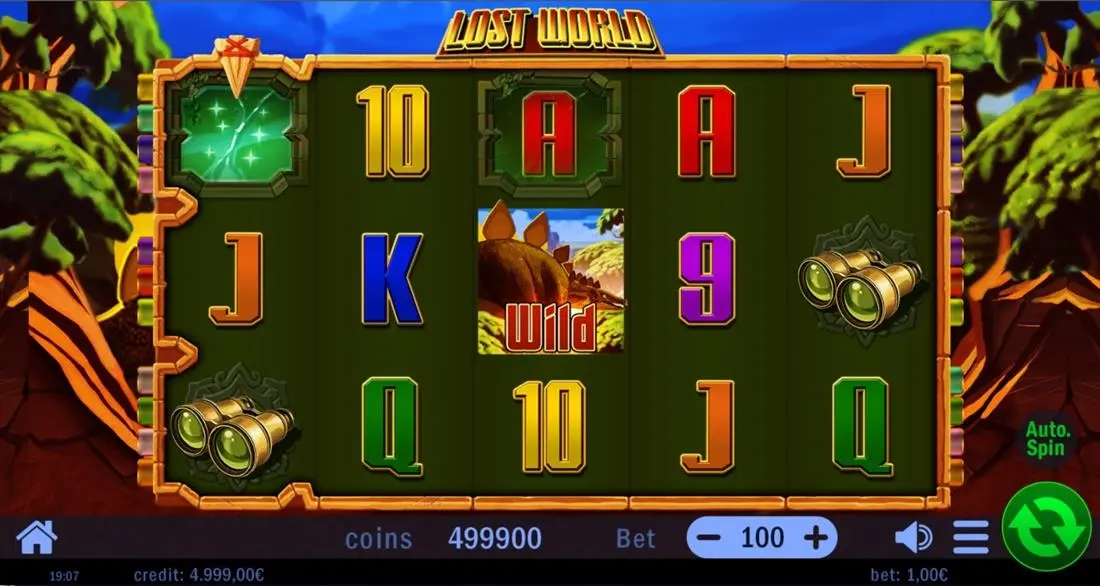
Lost World is a five-reel release from Swintt carrying a published return-to-player figure of 95.17%. That sits a little below the average for the slots catalogued here, which is the first thing worth weighing before you put money behind this lost world slot. A free demo exists, so testing the pace of it costs nothing at all.
Is Lost World Slot worth playing?
It is worth a demo session, and it is a reasonable pick if you already like what Swintt do. It is harder to justify on the numbers alone, because the return is below average for the wider market.
The case in its favour is popularity. Ranked 2541 by traffic, it sits in roughly the top 13% of the games tracked here, which means plenty of people keep coming back to it. That is not evidence of generosity — popularity and payout percentage are unrelated — but it does suggest the game holds attention, which is the part a spec sheet cannot tell you.
The case against is the 95.17% return. Across the full catalogue the average is 95.71%, so this title gives back about 0.54 percentage points less per unit staked over a very large sample. Against Swintt’s own library of 173 games, which averages 94.67%, it is actually half a point better than typical. So the honest summary is: above average for the studio, below average for the market.
What 95.17% RTP means over 1,000 spins
Return to player is a long-run statistical average, not a promise about your session. At 95.17%, the game is built to return £95.17 for every £100 wagered across a sample far larger than any individual will ever play — millions of spins, not thousands.
Put a number on it anyway. Stake £0.20 a spin for 1,000 spins and you have wagered £200. The theoretical return on that is £190.34, an expected cost of £9.66. That is the figure to treat as the price of the entertainment. What actually happens will look nothing like a smooth drip of £9.66 — you might finish ahead, or you might lose the lot, because 1,000 spins is a tiny sample against the maths.
Compare it to the alternatives to see the scale. A 96.59% game costs a theoretical £6.82 over that same £200 turnover. So the gap between this and a higher-return title is a couple of pounds per thousand spins at 20p stakes. Real, but small next to the swings variance produces in any single session. Every spin is independent; nothing that happened on the previous one changes the next.
How volatile is Lost World?
Swintt has not published a volatility rating for this title, and no reliable figure appears in the available data. Treat any confident claim you see elsewhere — high, medium or low — as guesswork unless the provider states it. Missing information is worth knowing about, because volatility affects your session more visibly than RTP does.
Here is the general framework so you can judge it yourself in the demo. Low-volatility slots pay small amounts often; balances drift rather than lurch, and a modest bankroll stretches a long way. High-volatility slots pay rarely and larger, which means long dry stretches punctuated by occasional big hits, and they demand a bankroll deep enough to survive those stretches. Medium sits between the two.
Two games can share an identical 95.17% return and feel completely different for this reason. The percentage tells you the long-run cost; volatility tells you how bumpy the ride is on the way there. The practical move is to run 200 or 300 demo spins and watch the shape of the balance: frequent small returns, or long flat runs? That answers the question faster than any label would.
What the Adventure theme brings to the game
Adventure is one of the larger categories in the catalogue, with 326 titles carrying the label, and it is a broad one. It generally covers exploration, expeditions and journeys into somewhere unmapped — the name here points squarely at that tradition. Beyond the label and the title, the specifics of the artwork, symbols and audio are not documented in the data available, so this review will not guess at them.
What a theme actually does for you is set expectations of tone, not mechanics. Adventure slots tend to lean on a sense of progression, and many games in the category build bonus structures around that idea, but whether this one does anything of the sort is not something the published information confirms. Symbol names, feature counts and multiplier values are all unlisted.
That matters less than it sounds. Theme is the part you can evaluate for free and instantly — load the Lost World free demo, spend two minutes, and you will know whether the presentation works for you better than any written description could convey. The maths is the part worth reading about in advance.
Stakes, session length and bankroll
The minimum and maximum stake for this title are not published in the data available, so check the bet controls in the demo before assuming a range. That is a genuine gap: stake limits decide whether a game suits a £10 session or a £200 one, and no review should invent them.
The arithmetic you can do regardless. Work out what you are prepared to spend, then divide by the spins you want from it. A £40 budget at £0.20 a spin buys 200 spins of theoretical playtime; the same £40 at £1 a spin buys 40. Same return percentage, radically different session. Stake size does not change the 95.17% figure — it only changes how quickly the variance around that figure reaches you.
Two habits help. Decide the number before you open the game rather than during it, and treat the theoretical cost of your turnover as money already spent. No stake pattern, timing choice or progression alters the expected return of a slot — the outcomes are independent, so raising bets after losses simply enlarges the swings.
| Feature | Detail |
|---|---|
| Provider | Swintt |
| RTP | 95.17% |
| Reels | 5 |
| Theme | Adventure |
| Type | Slot Machine |
| Popularity rank | 2541 (top 13%) |
| Free demo | Available |
| Volatility | Not published |
| Paylines | Not published |
| Max win | Not published |
Alternatives if Lost World is not for you
If the return percentage is your sticking point, the clearest upgrade in the same theme is Rich Wilde and the Tome of Madness at 96.59% — 1.42 percentage points better, which over £200 of turnover is roughly £2.84 less in theoretical cost. Same broad adventure territory, materially better maths.
If you would rather stay with Swintt, Big Max Diamonds and Wilds is the closest comparison at 95.05%, within a rounding error of this title and a fair test of whether you like the studio’s approach generally. Wild Pharaoh returns 94.63%, so it costs a little more per unit staked, but it swaps the exploration angle for an ancient-Egypt one if the setting matters more to you than the fraction of a percent.
Worth noting that Swintt’s 173-game library averages 94.67% overall, so Swintt slots as a group tend to sit below the market. If return percentage is the deciding factor in your choices, you will generally find higher numbers outside this studio’s catalogue.
Final take
A competent five-reel adventure slot with a return of 95.17% — better than most of its studio’s output, slightly worse than the market at large. The popularity ranking suggests it plays well enough to keep people spinning, and the free demo means you can confirm that for yourself at no cost. The unpublished volatility, paylines and stake range are the frustrating part; you will have to establish those in the game itself.
Who should play it: anyone who likes Swintt’s style, or who wants an adventure-themed game and cares more about feel than half a percentage point. Who should look elsewhere: anyone optimising purely for return, who will do better with a 96%-plus title.
Slots are paid entertainment, not income. This is an 18+ activity — set a budget you are comfortable losing before you start, keep to it, and stop when it is gone rather than topping it up. If gambling has stopped feeling like entertainment, support is available and free.
One last point on the demo: play money cannot pay out real money, and a good or bad run in demo mode says nothing about what real stakes will do. It is a test of whether you enjoy the game, nothing more.
Frequently Asked Questions
Can you play Lost World for free?
A free demo is available, so you can spin it with play credits and no deposit. That is the practical way to assess the parts the spec sheet leaves out, including volatility and bet range, neither of which Swintt has published. Demo results carry no cash value and do not predict real-money outcomes.
What is the RTP of Lost World?
The published return to player is 95.17%, meaning the game is designed to return £95.17 per £100 staked across an enormous sample of spins. That is 0.54 percentage points under the 95.71% catalogue average, though it is above the 94.67% average across Swintt's 173 titles. Short sessions will vary wildly from it.
Is Lost World a high volatility slot?
Swintt has not published a volatility rating, so any specific claim about it is unverified. The 95.17% RTP tells you the long-run cost but nothing about swing size. Running a couple of hundred demo spins and watching whether returns arrive frequently and small or rarely and large will answer it more reliably.
Who makes Lost World and what else do they produce?
Swintt developed it, a studio with 173 games in this catalogue averaging 94.67% RTP. Their other titles include Big Max Diamonds and Wilds at 95.05%, Wild Pharaoh at 94.63% and Sweet Bonbonella at 94.51%, so this release sits at the upper end of the studio's published return figures.
How does Lost World compare to Rich Wilde and the Tome of Madness?
Rich Wilde and the Tome of Madness returns 96.59% against 95.17% here, a 1.42-point advantage that works out to roughly £2.84 less theoretical cost per £200 wagered. Both sit in the adventure category. If long-run return is your main criterion, that one has the stronger numbers.